Your step-by-step guide to urban development guidelines 2026

Urban development professionals entering 2026 face a convergence of pressures that earlier planning cycles simply did not demand. Regulatory frameworks have grown more exacting, sustainability benchmarks are now embedded in approval criteria, and stakeholders expect demonstrable evidence of social and environmental impact before a single brick is laid. This guide cuts through that complexity. It takes you from foundational prerequisites through practical implementation, covering the regulatory landscape, design translation, innovation compliance, and the process discipline that separates delivered projects from stalled ones.
Key Takeaways
| Point | Details |
|---|---|
| Start with global frameworks | Always anchor your project in the latest UN and local strategic guidelines to streamline approvals. |
| Follow process over product | Careful adherence to step-by-step requirements is vital—design talent won’t substitute for gaps in process. |
| Integrate monitoring from day one | Set up indicator-based monitoring at project inception to meet 2026 compliance and impact standards. |
| Prioritise code-ready innovation | Any new building or tech should be code-compatible and ready for local authority sign-off. |
What you need to know before starting your 2026 project
Now that we’ve framed the challenge, let’s focus on what you’ll need in place before you start the formal planning.
The most consequential shift in 2026 is not a single new regulation. It is the move toward results-based monitoring as a condition of project viability. UN-Habitat’s 2026–2029 Strategic Plan frames sustainable urban development around housing, land and basic services, and sets measurable, results-based monitoring and impact assessment for the full 2026–2029 period. What this means in practice is that funders, approval bodies, and community stakeholders increasingly expect your project to demonstrate measurable progress against defined indicators, not just design intent.
Equally important is how you classify the settlement context you are working within. Urban–rural classification methods have been harmonised across regions to support comparability in reporting and planning evidence. This matters because the category your project falls into will determine which density thresholds, service standards, and infrastructure obligations apply. Getting that classification wrong at the outset creates downstream delays that can set a project back by months.
Here is a summary of the key terms every professional must be fluent in before entering any 2026 planning process:
- Housing adequacy: Measured against access to durable structures, sufficient space, secure tenure, and essential services
- Land governance: Refers to tenure security, equitable access, and land-use controls aligned with local policy
- Basic services: Water, sanitation, energy, digital connectivity, and mobility access
- Degree of urbanisation: The harmonised classification system distinguishing cities, towns, semi-dense areas, and rural zones
- Results-based monitoring: A structured approach to tracking indicators, measuring outputs, outcomes, and impact at each project milestone
Understanding future city planning in 2026 also means being ready with the right documentation before your first consultation meeting. The table below outlines the core requirements professionals should have prepared at project inception.
| Document | Purpose | Required by |
|---|---|---|
| Site classification report | Confirms urban–rural designation | Planning authority |
| Housing needs assessment | Evidences demand and target demographics | Funding bodies |
| Baseline indicator matrix | Establishes monitoring start points | UN-Habitat aligned frameworks |
| Land tenure verification | Confirms legal ownership and access rights | Local land registry |
| Basic services audit | Maps existing infrastructure capacity | Infrastructure departments |
The indicator-based approach is not bureaucratic overhead. It is the mechanism by which your project earns credibility with decision-makers who are themselves accountable to international reporting frameworks.
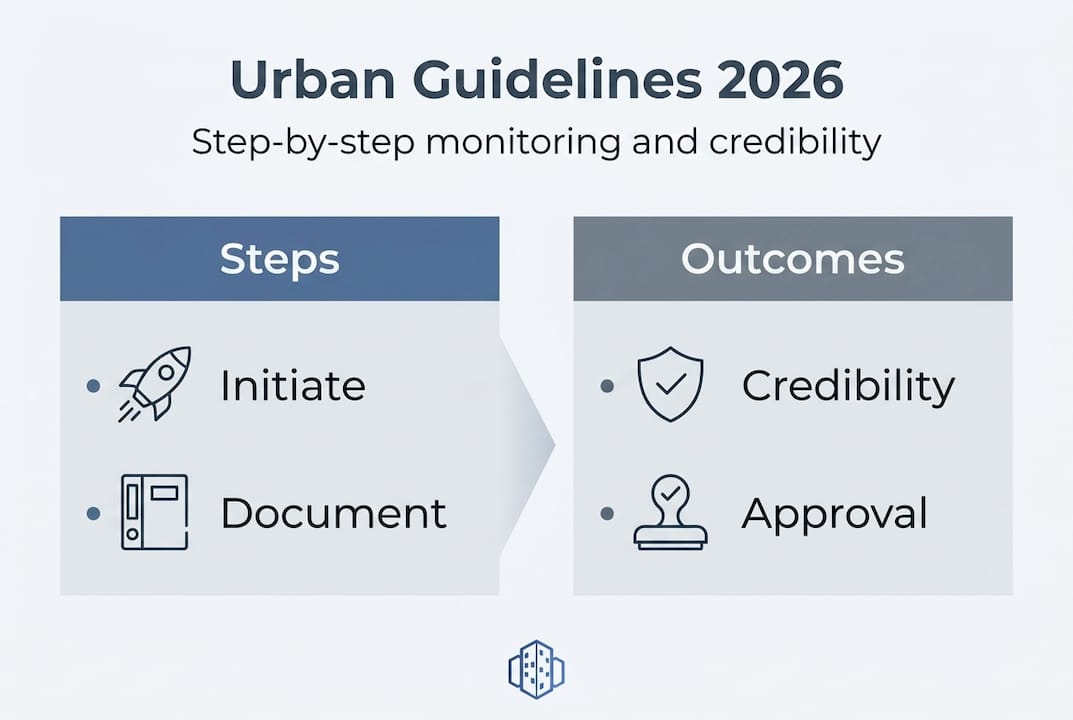
Step-by-step process for applying urban development guidelines in 2026
With the requirements and terms established, you can move forward to the actionable, step-by-step application of these guidelines.
Following top urban design strategies is easier when you have a replicable process structure. Use the following sequence as your baseline workflow for 2026 projects.
- Define project objectives aligned with 2026 policy goals. Start by mapping your project brief against the three UN-Habitat pillars: housing, land, and basic services. Every design decision that follows should be traceable back to at least one of these pillars. Projects that cannot make this connection early tend to struggle at the approval stage.
- Map site and context data using harmonised definitions. Use the degree of urbanisation classification to determine your regulatory environment. Collect GIS data on land use, transport access, population density, and service availability. This data layer becomes the evidence base for every subsequent decision.
- Apply Transit-Oriented Development (TOD) principles where applicable. For 2026, a widely adopted planning approach is TOD zoning policy design that couples higher density, mixed-use, walkable access, and streamlined permitting around transit corridors. Delhi’s recent relaxation of TOD norms to boost affordable housing supply is a strong example of how national governments are actively enabling this model. If your site is within 800 metres of a major transit node, TOD principles should be your first design lens.
- Document all decisions in a format that supports approval workflows. Use a structured decision log that captures the policy reference, design response, and measurable outcome for each major choice. This is the document that planning officers, infrastructure providers, and community representatives will interrogate.
- Choose your approval track deliberately. Not all projects follow the same path. The table below compares the two main tracks.
| Factor | Standard approval track | Streamlined/innovative track |
|---|---|---|
| Timeline | 12–24 months | 6–14 months |
| Documentation load | High | Moderate to high |
| Design flexibility | Constrained | Greater, with conditions |
| Monitoring requirements | Standard indicator set | Enhanced, real-time reporting |
| Typical project type | Conventional residential or commercial | TOD, offsite construction, mixed-use innovation |
- Secure pre-application engagement with approving bodies. Before submitting formally, schedule a pre-application meeting to validate your classification, confirm indicator expectations, and clarify whether your project qualifies for a streamlined track.
Pro Tip: Refer to the urban design workflow guide to identify where your current process is losing time. Most projects shed 15 to 20 per cent of their schedule in the gap between policy alignment and formal submission, precisely because decisions made early are not documented in a way that approval bodies can use directly.
Translating principles into design: From policy to buildable streets and spaces
Once you know the steps, it is crucial to connect guideline intent to physical designs that work in reality.
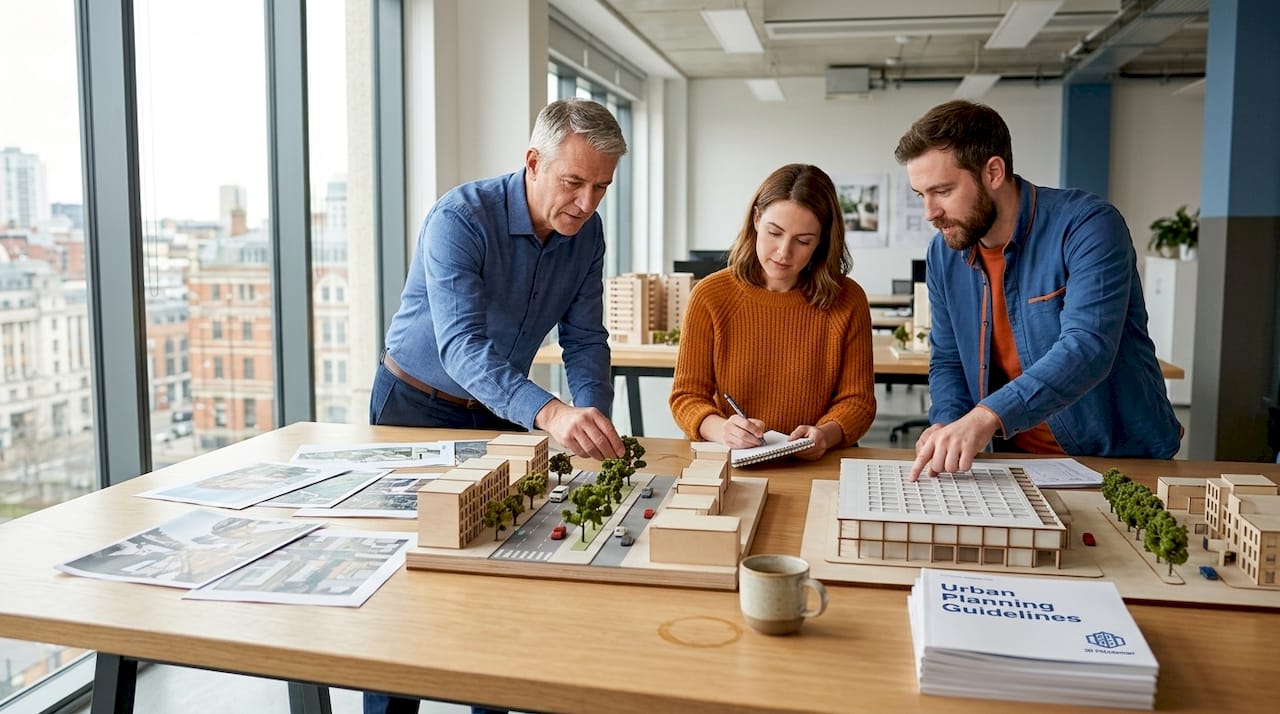
Policy language rarely tells you how wide a footpath should be or where to position a community plaza. That translation is your professional responsibility, and it is where the gap between good intentions and good outcomes tends to open up. New York City’s Principles of Good Urban Design provides one of the most practically usable frameworks at this interface, articulating what to prioritise at the city-project level and, crucially, why each principle matters to lived experience.
The core principles relevant to 2026 projects, drawn from leading international frameworks, include:
- Health and liveability: Streets should support active travel, with shaded pedestrian routes, cycle infrastructure, and access to green space within 400 metres of any residential unit
- Climate adaptation: Buildings and public spaces must account for increased heat, flooding risk, and air quality degradation, using passive design strategies as the first line of response
- Equity and access: Design should ensure that vulnerable populations, including older residents, disabled people, and low-income households, can access all services and public spaces without additional barriers
- Safety through design: Natural surveillance, well-lit public routes, and legible wayfinding reduce crime and improve community confidence in shared spaces
- Quality public realm: Streets, squares, and parks are not residual spaces. They are the connective tissue of urban life and should be designed with the same rigour as the buildings around them
“The gap between policy intent and built reality is almost always a design problem disguised as a compliance problem. When principles are not translated into specific spatial standards, the design team defaults to minimum code compliance, and minimum is rarely what residents experience as liveable.”
For each principle, apply it at three scales: the block level, the street section, and the building interface. A sustainable city design approach should be visible in how buildings meet the pavement, how streets manage stormwater, and how public spaces create genuine opportunity for social interaction.
Pro Tip: Create a principles matrix for your project. List each design principle in one column and your specific design response in the next. Add a third column for the measurable indicator that will confirm the principle has been achieved. This single document bridges the gap between policy and built form in a format that both designers and planners can use productively.
Common pitfalls at this stage include designing for compliance rather than experience, treating equity as an afterthought rather than a primary organising principle, and failing to model climate scenarios before fixing the building orientation or public space geometry. Avoid all three by embedding the principles matrix into your design brief from day one.
Ensuring innovation: Making new solutions code-compatible
As you close the gap from guidelines to built reality, addressing how to embed innovation without compliance risks is essential.
Innovation in construction and building typology is accelerating. Offsite construction, modular housing systems, small-format dwellings, and advanced material systems are all appearing more frequently in urban development briefs. But a recurring barrier to their adoption at scale is not technical. Innovation often needs to be code-compatible, meaning it must conform to local code and inspection and permit workflows to achieve uptake beyond pilot projects.
This is a critical distinction. A housing system that performs brilliantly in testing but cannot pass a standard building inspection, or cannot be financed because it falls outside conventional mortgage underwriting criteria, will not scale. The innovation has to be designed with the approval pathway in mind, not as an afterthought once the design is fixed.
Strategies that consistently improve code-compatibility outcomes for innovative solutions include:
- Early code mapping: Before finalising any innovative system, map it against the specific local building code sections it will be assessed against. Identify gaps and address them at design stage, not during inspection.
- Pre-certification of components: Offsite manufactured components that carry third-party certification arrive on site with their compliance evidence already in hand, significantly shortening inspection timelines.
- Parallel documentation streams: Maintain a compliance file that runs alongside your design file. Every design decision that touches code should generate a corresponding compliance note.
- Finance readiness planning: Small-format and non-traditional dwellings frequently face mortgage lending barriers. Engage with financial institutions early to confirm that your product specification falls within acceptable underwriting parameters.
- Inspection workflow alignment: Modular and offsite systems require inspections at the factory, not just on site. Confirm with your local authority that factory inspection protocols are in place and accepted before manufacturing begins.
The optimisation of urban projects with 3D tools is one area where technology directly supports code-compatibility. When design models are built to reflect actual code parameters, clash detection between design intent and regulatory requirement can be identified and resolved before any physical work begins. This is not merely a time-saving measure. It is a fundamental risk management tool for innovative project delivery.
A project team that builds code-compatibility checks into its design review process at each stage is statistically far less likely to face major rework or approval delays. Checklists are unglamorous but they are among the most effective instruments available.
An insider’s perspective: Why successful projects start with process, not product
With the recommended steps and checks in hand, here is a candid view from the field on what really determines success in 2026 urban development.
Most project failures we observe are not caused by poor design talent. They happen because the team misread the process framework, or started executing before the regulatory environment was properly understood. The indicator frameworks that now underpin UN-Habitat-aligned projects are not simply reporting requirements. They are the lens through which approving bodies assess project viability. A project that cannot demonstrate a clear, measurable path from design decision to impact indicator is, in effect, speaking a different language from its evaluators.
The standard versus streamlined approval track distinction is another area where incomplete understanding causes real damage. Teams that assume their innovative approach automatically qualifies for a faster track, without confirming this with the relevant authority, routinely find themselves in the standard track with an unconventional project and none of the documentation that the standard track expects. The result is delay, rework, and a damaged relationship with the planning authority.
The single biggest time-saver available to any 2026 project team is this: embed monitoring and design benchmarking from project inception. Use the urban design checklist to establish your benchmarks before the design programme begins, and link every subsequent design review to those benchmarks. Teams that do this consistently report faster approval times, fewer revision cycles, and stronger stakeholder confidence throughout delivery.
This connects to a broader truth about urban development strategies in 2026: the most effective ones are process-first. Design is the creative expression of a process that has already secured its foundations. Get the process right, and the design has room to be genuinely innovative.
Explore next-level urban development with 3D Cityplanner
If you are ready to put these guidelines into action smoothly, see how the right technology can power your workflow.
The step-by-step framework in this guide demands robust tools for data management, scenario testing, compliance checking, and stakeholder communication. The 3D Cityplanner platform is built precisely for this context, giving urban development professionals a single environment in which to design, analyse, monitor, and communicate project progress against 2026 guideline requirements.
From automatic building generation and line-of-sight visualisation to sound impact simulation and 4D project timeline modelling, the platform supports every stage of the process described in this guide. You can test TOD scenarios, validate design principles spatially, and share evidence-based outputs with planning authorities and community stakeholders in real time. A trial period is available without upfront payment, so you can assess the fit for your specific project context before committing.
Frequently asked questions
What are the three main pillars of UN-Habitat’s 2026–2029 urban development strategy?
Housing, land and basic services are the core pillars guiding all 2026–2029 urban development initiatives under the UN-Habitat Strategic Plan.
What is the TOD zoning approach mentioned in 2026 guidelines?
TOD means higher-density, mixed-use, walkable areas built around transit corridors and backed by streamlined permitting processes to accelerate housing delivery and reduce car dependency.
How do I ensure an innovative housing method is code-compliant in 2026?
Designs must be mapped against local code and approval pathways from the outset, with full documentation supporting factory inspections, on-site verification, and mortgage readiness where applicable.
What role do urban–rural definitions play in 2026 planning?
The harmonised classification system standardises how settlements are categorised across regions, directly determining which density thresholds, service standards, and regulatory obligations apply to your project.


