Why scenario planning for cities matters in 2026

Scenario planning for cities is defined as a structured method for generating multiple plausible futures, enabling urban decision-makers to prepare for a range of outcomes rather than betting on a single forecast. Unlike conventional urban forecasting, which assumes a linear trajectory, scenario planning treats uncertainty as a design condition. Cities facing climate disruption, demographic shifts, and rapid technological change cannot afford to plan for one future. The Urban Foresight and Adaptability Framework, the Lincoln Institute’s community workshops, and Hitachi’s AI-driven simulation work all demonstrate that multiple plausible futures produce more robust, adaptive urban strategies than any single projection ever could.
Why scenario planning for cities differs from traditional forecasting
Traditional urban forecasting produces a single trajectory: population grows at X rate, housing demand reaches Y units, infrastructure requires Z investment. That approach works when the future resembles the past. It fails when it does not.
Scenario planning draws up several plausible, sometimes deliberately provocative development paths, preparing planners for surprises rather than assuming continuity. Each scenario is not a prediction but a directional compass, helping cities weigh risks and opportunities across a spectrum of possible conditions. A city planning its mobility network might explore four distinct futures: autonomous vehicles dominate, cycling infrastructure becomes the primary mode, fuel costs make private ownership unviable, or remote work collapses commuting demand entirely. Each path demands different infrastructure choices today.
The contrast with conventional methods is significant:
| Feature | Traditional forecasting | Scenario planning |
|---|---|---|
| Number of futures | One | Four to six |
| Underlying assumption | Continuity | Uncertainty |
| Response to surprises | Reactive | Proactive |
| Planning horizon | Fixed | Iterative |
| Stakeholder involvement | Limited | Participatory |
| Output | Single plan | Portfolio of strategies |
Linear forecasting carries particular risks in volatile urban environments where climate, social, and technological forces interact unpredictably. A city that planned its flood defences on historical rainfall data alone is now rebuilding them at twice the cost. Scenario planning would have surfaced the high-rainfall future as a credible path worth preparing for.
Pro Tip: When building your first scenario set, include at least one scenario that feels uncomfortable or politically difficult. The scenarios that challenge assumptions are the ones that reveal genuine blind spots in your current plans.
How does scenario planning strengthen urban resilience?
The concept of polycrisis describes the simultaneous occurrence of multiple, interacting crises: climate shocks, economic instability, public health emergencies, and social fragmentation compounding each other. Urban systems are particularly exposed because cities concentrate people, infrastructure, and economic activity in ways that amplify cascading failures.
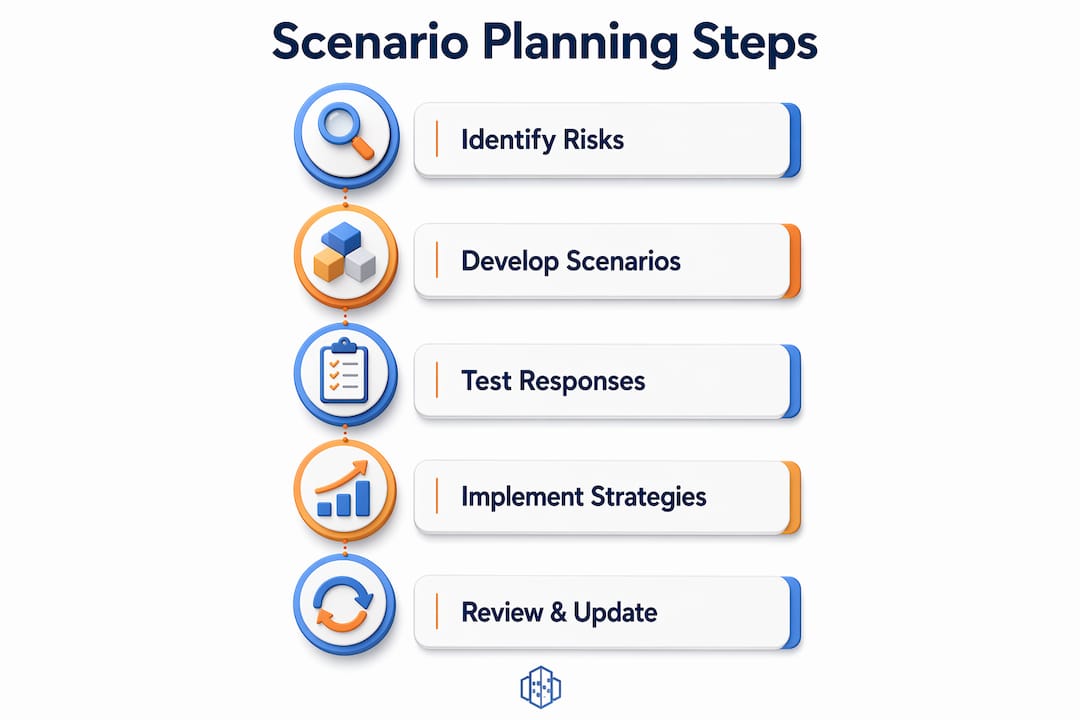
Traditional resilience thinking focuses on bouncing back from a known shock. Polycrisis demands something more: the capacity to adapt to conditions that have no historical precedent. Roland Berger’s research on future-proofing cities argues that embedding foresight and scenario capabilities into governance is the defining institutional shift cities must make. The Urban Foresight and Adaptability Framework provides measurable criteria for benchmarking that readiness, covering five pillars: anticipation, absorption, adaptation, transformation, and learning.
Practical steps for embedding foresight into urban governance include:
- Establish a dedicated foresight unit within the municipal planning department, with a mandate to update scenario sets on a rolling basis.
- Link scenario outputs to budget cycles, so that investment decisions reference the range of futures rather than a single baseline.
- Create cross-departmental scenario teams that include transport, housing, health, and emergency management, preventing siloed responses to shared risks.
- Commission regular horizon-scanning reports to identify emerging signals that may require scenario revision.
- Build experimentation into governance, allowing pilot projects to test adaptive strategies before full-scale commitment.
Cities that institutionalise scenario thinking in governance move from reactive crisis management to proactive risk navigation. That shift is not merely organisational. It changes the quality of decisions made years before a crisis arrives.
Pro Tip: Treat your scenario planning framework as a living governance instrument. Schedule a formal scenario review every 18 months, triggered earlier if a major disruptive signal emerges, such as a new climate projection or a significant policy change at national level.
What is participatory scenario planning in urban design?
Participatory scenario planning places residents and community stakeholders at the centre of the futures-building process. Rather than presenting communities with a finished plan, it invites them to co-create the scenarios themselves, producing strategies that carry genuine legitimacy and reflect local knowledge that technical models cannot capture.
The Lincoln Institute’s work on climate mobility strategies demonstrates this approach in practice. Residents design, test, and refine four to six potential relocation scenarios over approximately 18 months, exploring questions of if, when, and how communities might need to move in response to climate pressure. The process surfaces equity concerns, cultural attachments, and practical constraints that would be invisible in a purely data-driven exercise. It also builds the shared understanding that makes eventual decisions more durable.
The benefits extend beyond the planning process itself. Participatory scenario work supports social cohesion by giving communities a structured space to discuss difficult futures together. It improves mental health outcomes by reducing the anxiety of uncertainty, replacing vague dread with concrete options. It raises cultural awareness by surfacing the different ways that diverse communities experience risk and change.
Digital tools now augment participation significantly. Platforms that allow residents to visualise proposed scenarios in three dimensions, or to explore the implications of different land use choices through interactive models, make abstract futures tangible. This is where urban scenario modelling tools add genuine value to the participatory process.
Best practices for stakeholder engagement in scenario processes:
- Define the question together. Begin workshops by asking communities what futures they fear and what futures they hope for, rather than presenting pre-set scenarios for reaction.
- Use visual and spatial tools. Maps, 3D models, and interactive simulations make scenarios accessible to participants without technical backgrounds.
- Include vulnerable and marginalised groups deliberately. Climate and urban risk fall disproportionately on those with least political voice. Their knowledge is indispensable.
- Allow scenarios to evolve. Treat early workshops as drafts, not conclusions. Return to communities with refined scenarios for further input.
- Connect scenarios to decisions. Make explicit which planning choices each scenario would support, so participants understand the real stakes of the process.
How do extreme scenario simulations build operational readiness?
Extreme scenario simulations are stress tests designed for conditions that lie beyond historical experience. They do not ask what happened before. They ask what would happen if temperatures reached 50°C, if three climate shocks struck simultaneously, or if critical infrastructure failed during a public health emergency.
Paris conducted a 50°C heatwave exercise that revealed critical gaps in the city’s cooling infrastructure, hospital capacity, and inter-agency communication protocols. London’s Exercise Helios simulated cascading climate shocks, exposing coordination failures between health, transport, emergency services, and social care. Both exercises identified systemic weaknesses that would have been catastrophic if discovered during an actual event.
| Exercise | City | Scenario simulated | Agencies involved | Key outcome |
|---|---|---|---|---|
| 50°C heatwave | Paris | Extreme urban heat event | Health, emergency services, infrastructure | Identified cooling and communication gaps |
| Exercise Helios | London | Cascading climate shocks | Health, transport, social care, emergency services | Exposed multi-agency coordination failures |
These exercises serve a function that no desk-based planning process can replicate. They force decision-makers to experience the pressure of a crisis in a safe environment, revealing how protocols break down under stress and where communication chains fail. The multi-agency coordination that emerges from these exercises is qualitatively different from coordination designed in a meeting room. It is tested, refined, and trusted.
Cities that conduct regular simulation exercises also build institutional memory. Staff who have worked through a simulated 50°C heatwave respond differently when temperatures begin to climb in reality. The scenario becomes a shared reference point that accelerates decision-making when speed matters most.
How do scenario outputs translate into municipal policy?
Generating scenarios is only half the work. The other half is connecting those scenarios to the decisions that actually shape cities: zoning regulations, infrastructure investment, land use designations, and emergency protocols. This translation is where many scenario planning efforts stall.
Hitachi’s AI-driven approach to Japan’s shrinking cities demonstrates one solution. The system runs approximately 20,000 simulations and clusters the results into approximately 10 future scenarios, calibrated to align with typical five-year municipal planning cycles. Planners receive a manageable set of futures, each with clear policy implications, rather than an overwhelming volume of raw model output. This approach makes scenario planning operationally viable within the constraints of real municipal governance.
The World Bank’s Restrict-Condition-Promote framework provides a complementary tool for risk-informed urban planning. It translates hazard scenarios directly into zoning and investment decisions: restricting development in high-risk flood zones, conditioning development in moderate-risk areas on specific resilience measures, and promoting development in lower-risk locations. This framework gives scenario outputs a direct regulatory expression.
Key considerations for policy adoption of scenario outputs:
- Align scenario timelines with planning cycles. A scenario set that does not map onto the five-year budget and planning horizon will not influence decisions.
- Translate scenarios into policy language. Planners and politicians need narratives, not just data. Each scenario should have a clear story and a clear set of policy implications.
- Identify no-regret actions. Some investments make sense across all scenarios. Prioritise these first to build momentum and demonstrate value.
- Build in review triggers. Specify the conditions under which a scenario will be revisited, such as a specific temperature threshold or a population milestone.
- Communicate uncertainty honestly. Decision-makers who understand that scenarios are not predictions are better equipped to use them well.
Scenarios as a governance culture, not a planning exercise
Anne’s perspective: The most persistent failure I observe in city scenario work is treating it as a project with a start date and an end date. A team is assembled, workshops are held, a report is produced, and the scenarios sit on a shelf until the next crisis makes them look prescient or obsolete. That is not scenario planning. That is scenario theatre.
Iterative refinement through feedback and agile methods is what keeps scenarios genuinely useful. The cities that get the most from this practice are the ones that treat their scenario sets as living documents, updated when new data arrives, revised when political conditions shift, and stress-tested regularly through simulation exercises. They also combine digital tools with genuine community engagement, recognising that the best scenario is one that both models reality accurately and reflects the values of the people who will live in it.
The institutional challenge is real. Foresight units require budget, political protection, and a mandate that survives electoral cycles. But the alternative is planning for a future that will not arrive, at enormous cost. Urban leaders who embrace uncertainty as a source of strategic intelligence, rather than a problem to be managed away, are the ones building cities that will still be functional in 2050.
— Anne
Plan, simulate, and decide with 3dcityplanner
Scenario planning produces its greatest value when it is connected to the tools that make scenarios visible, testable, and communicable to all stakeholders.
3dcityplanner is a digital platform built for exactly this purpose. It supports 4D urban simulation, automatic building generation, sound impact modelling, and line-of-sight analysis, giving planning teams the capacity to visualise and compare multiple futures within a single environment. The platform’s timeline functionality allows project phases to be viewed and adjusted in real time, making it straightforward to test how different scenario assumptions change spatial outcomes. For teams working on participatory planning, the visual clarity of 3dcityplanner’s models makes complex scenarios accessible to community stakeholders without technical backgrounds. Explore the full platform feature list to see how it supports scenario-driven urban development from concept through to policy delivery.
FAQ
What is scenario planning for cities?
Scenario planning for cities is a structured method for exploring multiple plausible futures rather than relying on a single forecast. It enables urban decision-makers to test strategies across a range of conditions, from climate shocks to demographic shifts, and to identify robust policies that perform well across all of them.
Why do cities need scenario planning instead of traditional forecasting?
Traditional forecasting assumes the future will resemble the past, which makes it unreliable in volatile conditions. Scenario planning prepares cities for surprises by mapping several distinct futures and identifying the decisions that remain sound across all of them.
How does scenario planning support urban resilience?
Scenario planning embeds foresight into governance by identifying risks before they materialise and testing response strategies in advance. The Urban Foresight and Adaptability Framework provides a measurable structure for institutionalising this capacity across city departments.
What are extreme scenario simulations?
Extreme scenario simulations are city-wide exercises that test preparedness for conditions beyond historical experience, such as Paris’s 50°C heatwave drill or London’s Exercise Helios. They reveal coordination gaps and infrastructure weaknesses in a safe environment before a real crisis exposes them.
How are scenario outputs used in municipal policy?
Scenario outputs are translated into policy through tools such as the World Bank’s Restrict-Condition-Promote framework, which converts hazard scenarios into zoning and investment decisions. Systems like Hitachi’s AI platform cluster thousands of simulations into a manageable set of futures aligned with five-year planning cycles.
Recommended
- Future of City Planning 2026: Shaping Sustainable Urban Spaces – 3D Urban Development
- Explore key types of urban planning for 2026 success – 3D Urban Development
- Your step-by-step guide to urban development guidelines 2026 – 3D Urban Development
- What is urban scenario modelling for planners? – 3D Urban Development


