Urban project collaboration guide for professionals

Urban project collaboration is defined as the structured partnership among planners, architects, developers, and community members to deliver built environment outcomes that no single party could achieve alone. This urban project collaboration guide sets out the frameworks, tools, and engagement strategies that professionals need to manage multi-stakeholder projects with clarity and confidence. Whether you are coordinating a mixed-use regeneration scheme or a public transport corridor, the principles of collaborative urban development remain consistent: clear roles, sustained communication, and genuine community participation from the first briefing to the final handover.
What are the foundational frameworks for urban project collaboration?
Effective collaboration does not emerge from goodwill alone. It is built on a documented framework that defines who decides what, how information flows, and how disputes are resolved before they derail progress. The industry term for this is a partnership project management framework, and it is the structural backbone of any well-run urban initiative.
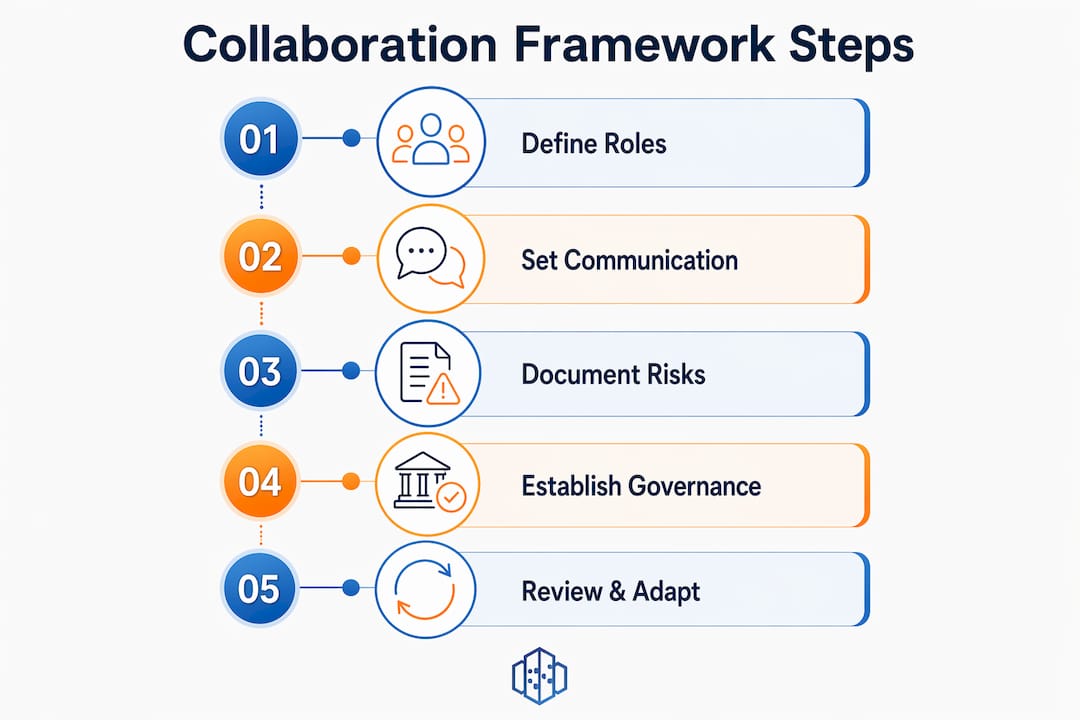
A partnership project management framework covers five core elements: roles and responsibilities, communication protocols, risk management, performance metrics, and a shared project plan. Each element must be documented and agreed upon at the project’s outset, not retrofitted when problems arise.
Follow this stepwise approach to build your framework:
- Define roles using a RACI matrix. Assign Responsible, Accountable, Consulted, and Informed status to every stakeholder for every key decision. This prevents duplication and eliminates the ambiguity that causes delays.
- Establish a communication cadence. Specify meeting frequency, reporting formats, and escalation paths. Weekly standups for delivery teams and monthly steering group reviews for senior stakeholders is a proven structure.
- Document a risk register from day one. Identify technical, financial, and community-related risks early, assign owners, and set review triggers.
- Set measurable performance metrics. Track quality, schedule adherence, budget variance, and stakeholder satisfaction at agreed intervals.
- Publish a shared project plan. Use a single platform that all parties can access and update in real time, so no team is working from an outdated version.
Governance structures sit above the operational framework and define accountability at the programme level. The California Strategic Growth Council prioritises projects with collaborative governance structures that include resident and community members alongside agency staff, with transparent oversight to deliver measurable benefits for disadvantaged groups. This model is worth adopting beyond California: embedding community representatives in governance committees, not just consultation panels, shifts the power dynamic and builds durable trust.
Pro Tip: Draft your collaboration norms document before the first multi-stakeholder meeting. Agreeing on how disagreements will be handled, before any disagreement occurs, is the single most effective way to protect project momentum.
How to integrate community engagement throughout an urban project’s lifecycle
Community engagement is not a box to tick at the planning application stage. NACTO advises that engagement must be actively sought during planning, action plan development, and project implementation, with collaboration norms and decision structures established to manage disagreement at each phase. Treating engagement as an ongoing process rather than a single event is the defining characteristic of projects that retain public support through to delivery.
The lifecycle of community engagement in urban projects typically moves through four phases:
- Visioning. Open-ended workshops, surveys, and walkabouts that surface community priorities before any design is fixed.
- Option development. Structured feedback on two or three design scenarios, with clear explanation of trade-offs.
- Detailed design. Targeted consultation with directly affected residents and businesses on specifics such as access, noise, and phasing.
- Implementation and monitoring. Regular public reporting on progress, with a named contact for ongoing queries.
The critical discipline at each phase is tailoring your tactics to the audience and the question being asked. GOV.UK guidance on local plan preparation recommends a well-defined engagement strategy that specifies purpose, audience, and objectives for each consultation stage, with findings published to close the feedback loop. A vague or inconsistent approach produces participation fatigue and weakens the evidentiary base for your decisions.
“Collaborative planning is most effective when residents and community representatives are treated as equals alongside agency staff, which builds trust and transparency.” — NACTO
Well-resourced communities present a particular challenge. Organised opposition groups can delay projects significantly if they feel excluded from meaningful decisions. The remedy is early leadership involvement: bring elected members and senior officers into community sessions, not just technical officers, to signal that the project has genuine political commitment and that feedback will be acted upon.
Co-creation goes further than consultation. Springer Nature research on urban transformations defines co-creation as a process that empowers collective solution shaping and continuous learning, distinct from input-seeking participation. Practically, this means creating ongoing activity spaces, such as design working groups or neighbourhood stewardship committees, that persist beyond the facilitated workshop phase and give participants a continuing role in shaping outcomes.
Which digital tools enhance real-time collaboration in urban projects?
Digital platforms have become the operational infrastructure of multi-stakeholder urban projects. The right tool reduces email chains, creates a single source of truth for project data, and gives every party visibility of progress without requiring a meeting to obtain it.

The table below compares platforms commonly used by urban professionals:
| Platform | Key features | Best suited for |
|---|---|---|
| Asana | Task tracking, timeline views, workload management | Delivery team coordination across multiple workstreams |
| Monday.com | Customisable dashboards, automation, integrations | Programme-level oversight with diverse stakeholder groups |
| 3dcityplanner | 3D and 4D modelling, BIM integration, real-time visualisation, sound and sightline analysis | Spatial design coordination and stakeholder visualisation |
| Microsoft Teams | Document sharing, video conferencing, channel-based communication | Day-to-day communication within and between organisations |
Digital tools like Asana and Monday.com provide shared workspaces for real-time communication, task tracking, and dashboard oversight that reduce email clutter and delays. For urban professionals, the additional value of a platform like 3dcityplanner lies in its ability to translate complex spatial data into visualisations that non-technical stakeholders can engage with directly. When a community group can see a 3D model of a proposed development and understand sightline or noise impacts, the quality of their feedback improves substantially.
Artificial intelligence is beginning to play a role in risk identification and data-driven decision-making within these platforms. Predictive analytics can flag schedule risks before they become delays, and automated reporting reduces the administrative burden on project managers. The key is integration: a platform that connects design data, task management, and stakeholder communication in one environment eliminates the version-control problems that plague projects using disconnected tools.
Pro Tip: When selecting a collaboration platform, prioritise interoperability with BIM file formats. A tool that cannot ingest IFC or Revit files will create a parallel workflow rather than a unified one, which defeats the purpose of digital coordination.
What are common challenges in urban project collaboration and how to address them?
Even well-structured projects encounter friction. Recognising the most common failure modes and having a prepared response is what separates experienced urban professionals from those who are caught off guard.
The most frequent challenges, and their remedies, are as follows:
- Unclear decision-making authority. When no one knows who has the final say, decisions stall or get relitigated. Resolve this by defining decision rights in the RACI matrix at project inception and reviewing them at each phase gate.
- Participation fatigue. Asking the same community members to attend repeated sessions with no visible outcome erodes goodwill. Stage your engagement to match project milestones and always publish what you heard and what you decided as a result.
- Insufficient public education before major decisions. Austin’s 2026 mega-site development deal illustrates this risk directly. The city faced community opposition to a 45-year development agreement partly because public details and education time were limited before the vote. Adequate outreach windows and plain-language summaries of complex agreements are not optional extras.
- Collaboration ending at project handover. Many partnerships dissolve once planning permission is granted or construction begins, leaving implementation without the community relationships that made the earlier phases work. Build post-approval engagement into the project programme from the start.
Practical measures to maintain momentum across all stakeholder groups include:
- Assigning a dedicated collaboration lead whose sole responsibility is stakeholder relationships, not technical delivery.
- Holding brief, structured check-ins rather than lengthy all-hands meetings, to respect participants’ time.
- Using shared dashboards so stakeholders can self-serve progress information without waiting for a report.
- Documenting and circulating decisions within 48 hours of each meeting to prevent misalignment.
NACTO emphasises that disagreement is a normal feature of collaborative processes, not a sign of failure. The projects that handle conflict well are those that established clear governance norms before the first disagreement arose.
How can architects, contractors, and planners align early to improve outcomes?
Professional stakeholder alignment is the upstream investment that pays dividends throughout delivery. When architects, contractors, and planners share goals, vocabulary, and risk awareness from the design phase onwards, the downstream costs of rework, disputes, and programme overruns fall significantly.
The 2026 AIA/AGC joint framework formalises this principle by emphasising shared goals, open communication, and role clarity as the foundation of professional collaboration. Engaging contractors during the design phase improves constructability and cost predictability, two outcomes that benefit every party including the client and the community.
Key practices for early professional alignment include:
- Integrated project delivery workshops. Bring architects, structural engineers, contractors, and planners into a single room during RIBA Stage 2 or equivalent to identify buildability constraints before they become design problems.
- Shared risk registers. A risk register that all professional parties contribute to and can view creates collective ownership of mitigation actions rather than blame-shifting when issues arise.
- Digital coordination tools. Platforms that support clash detection, 4D scheduling, and real-time model sharing allow professional teams to resolve conflicts in the model rather than on site.
- Performance metric tracking. Agree on quality, safety, and schedule metrics at the outset and review them jointly at each project stage. Shared metrics create shared accountability.
Early alignment among architects and contractors, rooted in shared goals and open communication, leads to better risk management and project reliability. The trust built during early collaboration also makes it easier to manage the inevitable surprises that arise during construction, because the relationships and communication channels are already established.
What I have learned from years of watching urban collaboration succeed and fail
The most consistent pattern I have observed across urban projects is this: the ones that struggle are not short of talent or funding. They are short of structure. Teams assume that goodwill and professional competence will carry them through disagreements, role ambiguity, and community resistance. They rarely do.
The projects that deliver well share one habit: they invest disproportionately in the collaboration infrastructure at the very beginning. They spend time on the RACI matrix, the governance document, and the community engagement strategy before anyone has drawn a line on a plan. That upfront investment looks like overhead. It is actually risk management.
I am also sceptical of the tendency to treat digital tools as a substitute for genuine human engagement. A beautifully rendered 3D model shown to a community group that has never been asked what it actually wants is a presentation, not a collaboration. The tools matter, but they serve the relationship, not the other way around. Platforms like 3dcityplanner are most powerful when they are used to make a real conversation more informed, not to replace the conversation entirely.
The equity dimension deserves more attention than most guides give it. Inclusive stakeholder engagement in projects means actively designing participation so that less organised, less resourced community groups have a genuine voice alongside well-funded objectors. That requires deliberate effort, translated materials, accessible venues, and sometimes direct outreach rather than open invitation.
Finally, do not end the collaboration when the planning permission is granted. The implementation phase is where community trust is either confirmed or destroyed. Keep the engagement structures alive through construction and into occupation.
— Anne
See how 3dcityplanner supports your collaboration framework
Effective urban project collaboration depends on having the right digital infrastructure to connect your team, your data, and your stakeholders in one place.
3dcityplanner provides urban professionals with real-time collaboration tools that integrate 3D and 4D modelling, BIM compatibility, sightline and sound analysis, and shared project dashboards. Whether you are coordinating a design team across multiple disciplines or presenting spatial options to a community group, the platform gives every stakeholder a clear, accessible view of the project. You can explore the full collaboration feature set and start a free trial without any upfront commitment, so you can assess how it fits your workflow before making a decision.
FAQ
What is urban project collaboration?
Urban project collaboration is the structured process by which planners, architects, developers, and community members work together under defined roles and governance frameworks to deliver built environment outcomes. It encompasses professional coordination, community engagement, and digital tool integration across all project phases.
How do you build a collaboration framework for an urban project?
Start by defining roles using a RACI matrix, establishing a communication cadence, and documenting a shared risk register. A partnership project management framework should also include performance metrics and a shared project plan accessible to all parties from project inception.
Why does community engagement need to be ongoing?
NACTO advises that engagement must be integrated at each project phase rather than conducted as a single event, because community priorities and concerns evolve as designs develop. Ongoing engagement builds the trust and evidentiary base needed to defend planning decisions.
What is the difference between consultation and co-creation?
Consultation collects input at defined points; co-creation empowers participants to shape solutions continuously. Research published in Urban Transformations shows that co-creation creates activity spaces that persist beyond facilitated workshops, enabling enduring collaboration rather than one-off feedback.
When should architects and contractors start collaborating?
The 2026 AIA/AGC framework recommends engaging contractors during the design phase, not after tender, to improve constructability, cost predictability, and risk management from the earliest stages of a project.


