Top strategies to improve urban planning decisions
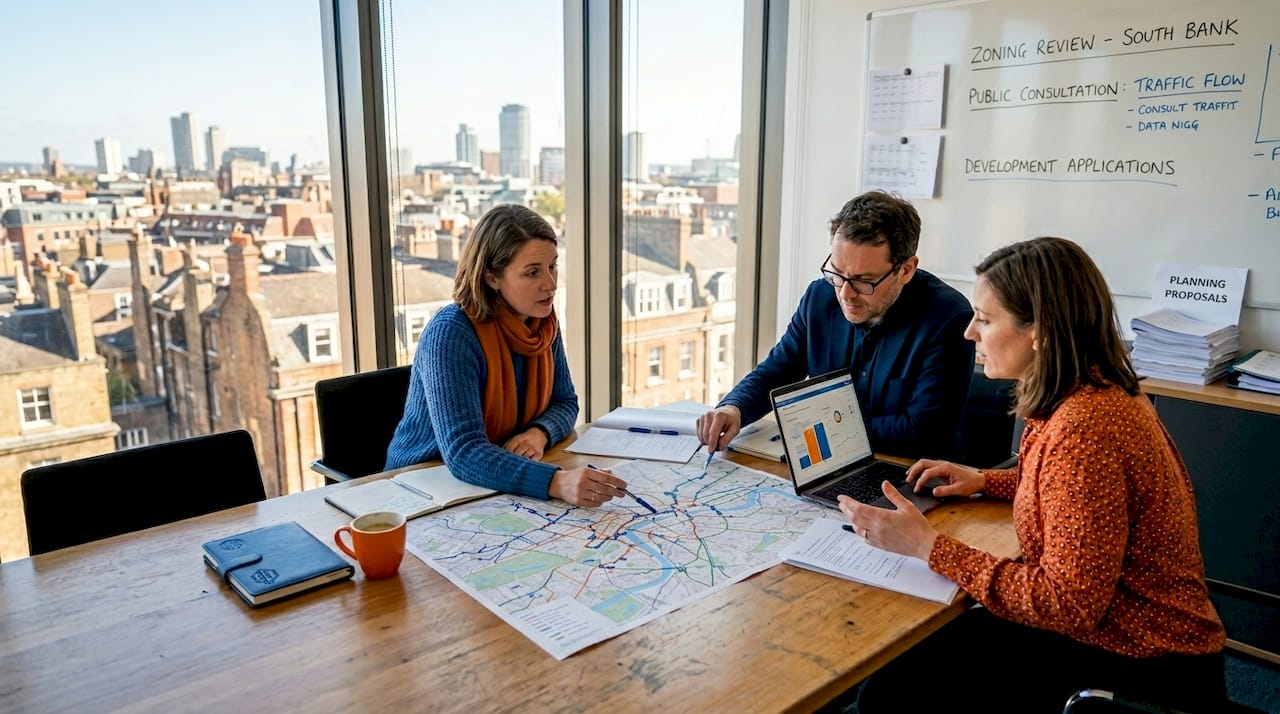
Urban planning decisions carry consequences that last decades. A poorly assessed transport corridor, a zoning framework that ignores demographic shifts, or a development strategy that alienates local communities can cost cities enormous sums and erode public trust. Yet many planning teams still rely on fragmented assessment processes, siloed datasets, and reactive stakeholder engagement. The pressure to balance economic viability, social equity, environmental sustainability, and political feasibility simultaneously is immense. This article presents the advanced, evidence-based strategies that leading practitioners use to navigate that complexity and make decisions that actually hold up over time.
Key Takeaways
| Point | Details |
|---|---|
| Establish clear criteria | Robust urban planning decisions depend on multi-dimensional, locally-relevant evaluation frameworks. |
| Embrace advanced analysis | Multicriteria and AI-driven methods offer rigour, but must be integrated with context and stakeholder input. |
| Prioritise stakeholder alignment | Technical approaches alone are often eclipsed by cultural, political, and stakeholder factors in real-world project outcomes. |
| Mix strategies by context | Rules-based, transformation, and participative approaches should be selected and blended according to local needs and viability. |
| Focus on transparency | Ensure transparency and fairness in decision-support systems, especially when applying AI and ML models. |
Establishing criteria for effective urban decisions
Every sound urban planning decision begins with a clearly defined set of evaluation criteria. Without them, assessments become arbitrary, comparisons between alternatives become impossible, and stakeholder alignment remains out of reach. The challenge is that no single dimension tells the full story. Economic return matters, but so does social inclusion, carbon impact, and political deliverability.
Experienced planners draw from a range of dimensions when setting criteria:
- Economic: cost-benefit ratios, land value uplift, job creation, fiscal sustainability
- Social: housing affordability, access to services, community cohesion, displacement risk
- Environmental: carbon emissions, biodiversity net gain, flood resilience, air quality
- Political: alignment with local authority priorities, electability, regulatory compliance
To integrate these dimensions rigorously, sustainable urban planning frameworks commonly incorporate tools such as Stakeholder Analysis, STEEP, SWOT, and Multicriteria Decision Analysis (MCDA). Research confirms that integrated frameworks combining these approaches support sustainable urban scenario selection by forcing teams to test options against multiple, sometimes conflicting, criteria simultaneously.
“The quality of an urban planning decision is only as strong as the criteria used to make it. Broad, contextually grounded criteria are the foundation on which every viable strategy must be built.”
Pro Tip: When setting evaluation criteria, always validate them against both historical local data and prospective uncertainties. A city preparing for significant population growth needs criteria weighted differently from one managing shrinkage and infrastructure ageing.
UN-Habitat explicitly prioritises compact, resilient city forms in its planning guidance, and this should inform how you weight density, connectivity, and climate adaptation in your own criteria matrices. Criteria that appear neutral on paper can embed significant value judgements, so making those judgements transparent from the outset is not just good practice. It is essential for democratic accountability.
Multicriteria decision analysis: tools and methods
With decision criteria established, the next question is how to systematically evaluate competing alternatives against them. This is precisely where Multicriteria Decision Analysis tools prove their worth. MCDA is not a single method. It is a family of analytical approaches, each with distinct strengths depending on the number of alternatives, the nature of the data, and the degree of stakeholder involvement required.
Several MCDA methods are in regular use across urban planning practice:
- MAVT (Multi-Attribute Value Theory): translates qualitative preferences into numerical scores; well suited to structured stakeholder workshops
- TOPSIS: ranks alternatives by their distance from an ideal solution; effective for large option sets with quantitative data
- VIKOR: focuses on maximising group utility and minimising regret; useful when consensus among stakeholders is the primary goal
- COPRAS: evaluates the ratio of beneficial to non-beneficial criteria; practical for infrastructure investment decisions
- ARAS: compares each alternative to an optimal reference point; transparent and straightforward to communicate to non-technical audiences
Research shows that MCDA methods like MAVT, TOPSIS, and VIKOR enable evaluation of alternatives across economic, environmental, and social criteria with meaningful stakeholder input. The right method depends heavily on context.
| Method | Best for | Key strength | Limitation |
|---|---|---|---|
| MAVT | Structured stakeholder input | Captures subjective preferences | Requires expert facilitation |
| TOPSIS | Large quantitative datasets | Fast, scalable | Less intuitive for lay audiences |
| VIKOR | Consensus building | Balances individual and group utility | Sensitive to weight changes |
| COPRAS | Infrastructure investment | Handles benefit/cost ratios directly | Less suited to qualitative data |
| ARAS | Communicating results | Transparent benchmark comparison | Requires clearly defined ideal |
Integrating MCDA with GIS data elevates the analysis considerably. GIS-integrated MCDA allows planners to overlay spatial constraints, demographic data, and environmental sensitivity maps with scored alternatives. This produces outputs that are not only analytically rigorous but visually communicable to elected members and communities. When you combine collaborative decision tools with GIS-grounded MCDA, you significantly reduce the risk of politically contested decisions being overturned at a later stage.

Pro Tip: For complex urban scenarios involving more than five alternatives and multiple competing interest groups, consider using VIKOR as a starting point. Its focus on minimising regret across the group makes it particularly well suited to politically sensitive decisions where no single “best” option exists.
Stakeholder engagement and cultural context
Technical frameworks and MCDA tools are necessary, but they are never sufficient on their own. Real-world urban planning outcomes frequently depend on human and political dynamics that no spreadsheet can fully anticipate. Understanding this is not a concession to irrationality. It is a mark of professional maturity.
Effective stakeholder engagement in urban planning requires more than consultation events. It demands ongoing, structured dialogue that genuinely informs decisions rather than simply validating them after the fact. Key principles include:
- Mapping all affected stakeholders early, including those with indirect interest
- Distinguishing between stakeholders with power to block or accelerate, and those with knowledge to enrich analysis
- Creating deliberate feedback loops so that stakeholder input visibly shapes outcomes
- Acknowledging conflict openly rather than suppressing it in the interests of apparent consensus
Research into light rail decision-making in Finnish cities reveals just how profoundly local context shapes outcomes. Success in Tampere versus Turku depended not primarily on technical merit but on geography, economics, political support, and stakeholder alignment that went well beyond rational arguments alone. Tampere’s more successful implementation reflected a decision culture in which political leadership, civic identity, and long-term economic vision were genuinely aligned. Turku’s slower progress reflected a more fragmented stakeholder environment.
This is not a unique case. Evidence consistently shows that stakeholder engagement and decision cultures critically influence outcomes, often overriding purely data-driven rationality in complex projects. The implication for planners is clear.
“Data can describe a city. Only people can shape it. The most robust technical assessment still needs a political and social coalition behind it to succeed.”
For practitioners wanting to build that coalition, the complete guide to stakeholder engagement offers practical frameworks for structuring participation across different project phases. Cultural context, decision-making norms, and institutional trust levels all need to be factored in well before any technical assessment begins.
Rules-based and transformation strategies: lessons from practice
Once a clear strategy framework is in place, planners must choose between approaches that range from highly prescriptive to highly adaptive. Rules-based systems define clear parameters for what can be built, where, and to what standard. Transformation strategies, by contrast, set a directional vision and allow iterative adaptation as conditions evolve.
Both approaches carry trade-offs. Rules-based systems offer developers and communities predictability. They reduce negotiation overhead and can accelerate delivery dramatically. However, they require rigorous upfront viability testing and must be calibrated carefully to local land market conditions.
Croydon’s Suburban Design Guide provides a compelling illustration. Croydon achieved the highest rate of small-site housebuilding in London by deploying a clear, rules-based approach that emphasised land availability near stations and removed ambiguity from the consenting process. The lesson is that well-designed rules, applied in the right spatial context, can unlock delivery at a pace that discretionary systems rarely match.
Transformation strategies, meanwhile, operate at a different scale. UN-Habitat’s urban planning strategies categorise these approaches as city-wide transformations, infill strategies, new towns, and public space improvements, with a consistent priority given to compact, integrated, and resilient urban forms.
| Strategy type | Typical scale | Key advantage | Risk |
|---|---|---|---|
| Rules-based | Site to neighbourhood | Speed and certainty | Inflexibility in varied contexts |
| City-wide transformation | Metropolitan | System-level change | Long timescales, political complexity |
| Infill | Neighbourhood | Efficient use of existing assets | Community resistance |
| New towns | Regional | Opportunity for bold design | High infrastructure costs |
The practical implication is that most successful urban planning programmes combine elements of both approaches. A rules-based system governs incremental development, whilst a transformation strategy guides major investment decisions and infrastructure corridors. Recognising when to apply each mode is one of the most valuable judgements a senior planner can develop.
Harnessing AI and machine learning for complex urban decisions
Digital tools and artificial intelligence are reshaping decision support in urban planning at a remarkable pace. Where early planning support systems offered static scenario modelling, contemporary AI-powered tools can process vast datasets, learn from previous decisions, and surface patterns that would be invisible to human analysis alone.
The practical applications are expanding rapidly:
- Scenario ranking: Machine learning models can evaluate dozens of urban development scenarios against weighted criteria simultaneously, delivering ranked outputs within minutes rather than weeks
- Sensitivity analysis: AI systems identify which criteria weightings most significantly affect outcomes, helping planners understand where uncertainty is concentrated
- Spatial pattern recognition: Algorithms detect land use anomalies, underutilised parcels, and infrastructure gaps at city scale
- Predictive modelling: ML tools forecast demographic change, traffic generation, and environmental impact under multiple future conditions
Research demonstrates that machine learning decision support systems using approaches like RF-RFE, LOPCOW, and ERUNS with q-ROFS can rank urban development options, identifying Green Urbanisation strategies as optimal under multiple sustainability criteria simultaneously.
The evolution of AI planning support systems from rule-based models to genuinely learning systems improves scenario exploration considerably, but it also introduces new obligations around transparency, fairness, and participatory governance. An algorithm that consistently favours certain land uses or demographic groups can entrench inequality at scale if its outputs are not interrogated critically.
Connecting AI tools for urban planning to collaborative workflows is therefore essential. The outputs of machine learning analysis must be legible to stakeholders, not just technically proficient. For planners interested in the broader role of these technologies, the discussion of AI in urban design collaboration provides a valuable reference point.
Pro Tip: Use hybrid MCDA and AI approaches for the strongest analytical results. Running TOPSIS or VIKOR alongside a machine learning scenario ranking produces outputs that are both technically robust and methodologically transparent, which significantly strengthens the decision record for future scrutiny.
The missing ingredient: balancing analysis with local realities
Here is an uncomfortable truth that the urban planning profession does not always voice clearly: the most technically sophisticated decision framework cannot guarantee a good outcome if it is deployed without genuine respect for local realities.
We have seen this pattern repeatedly. A planning authority invests heavily in GIS-integrated MCDA, commissions detailed transport modelling, and produces a technically impeccable options appraisal. Then the project stalls because a local community group was never meaningfully consulted, or because the political leadership changed and no one had built sufficient cross-party support for the strategy. The analysis was excellent. The outcome was still poor.
The most resilient urban planning strategies are those that treat collaborative planning for sustainable cities not as a stage-gate in the process but as a continuous thread running through it. They build decision frameworks that are transparent enough for non-specialists to interrogate, flexible enough to incorporate new evidence, and grounded in ongoing dialogue with the communities they affect.
Data and models are indispensable. But cities are not abstract systems. They are living environments shaped by history, culture, identity, and competing interests. The planners who navigate this most successfully are those who know when to trust the model and when to look up from the screen and listen.
Ready to transform your urban planning workflow?
The strategies covered in this article, from rigorous criteria setting and MCDA to AI-powered scenario analysis and deep stakeholder engagement, are most powerful when supported by tools designed specifically for the complexity of urban planning work.
The 3D Cityplanner platform brings these capabilities together in a single, collaborative environment. From 3D scenario visualisation and sound impact simulation to automatic building generation and 4D project timelines, it gives planning teams the analytical power and communication tools they need to make evidence-based decisions with confidence. Whether you are assessing a major city-wide transformation or managing incremental small-site development, the platform supports your workflow at every stage. Explore the platform with a no-commitment trial and see how it can strengthen your next project.
Frequently asked questions
What are common pitfalls in urban planning decision-making?
Common pitfalls include underestimating stakeholder influence, setting criteria that are too narrow, and overreliance on technical models without sufficient local input. Research confirms that decision cultures critically influence outcomes, often overriding data-driven assessments in complex projects.
How does MCDA benefit urban development projects?
MCDA enables planners to compare complex development options systematically across economic, environmental, and social criteria, producing balanced and broadly supported solutions. Methods like MAVT, TOPSIS, and COPRAS each offer distinct strengths depending on the nature of the decision and the data available.
What role does AI play in supporting urban planning decisions?
AI helps simulate scenarios, rank development options, and integrate complex spatial and demographic data at a speed and scale beyond manual analysis. However, as AI planning support systems evolve, their outputs must be balanced with rigorous transparency, fairness checks, and genuine stakeholder participation.
Can rules-based planning always deliver better outcomes than discretionary methods?
Not always. Rules-based systems improve efficiency and certainty, but require careful calibration to local land markets and stakeholder contexts. Croydon’s rules-based approach succeeded specifically because land availability near stations was already strong, a condition that does not translate automatically to every urban context.
Recommended
- Top urban development strategies for city optimisation 2026 – 3D Urban Development
- Why optimise city planning: 3D tools for better design – 3D Urban Development
- Top city planning strategies using advanced 3D technology – 3D Urban Development
- Why optimising urban spaces drives smarter cities – 3D Urban Development


