The role of urban consultancy in city planning

Urban consultancy is frequently misunderstood as a service that arrives with ready-made answers and leaves behind a polished report. The reality is far more complex. The role of urban consultancy in modern city planning spans strategic analysis, governance support, infrastructure advisory, and community engagement. It requires deep contextual knowledge, not generic templates. For urban planners, government officials, and community leaders, understanding what consultancy genuinely delivers, and where it falls short, is the difference between advice that transforms a city and advice that gathers dust on a shelf.
Defining the role of urban consultancy
Urban consulting services cover a broad spectrum. At one end, you have high-level strategic planning and masterplanning. At the other, you have granular infrastructure advisory, placemaking guidance, and project delivery support. A single engagement can span all of these, and often does. Consultancy support on major garden community developments like Welborne Garden Village has exceeded ten years, from initial masterplanning through to infrastructure delivery.
The function of urban planners within a consultancy differs significantly from the role of internal planning teams. Internal teams carry institutional memory, political accountability, and day-to-day operational responsibility. Consultancies bring external expertise, benchmarking data, specialist skills that would be too costly to maintain in-house, and the freedom to challenge existing assumptions without political risk.
Urban development consulting typically involves:
- Strategic planning and masterplanning: Defining long-term spatial frameworks that align growth with infrastructure capacity and community needs
- Placemaking and urban design: Shaping the quality, identity, and social function of public spaces and mixed-use environments
- Infrastructure advisory: Advising on transport, utilities, and digital infrastructure investments to support planned growth
- Finance structuring: Helping local authorities and developers identify and unlock funding sources for capital programmes
- Stakeholder engagement: Facilitating public participation, community dialogue, and cross-sector partnership development
- Environmental impact assessment: Evaluating how development proposals affect ecology, air quality, noise levels, and climate resilience
This breadth is precisely why the benefits of urban consultancy are so significant when engagements are well managed. Consultants act as a multiplier for internal capacity, not a replacement for it.
Why context shapes consultancy outcomes
One of the most persistent failures in urban planning consultancy is the assumption that solutions which worked in one city can be transplanted directly to another. They cannot. Governance structures, land ownership models, political cultures, and community expectations differ profoundly between cities, and often between neighbourhoods within the same city.

Governments with strong internal planning capacity use consultancy advice most effectively because they can challenge it, contextualise it, and adapt it rather than simply accept it. This creates a productive tension that improves outcomes. Where internal capacity is weak, the same advice risks being adopted uncritically, producing plans that are technically proficient but institutionally undeliverable.
There is a genuine paradox at the heart of how urban consultancy works. The cities that need external expertise most urgently are often those least equipped to make good use of it. Commissioning a masterplan without an institutional home to own it, implement it, and update it over time produces a document rather than a direction.
“Treat consultancy as part of a sustained institutional conversation, not a one-off intervention, to ensure relevance and real-world impact.”
This means the importance of urban consultancy goes beyond technical content. Consultants who work effectively at this level stretch into governance advice, capacity-building, and long-term organisational strategy. They help build the internal muscle that will outlast their own engagement.
Pro Tip: Before commissioning a consultancy, ask whether your organisation has the internal capacity to critically engage with the advice you will receive. If not, build that capacity first or include it as a deliverable within the consultancy scope itself.
Sustainability, finance, and inclusion challenges
Cities face a financing problem that no amount of planning expertise alone can solve. Globally, cities require USD 5 trillion annually for sustainable urban transformation, yet current financing flows reach only USD 831 billion per year. That gap is not just a numbers problem. It is a governance and structuring problem, and it is precisely where urban planning consultancy adds measurable value.
Consultancies help cities structure bankable projects, meaning projects that are sufficiently well-governed, de-risked, and financially transparent to attract institutional investment. This includes designing green bond frameworks, advising on public-private partnership structures, and helping governments articulate infrastructure pipelines that private capital can price and underwrite.
The sustainability challenge has a human dimension too. Sustainable urban transformation depends on integrating governance, finance, and technology with genuine community participation, not just producing planning documents. Consultancies that embed social inclusion into their frameworks, addressing housing affordability, accessibility, and equitable distribution of green space, deliver outcomes that are more durable and politically resilient.
The most effective urban consulting services in this space typically deliver across three interconnected areas:
- Climate resilience planning: Assessing flood risk, urban heat island effects, and biodiversity net gain requirements, then integrating these into spatial frameworks
- Finance instrument design: Structuring green bonds, infrastructure levies, and impact investment vehicles that match project timelines with investor expectations
- Inclusive growth frameworks: Ensuring that regeneration programmes do not simply displace existing communities but create tangible benefits for them through employment, housing, and public services
Using urban planning software with environmental impact assessment capabilities alongside consultancy work allows these assessments to be conducted with greater accuracy and presented to stakeholders in formats they can genuinely interrogate.
Public versus private sector consultancy dynamics
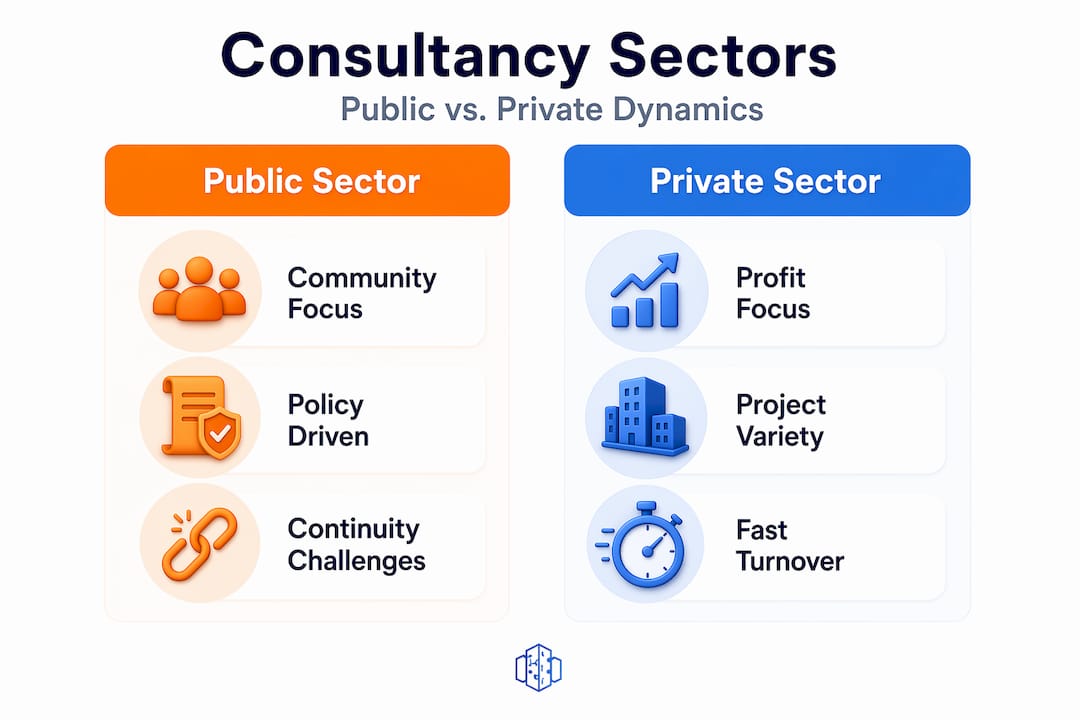
The context in which urban development consulting takes place shapes its character entirely. Public sector engagements operate under fundamentally different constraints from private sector ones.
| Factor | Public sector | Private sector |
|---|---|---|
| Primary objective | Long-term community outcomes and policy compliance | Profitable, on-time delivery for clients or investors |
| Typical timeframe | Extended, often multi-year with political cycles | Faster-paced with commercial deadlines |
| Stakeholder complexity | High: elected officials, communities, regulators, partners | Moderate: clients, planning authorities, funders |
| Job security | Greater stability, structured career progression | Higher pay, greater project variety |
| Governance constraints | Procurement rules, transparency requirements, budget cycles | Commercial flexibility, but still subject to planning regulations |
| Risk of stalling | High due to political change or budget cuts | Lower, though market conditions affect viability |
Private sector urban design tends to offer better financial rewards and exposure to a wider range of projects, while public sector roles provide greater job security and a clearer focus on community goals. For consultancies working across both, understanding which context they are operating in at any given moment is non-negotiable.
The challenges of continuity are particularly acute in the public sector. When a political administration changes or a key officer moves on, the institutional memory that held a programme together can disappear almost overnight. Regeneration programmes require rigorous infrastructure-style project controls including risk management and clear asset ownership to maintain momentum through these transitions.
Commissioning consultancy effectively
The difference between consultancy that delivers lasting change and consultancy that produces unused reports almost always comes down to how the engagement was commissioned in the first place. Clarity about the purpose of the advice is the single most important factor in whether a consultancy engagement delivers value.
Consider these practical steps when commissioning urban consulting services:
- Define the commissioning intent clearly. Are you seeking exploratory advice to open up options, protective advice to justify decisions already taken, capacity-building support to strengthen your team, or diagnostic assessment to understand what is going wrong? Each intent requires a different brief and a different type of deliverable.
- Create an institutional home for the output. Before the consultancy begins, identify the officer, team, or board that will own the recommendations and be accountable for acting on them. Without this, even excellent advice becomes inert.
- Involve local expertise from the outset. External consultants bring comparative knowledge, but local practitioners, community organisations, and public sector officers hold contextual understanding that no amount of benchmarking can replicate. Build this into the methodology, not as an afterthought.
- Plan for implementation, not just delivery. Commission a consultancy with a clear view of what the next step looks like once the report is received. If there is no implementation plan, budget, or organisational capacity to act, the engagement is premature.
- Build in review and iteration. Urban conditions change. A consultancy engagement that treats its brief as fixed from day one will produce outputs that are out of date by the time they are delivered. Build structured review points into the programme.
Pro Tip: When evaluating consultancy proposals, ask each firm to describe a project where their advice was not implemented and what they learnt from it. How a consultancy reflects on failure tells you far more about their quality than their portfolio of successes.
Effective engagement also means sustaining the relationship beyond a single commission. Consultancy as a sustained institutional conversation produces compounding value as the external team deepens its understanding of your city’s specific constraints and opportunities over time. This is how sustainable cities are shaped through masterplanning rather than single interventions.
What experience teaches you about urban consultancy
I have worked alongside governments and communities long enough to observe a consistent pattern. The most technically accomplished consultancy reports I have seen have also been, in some cases, the least influential. Not because the analysis was wrong, but because the political and institutional conditions needed to act on it were simply absent.
What I have learnt is that governance is not a secondary concern in urban planning consultancy. It is the primary one. Technical content is only as useful as the institutional capacity that receives it, interrogates it, and carries it forward. When that capacity does not exist, the best approach is not to deliver the report and move on. It is to say so clearly, adjust the scope, and build the capacity alongside the advice.
I have also seen how the temptation to treat consultancy as a one-off solution leads organisations into repeated cycles of re-commissioning. The same questions get asked of different firms, producing variations on the same answers, with no one building on what came before. This is expensive and demoralising for everyone involved.
My honest view is that the importance of urban consultancy is not in dispute, but its effectiveness is entirely contingent on how it is managed. The best consultancy relationships I have witnessed look more like extended partnerships, where external and internal teams think together, disagree productively, and build shared understanding over time. That is the standard worth holding out for.
— Anne
How 3dcityplanner supports urban planning professionals
Effective urban consultancy depends on tools that match the ambition of the projects being delivered. 3dcityplanner offers urban planning professionals a platform built for exactly this kind of work, combining 3D masterplanning, environmental simulation, line-of-sight analysis, and 4D project timeline visualisation in a single working environment.
Whether you are structuring a complex regeneration programme, assessing climate resilience options, or presenting a spatial framework to elected officials, 3dcityplanner gives your team the analytical depth and visual clarity to make decisions with confidence. The platform supports collaboration between consultants, government officers, and community stakeholders, keeping everyone working from the same spatial data. Explore the full capabilities of the urban planner platform and see how it can support your next consultancy engagement.
FAQ
What is the role of urban consultancy?
Urban consultancy provides strategic planning, masterplanning, infrastructure advisory, and governance support to cities and private clients. It supplements internal planning capacity with specialist expertise and data-driven analysis to improve urban development outcomes.
How does urban consultancy differ from internal planning teams?
Internal planning teams carry day-to-day operational responsibility and institutional knowledge, while consultancies bring external expertise, benchmarking data, and the freedom to challenge assumptions. The two work most effectively in combination rather than as substitutes for one another.
Why do some consultancy engagements fail to deliver results?
Consultancy recommendations that ignore political context and institutional capacity frequently end as unused reports. Without a clear commissioning intent, an institutional home for the output, and an implementation pathway, even high-quality advice cannot translate into real-world change.
What is the finance gap facing sustainable urban development?
Cities globally require USD 5 trillion annually for sustainable urban transformation but currently receive less than USD 831 billion. Urban consultancies play a significant role in structuring bankable projects that can attract the institutional investment needed to close this gap.
How long does a typical urban consultancy engagement last?
Timescales vary considerably by project scope and sector. Major garden community developments have seen consultancy involvement spanning over a decade, while more focused diagnostic or strategic assignments may conclude within months. The most impactful engagements tend to be sustained over time rather than delivered as single interventions.


