Role of data in urban development: a guide

Urban planners once made decisions from paper surveys, decades-old census records, and gut instinct. The role of data in urban development has since transformed beyond recognition. Today, cities face complex, interlocking challenges — housing pressures, climate risk, ageing infrastructure — that no single dataset can capture alone. Professionals who understand how to gather, analyse, and act on spatial data are consistently making better decisions, faster. This guide walks through the frameworks, technologies, and governance approaches that turn raw data into genuine urban progress.
How spatial data shapes evidence-based urban planning
Every urban development decision rests on assumptions about place: where people live, how they move, what infrastructure exists, and where risks concentrate. Spatial data makes those assumptions visible and testable. Without it, planning is largely reactive. With it, you can anticipate, model, and justify decisions to every stakeholder in the room.
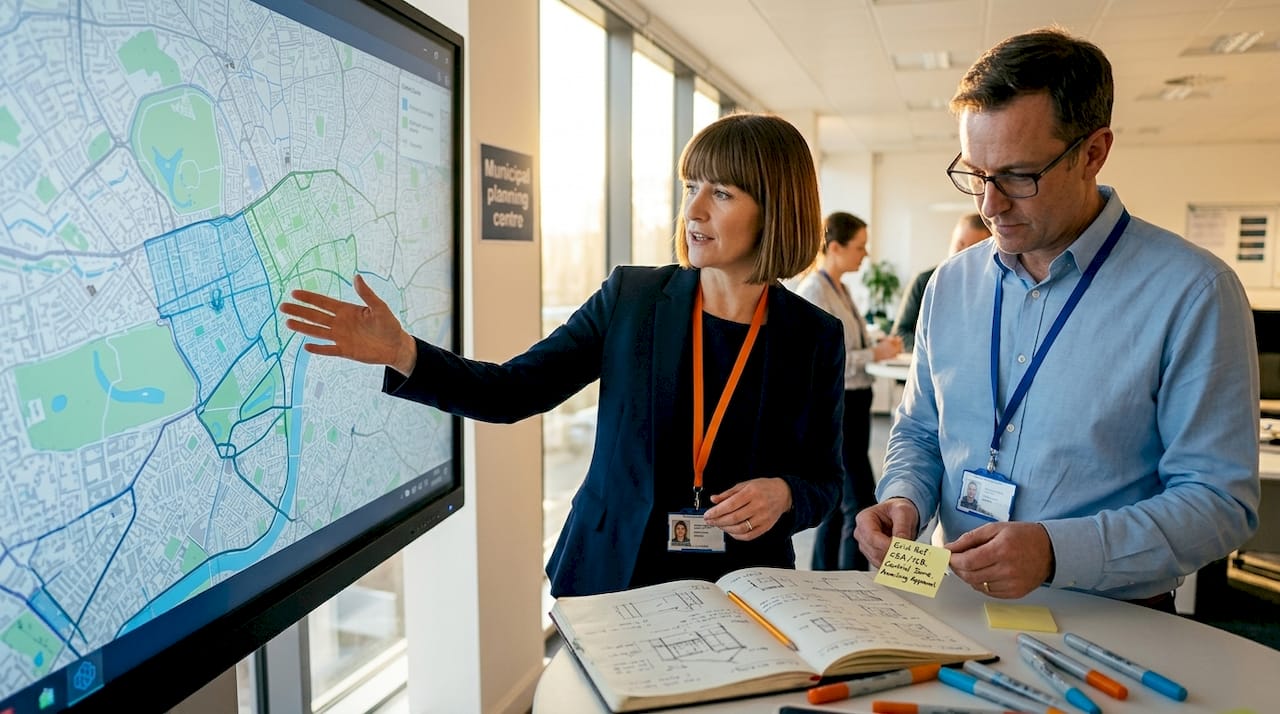
Evidence-based, spatially informed decision-making is now a core part of modern urban planning, particularly in delivering adequate housing and basic service provision. The UN-Habitat 2025 AI for Spatial Mapping and Analysis toolkit identifies this as foundational, noting that spatial knowledge strengthens not just planning accuracy but also the equity of outcomes across communities.
Spatial data captures urban complexity across multiple dimensions simultaneously:
- Land use patterns: identifying underutilised parcels, mixed-use zones, and development corridors
- Infrastructure networks: mapping roads, utilities, drainage, and public transport against population density
- Social indicators: overlaying deprivation indices, access to services, and demographic trends
- Environmental factors: incorporating green space, air quality, flood plains, and heat island data
Where spatial data becomes especially powerful is in combination with Geospatial Artificial Intelligence, or GeoAI. GeoAI integrates spatial datasets with machine learning to automate analysis that would otherwise take months. For example, a city authority assessing informal settlement growth can use GeoAI to process satellite imagery across thousands of square kilometres, flagging at-risk zones in hours rather than weeks.
The process of creating 3D city models extends this further, converting spatial datasets into navigable, three-dimensional environments where planners can test interventions before a single permit is issued. This is where urban data analysis strategies begin to translate into genuine decision-making confidence.
Using risk and hazard data for resilient urban development
Spatial data becomes critically important when applied to hazard and disaster risk. Cities are increasingly exposed to flooding, extreme heat, seismic activity, and landslide risk. The question is not whether risk data exists, but whether planning systems are structured to act on it.
The World Bank’s 2026 From Risk to Resilience handbook makes a practical point: cities use hazard data to create actionable land-use rules rather than simply producing risk maps that sit in reports. The Restrict-Condition-Promote (RCP) framework is a structured approach to this:
- Restrict: prohibit development in high-hazard zones such as active floodplains or unstable slopes
- Condition: permit development only with enforceable safeguards, including elevated foundations, green buffers, or drainage requirements
- Promote: direct growth and investment towards lower-risk areas through incentives and infrastructure priority
| Risk data application | Planning outcome | Example |
|---|---|---|
| Flood hazard mapping | Zoning restrictions on floodplain development | Restricting residential construction within 1-in-100-year flood extents |
| Heat island analysis | Green infrastructure siting requirements | Mandating tree canopy cover in new commercial developments |
| Seismic vulnerability data | Building code enforcement | Conditioning permits on structural retrofitting in high-risk districts |
| Landslide susceptibility maps | Infrastructure investment prioritisation | Redirecting road investment away from unstable hillside corridors |
Governance is where risk data either delivers value or evaporates. The data must be embedded in statutory planning instruments, not treated as advisory. That requires political will, technical capacity within planning authorities, and clear accountability arrangements. An efficient 3D urban planning workflow can support this by visualising risk overlays within the same environment used to design and assess development proposals.
Pro Tip: When presenting risk data to elected officials or community groups, translate technical metrics (e.g., return period probabilities) into concrete local scenarios, such as “this area floods on average every 12 years.” That framing converts abstract statistics into decisions people can act on.
Integrating GeoAI and transparency in urban spatial analysis workflows
GeoAI is no longer a research concept. It is being embedded into live planning systems across cities in Europe, Southeast Asia, and sub-Saharan Africa. It automates the processing of satellite imagery, LiDAR point clouds, and socio-economic datasets, producing spatial analyses at a speed and scale that human teams cannot match manually.
However, speed without transparency creates real problems. A 2026 review published in MDPI confirms that GeoAI is embedded within planning governance, with key challenges around data access, model transparency, and ethics actively shaping how and where it is adopted. When a GeoAI model recommends restricting development in a particular neighbourhood, planning authorities and communities need to understand why. Opaque models erode trust and, in some jurisdictions, create legal exposure.
Responsible integration of GeoAI into urban spatial analysis workflows requires attention to several practical considerations:
- Data provenance: document where your input datasets come from, when they were collected, and what their known limitations are
- Model explainability: use tools that produce interpretable outputs, not just predictions; planners need to defend their decisions
- Ethical review: conduct equity audits to check whether model outputs systematically disadvantage particular communities
- Stakeholder communication: explain what the model does and does not do before presenting outputs in public forums
Urban planning AI tools that embed these principles from the outset are far more likely to build the institutional trust needed for long-term adoption. The alternative, deploying GeoAI without governance frameworks, tends to generate short-term outputs but long-term scepticism.
Pro Tip: Establish a brief “model card” for each GeoAI tool you deploy, modelled on practice from the machine learning community. Document the training data, intended use, known limitations, and who reviewed it. This single-page document transforms a black box into a defensible planning tool.
Real-time collaboration in urban planning becomes significantly more effective when all participants can access the same transparent, well-documented data layers, rather than debating which dataset is correct.
Leveraging 3D spatial technologies for enhanced collaboration and decision-making
3D spatial technologies are changing the dynamic in planning meetings. Where a conventional land-use map requires significant interpretation, a 3D city model is immediately intelligible to engineers, developers, elected members, and community representatives alike. That shared understanding accelerates decisions and reduces costly misalignments between disciplines.
Urban Digital Twins, living simulation environments updated with real-time data, take this further. They allow teams to test scenarios before committing capital or approvals:
- Model a proposed development in its existing urban context, with accurate sun, shadow, and wind modelling
- Overlay transport demand data to assess access and congestion impacts under different configurations
- Simulate sound propagation to identify noise-sensitive receptors before design is finalised
- Apply flood or heat risk layers to test resilience under projected climate scenarios
- Share the model with community stakeholders via accessible interfaces, enabling genuine participation
The contrast between traditional and 3D-enhanced workflows is substantial:
| Aspect | Traditional workflow | 3D-enhanced workflow |
|---|---|---|
| Data visualisation | 2D maps and reports | Interactive 3D model updated in real time |
| Stakeholder engagement | Public exhibitions with static boards | Shared digital environment accessible remotely |
| Scenario testing | Manual recalculation across separate datasets | Instant scenario comparison within one platform |
| Cross-disciplinary coordination | Sequential reviews with version conflicts | Simultaneous access to a single source of truth |
| Decision documentation | Meeting minutes and memoranda | Audit trail embedded in the model history |
Teams using AI-enhanced urban design collaboration report fewer revision cycles and faster sign-off on planning applications. The data is more visible, the trade-offs are clearer, and there is less room for misinterpretation. Participation tools in urban planning that integrate with 3D environments further support inclusivity by giving communities meaningful ways to engage, rather than passive consultations. When GIS integration tools are connected to 3D platforms, the combined output is considerably richer than either system produces independently.
Translating data insights into practical urban development outcomes
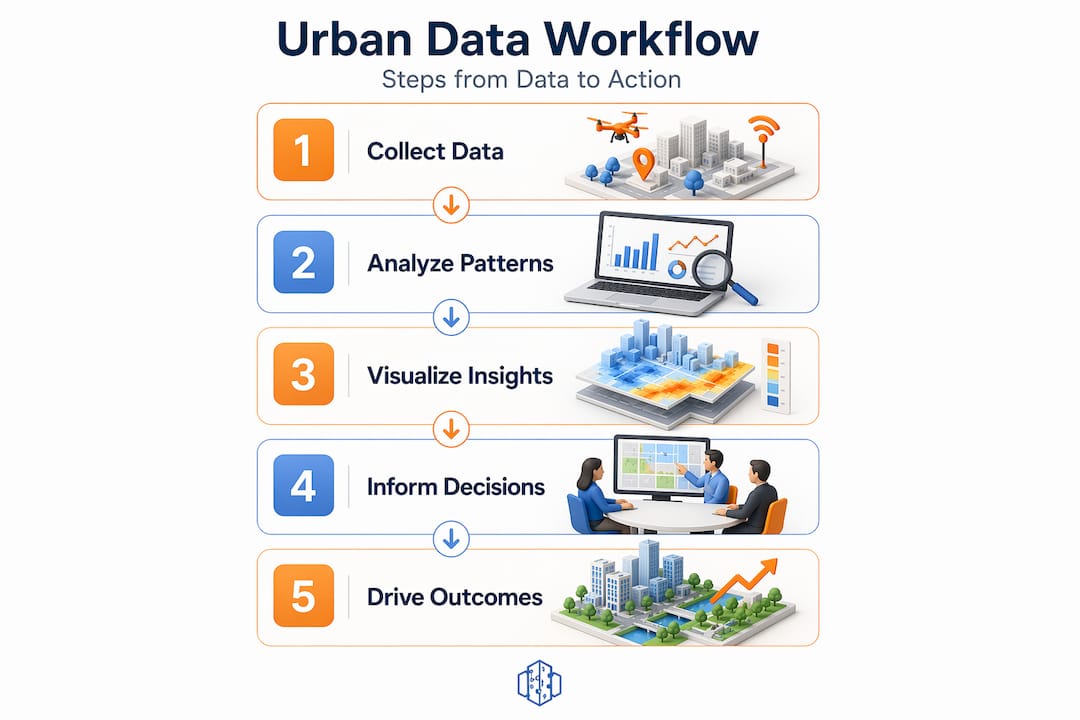
Analysis without action is just a report. The real measure of big data in urban development is whether insights translate into zoning decisions, investment priorities, permit conditions, and enforceable standards. That transition from insight to action is where many projects stall.
The World Bank is explicit on this point: data-driven planning succeeds when operationalised into decision levers like zoning and investments, paired with governance workflows, rather than producing standalone analytics. Equally, GeoAI initiatives require early budgeting for explainability and ethics review, as retrofitting these considerations after deployment consistently causes delays and erodes stakeholder confidence.
A practical sequence for operationalising data insights:
- Anchor data to specific decisions: identify which zoning classification, infrastructure investment, or policy instrument each dataset informs, before analysis begins
- Assign governance ownership: name the authority or officer responsible for acting on each data output, not just receiving it
- Build in review cycles: schedule regular data updates and decision reviews so insights remain current and actionable
- Establish transparency protocols: document how data inputs shape decisions, creating an audit trail that supports accountability and public trust
- Connect data to enforcement: ensure that planning conditions derived from data analysis are tracked through to implementation, not lost at approval stage
“Translating data into urban outcomes requires governance as much as technology. The most sophisticated spatial analysis is only as effective as the institutional capacity to act on its findings.”
Urban planning data sources and the workflows that connect them to decisions are where the impact of data on cities becomes tangible. Teams that embed this discipline early avoid the common failure mode of producing excellent analysis that influences nothing. Real-time data efficiency gains compound over time when data is connected to governance, not treated as a parallel activity.
Pro Tip: Create a “data to decision” register for each project. Map every key dataset to the specific planning decision it informs, the officer responsible, and the review date. This simple discipline prevents valuable analysis from going unread and keeps data central to the governance process.
Rethinking data’s role: balancing technology, ethics, and collaboration
There is a persistent assumption in urban development circles that better technology automatically produces better outcomes. It does not. The impact of data on cities depends almost entirely on how that data is governed, communicated, and integrated with human judgement.
GeoAI models can process spatial data faster than any team of analysts. But they can also encode historical biases into future decisions, recommend infrastructure in ways that compound existing inequalities, or generate outputs that communities rightly distrust if the process is opaque. The technology is not the problem. The assumption that technology is sufficient is.
What this means practically is that smart city data usage requires investment in governance and communication alongside technical tools. Transparency is not a compliance exercise; it is the mechanism by which data earns its authority. When communities understand how their neighbourhoods were analysed and can meaningfully engage with the findings, they are far more likely to support the outcomes.
UN-Habitat confirms that GeoAI is intended to complement community engagement in urban planning, not replace it, reinforcing the human-centred nature of the discipline. The professionals who will lead the next generation of urban development are those who treat data as a collaborative asset: shared openly, interrogated honestly, and connected to the lived experiences of the people their plans affect. That is a harder discipline than deploying a GeoAI model, but it is where durable urban progress is actually built.
How 3D Cityplanner supports data-driven urban development
Applying the frameworks in this article requires a platform that connects spatial data, risk analysis, and stakeholder collaboration in one environment. That is precisely what 3D Cityplanner is built to do.
The 3D Cityplanner platform integrates spatial data layers, AI-assisted analysis, and 3D visualisation tools so that urban development professionals can move from raw data to defensible decisions without switching between disconnected systems. It supports real-time collaboration across disciplines, enables 4D timeline planning for phased projects, and includes participation tools that make spatial data genuinely accessible to community stakeholders. Whether you are assessing hazard risk, modelling development scenarios, or coordinating across a multi-agency team, 3D Cityplanner provides the data environment your project needs. Explore the platform with a free trial and see how data transforms urban areas in practice.
Frequently asked questions
What types of data are most important in urban development planning?
Spatial data, hazard and risk information, and socio-economic data are the most critical inputs, as spatially informed planning decisions underpin adequate housing delivery and equitable service provision. Combining these datasets within a single analytical environment produces the most reliable planning outcomes.
How does risk data influence zoning regulations?
Risk data guides zoning by restricting development in high-hazard areas, conditioning approvals with safeguards, and directing growth toward safer zones. Using the Restrict-Condition-Promote framework, planners can convert hazard maps into enforceable land-use rules that measurably reduce disaster impact.
What ethical concerns are associated with using GeoAI in urban planning?
Ethical concerns include data access restrictions, model opacity, algorithmic bias, and ensuring that outputs are trusted before informing decisions. Key GeoAI challenges around transparency and ethics must be addressed through early governance frameworks, not retrofitted after deployment.
Can 3D modelling improve collaboration in urban projects?
Yes. 3D spatial technologies enable immediate visual understanding across disciplines and stakeholder groups, supporting clearer scenario comparison and more inclusive participation. Teams using 3D environments consistently reduce revision cycles and reach planning decisions more efficiently than those relying on 2D documentation alone.


