The role of technology in city development
Most urban planners know that technology has changed how cities operate. Fewer recognise that the role of technology in city development has shifted from support function to central nervous system. Technology no longer assists planning decisions; it increasingly generates, validates, and executes them. With over 70% of the global population projected to live in urban areas by 2050, cities face infrastructure challenges that no spreadsheet or traditional master plan can resolve alone. What follows covers the core technologies reshaping urban systems, the real barriers to deploying them at scale, their implications for sustainability and equity, and the practical examples worth learning from.
The role of technology in city development today
Technology in urban planning has moved well beyond GIS mapping and CAD drawings. Today, cities are deploying interconnected systems: AI for predictive analytics, digital twins for real-time simulation, edge computing for distributed data processing, and integrated data platforms that serve as a single source of truth across departments. Each of these plays a distinct role in how modern infrastructure is managed.
AI and predictive analytics allow planners to model traffic patterns, forecast energy demand, and anticipate where maintenance failures are likely to occur before they happen. Data analytics and AI help reduce municipal service costs and improve efficiency, particularly through sensor networks and predictive capabilities confirmed by McKinsey Global Institute and IDC research.
Digital twins are living simulation environments that mirror physical city systems in real time. Rather than reacting to failures, planners and operators can test scenarios, such as a new transit corridor or a flood response, before committing to physical changes. You can read more about how digital twins work in urban planning contexts to understand their practical scope.

Edge computing addresses one of the more overlooked problems in smart city architecture: the cost and latency of sending all data to a central server. By processing information closer to the source, cities can run AI inference at lower cost and higher speed.
Data integration platforms connect siloed systems across transport, utilities, housing, and emergency services. Without them, even the best individual tools produce fragmented insights that cannot inform city-wide decisions.
Key areas where these technologies are already making a measurable difference include:
- Traffic management using real-time sensor data and adaptive signal control
- Predictive maintenance for ageing water and energy infrastructure
- Environmental monitoring for air quality, noise, and flood risk
- Housing demand modelling to inform planning policy
- Emergency response coordination using live data feeds
Pro Tip: Begin technology infrastructure planning at the site selection stage, not after construction. Early decisions about data centre placement, connectivity, and energy sourcing shape the long-term feasibility of your smart city systems.
From pilots to operations: the scaling gap
Here is where most technology initiatives stall. A city deploys a promising AI pilot in traffic management. Results are good. Stakeholders are enthusiastic. And then nothing changes at scale. Only 7% of AI pilots reach enterprise scale in cities, with the failure typically traced to the absence of operational model integration and workflow redesign.
The distinction between a proof of concept and operational transformation is critical. A pilot proves a technology works under controlled conditions. Operational transformation means rebuilding the processes, roles, and decision-making structures around that technology so that it becomes embedded in daily practice.
Nadeem Ullah, cited in research on how cities scale AI, makes the point plainly: automating a broken workflow produces a faster broken workflow. Scaling AI requires redesigning how decisions are made, not just digitising existing ones.
“Cities that succeed with AI are those that treat it as an organisational transformation project, not a technology procurement exercise.”
Examples from cities that have progressed beyond pilots illustrate what works:
- Boston embedded data analysts within city departments rather than keeping them in a centralised IT team, which meant insights were acted on by people with operational authority.
- Prague redesigned its waste collection routing after deploying AI, cutting fuel costs and service time, but only after retraining drivers and adjusting depot schedules to match new route logic.
- Sunderland used its smart city infrastructure to coordinate services across housing, health, and transport. The key was cross-departmental governance, not the technology itself.
The consistent pattern across these cities is that technology deployment succeeded when it was treated as a reason to redesign city workflows, not merely automate what already existed.
Pro Tip: Before rolling out a technology platform across departments, map your existing decision-making workflows in detail. If those workflows are inefficient, address them first. Technology applied to a sound process multiplies its value.
Technology, sustainability, and equity
The impact of tech on cities is not uniformly positive. Whether technology accelerates equitable and sustainable development depends heavily on policy choices and income levels.
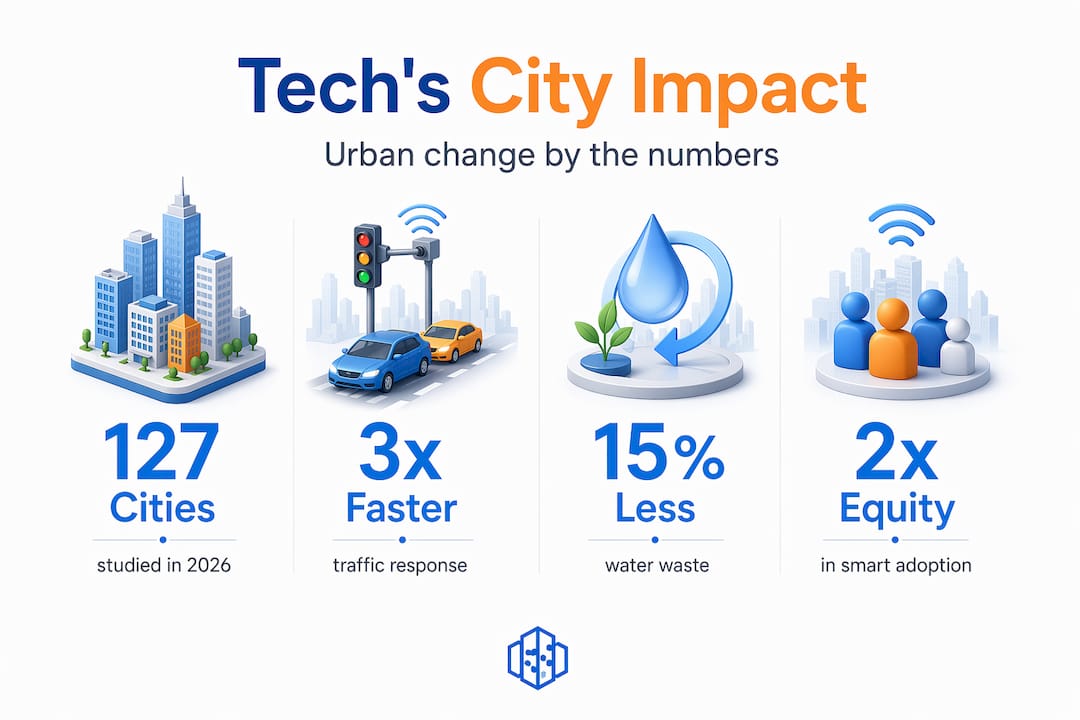
A 2026 study of 127 cities globally found a positive correlation between city income level and smart technology adoption. Wealthier cities not only adopted more technology, they were more likely to direct it towards equity and sustainability goals. Lower-income cities that did adopt smart technologies tended to focus on economic competitiveness rather than social outcomes. This creates a compounding risk: technology widens the gap between cities if access and policy intent are not addressed together.
At the infrastructure level, digital tools are already contributing to environmental goals. The table below outlines some key application areas:
| Technology | Application | Sustainability benefit |
|---|---|---|
| IoT sensors | Water leak detection and usage monitoring | Reduces water waste and infrastructure costs |
| Adaptive traffic systems | Real-time signal control based on flow data | Lowers emissions from idling vehicles |
| AI-driven energy grids | Demand forecasting and load balancing | Cuts peak energy consumption |
| Environmental monitoring networks | Air quality, noise, and flood risk tracking | Enables faster policy response |
| Digital twin modelling | Scenario testing for green infrastructure | Reduces costly physical trial and error |
Equity challenges extend beyond which cities adopt technology to which residents benefit from it. The NYC Comptroller’s 2026 report on AI and fiscal planning highlighted that modernising dated municipal technology is urgent not just for operational efficiency but for avoiding inequality exacerbation. Outdated systems concentrate service failures in lower-income neighbourhoods, where residents have the least ability to absorb them.
Technology’s role in sustainable development depends on treating digital infrastructure as a public good, with procurement, deployment, and governance decisions made with equity as a design requirement rather than an afterthought.
Practical applications and emerging trends
The gap between the theoretical promise of smart cities and what is actually deployable at scale has narrowed considerably. Several current deployments offer clear evidence of how technology shapes city infrastructure in practice.
- HCM City’s digital twin programme: Ho Chi Minh City has deployed digital twin technology to support real-time urban governance across traffic, lighting, drainage, and environmental monitoring. Planners can simulate the impact of a new road or a shift in drainage capacity before physical works begin, significantly reducing decision risk.
- Taiwan’s Smart Eye Guardian: This edge-computing deployment uses AI inference over distributed endpoints to process surveillance and monitoring data locally rather than sending it to a central server. The first phase used 20 cameras, scaling to over 80, while avoiding the cost and latency penalties of centralised processing.
- Third-party data integration: Several cities now draw on commercial data sources, including mobility data from navigation applications and real estate transaction data, to supplement their own datasets. This reduces the infrastructure investment required for comprehensive urban analytics.
- Decentralised AI governance platforms: Emerging tools allow multiple city departments to access shared AI models and data pipelines without requiring centralised IT control. This addresses the governance fragmentation that has historically made cross-departmental technology deployment difficult.
The following comparison illustrates how traditional approaches differ from technology-enabled urban planning:
| Dimension | Traditional planning | Technology-enabled planning |
|---|---|---|
| Data sources | Census, manual surveys, historical records | Real-time sensors, satellite data, third-party feeds |
| Decision speed | Weeks to months | Hours to days |
| Scenario testing | Physical models or 2D drawings | Digital twin simulations |
| Stakeholder engagement | Public meetings, printed documents | Interactive 3D platforms, real-time visualisation |
| Monitoring | Periodic audits | Continuous automated tracking |
The digital transformation in urban areas is not a future state. For cities with the governance structures to support it, it is already the operating reality.
My take on where this is actually heading
I have spent years watching cities invest heavily in technology and underinvest equally heavily in the organisational conditions that would make that technology work. In my experience, the most common failure mode is not technical. It is political.
A city buys a sophisticated data platform. Different departments refuse to share data because of turf concerns. The platform becomes an expensive silo. Nobody is surprised except the vendor.
What I have learned is that technology in urban planning only delivers its potential when governance reform accompanies it. That means cross-departmental data-sharing agreements, political commitment from senior leadership, and community engagement that goes beyond information sessions to genuine co-design. The cities that are pulling ahead are not the ones with the best technology. They are the ones that built the organisational architecture to use it.
I am also sceptical of the narrative that AI will make urban planning more objective. AI reflects the data it is trained on, and urban data has historical inequality baked into it. If you deploy a predictive policing or housing allocation algorithm without auditing your training data, you are not removing bias. You are automating it.
The shift I want to see in the next five years is less about which platform cities adopt and more about whether policymakers treat digital infrastructure with the same long-term thinking they apply to physical infrastructure. A road built today will serve a city for 50 years. A data governance framework built today should do the same.
— Anne
See the technology in action with 3dcityplanner
Understanding the principles is one thing. Applying them to a real project is another.
3dcityplanner gives urban planners, policymakers, and project teams a platform built specifically for the kind of work this article describes. From automatic building generation and line-of-sight analysis to noise simulation and 4D project timelines, the tools are designed for real-world planning decisions, not demonstrations. You can explore the full platform feature list to see how each capability maps to your planning workflow, or use the 3D Geoviewer to experience real-time urban visualisation for yourself. A trial is available without prior payment.
FAQ
What is the role of technology in city development?
Technology functions as the operational backbone of modern city development, enabling data-driven decision-making, real-time infrastructure management, and scenario planning through tools such as AI, digital twins, and integrated sensor networks.
Why do most AI pilots in cities fail to scale?
Only 7% of AI pilots in cities reach enterprise scale, primarily because organisations focus on technical deployment without redesigning the workflows and governance structures needed to embed data-driven decisions into daily operations.
How does technology support sustainability in urban areas?
Technologies such as IoT sensors, adaptive energy grids, and digital twin modelling help cities reduce water waste, lower vehicle emissions, and test green infrastructure scenarios before physical implementation, directly supporting environmental sustainability goals.
Does income level affect how cities adopt smart technology?
A study of 127 cities found that wealthier cities adopt more smart technology and are more likely to direct it towards equity and sustainability, while lower-income cities tend to focus primarily on economic competitiveness.
What is a digital twin and how is it used in city planning?
A digital twin is a real-time simulation of physical urban systems, including traffic, drainage, and energy networks. Cities such as Ho Chi Minh City use digital twin platforms to model the impact of infrastructure changes before committing to construction.


