Smart city planning tips for urban professionals

Urban environments face mounting pressure. Population growth, climate volatility, and deteriorating infrastructure are converging into challenges that demand far more than incremental fixes. Smart city planning, or what urban development professionals formally call intelligent urban systems design, offers a strategic pathway through this complexity. But applying these smart city planning tips effectively requires structure, not just enthusiasm for technology. This article presents evidence-backed, practitioner-focused guidance to help you move from concept to delivery, covering digital twins, design codes, resilience frameworks, and the measurement standards that hold it all together.
1. Define your planning criteria before choosing any technology
The single biggest mistake urban planners make is selecting technologies before establishing what success looks like. Before any procurement or pilot launch, define your evaluation criteria clearly.
Strong criteria for smart urban planning include:
- Integration readiness: Can the solution connect across transport, energy, water, and social services without creating new data silos?
- Risk-informed foundations: Does the approach incorporate hazard data and climate projections as planning inputs, not afterthoughts?
- Data governance: Is there a clear framework for data ownership, standardisation, and interoperability across agencies?
- Stakeholder alignment: Have citizens, businesses, and elected officials been engaged in scoping, not just consultation after decisions are made?
- Measurable performance: Are you using recognised frameworks such as the ISO 37120 series, which covers 19 themes of city services and quality of life?
- Iterative delivery: Is the plan structured for phased pilots rather than big-bang deployment?
Treating these as gating conditions, rather than aspirational ideals, transforms your planning process from reactive to genuinely strategic.
Pro Tip: Before approving any smart city budget, ask each technology supplier to demonstrate how their solution maps to at least three of your defined criteria. If they cannot, that tells you something important.
2. Build digital twin architecture on closed-loop feedback
Digital twins are frequently sold as visualisation tools. That framing undersells them and, worse, leads to poor implementation decisions. The real value of an urban digital twin lies in its ability to create continuous feedback between the physical city and digital governance decisions.
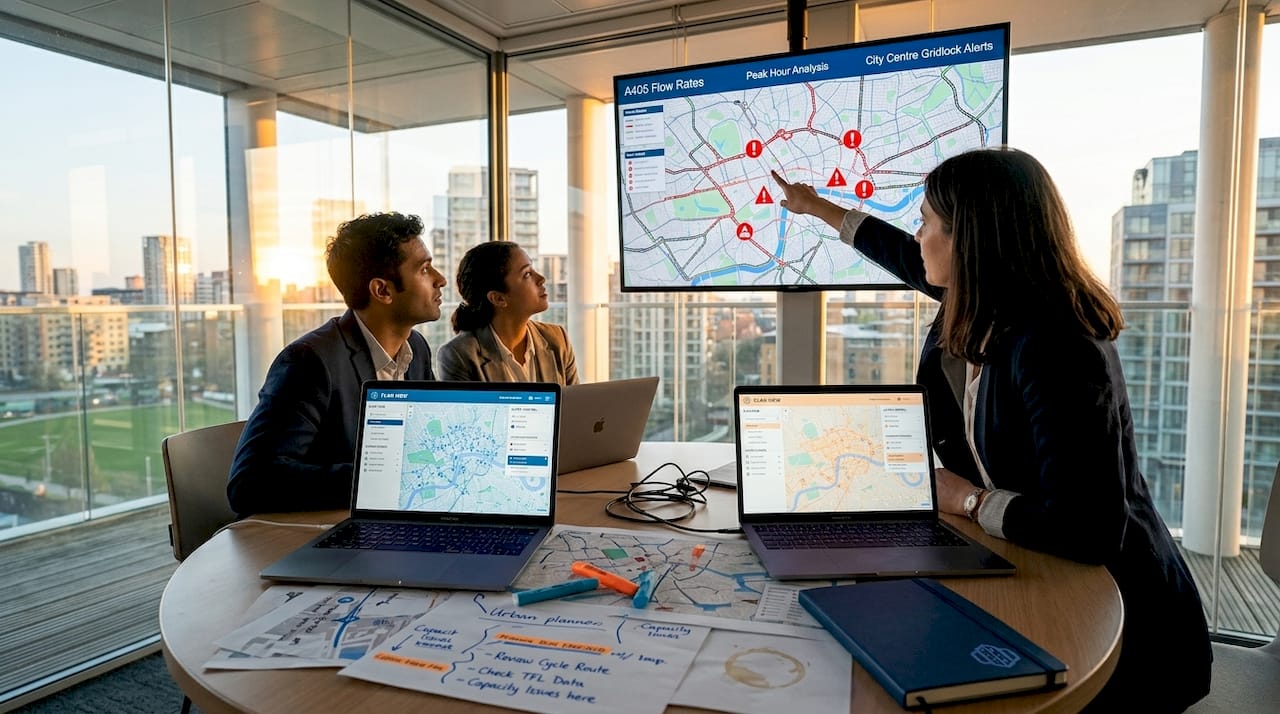
Research into city-scale deployments shows that multi-component interfaces between sensing layers, data platforms, analytics engines, and urban applications must be treated as core deliverables, not technical details to sort out later. When these interfaces are left implicit, integration failures emerge late in the project, at precisely the moment when they are most costly to fix.
A well-structured digital twin architecture for smart city planning should cover four layers:
- Sensing: IoT devices, satellite imagery, traffic counters, and environmental sensors feeding real-time data
- Data platform: A unified repository with defined schemas and governance rules
- Analytics: Models for scenario analysis, demand forecasting, and performance benchmarking
- Applications: Planning tools, public-facing dashboards, and emergency response systems
“Digital twins succeed by operationalising continuous feedback loops between sensing data and urban governance decisions, not only by immersive 3D visualisation.” (Digital-twin–driven urban lifecycle paradigm)
Develop scenario templates early. These translate your analytics capability into repeatable, decision-ready formats that planners can use without needing data science expertise every time.
3. Use open standards to avoid vendor lock-in
Interoperability is not a procurement checkbox. It is a long-term strategic asset. Cities that standardise on open data formats and open APIs retain the ability to switch vendors, integrate new tools, and share datasets with neighbouring authorities without costly renegotiation.
When evaluating smart infrastructure solutions, insist on documented API specifications, support for widely used geospatial formats such as CityGML or IFC, and clear data portability clauses. Companion standards ISO 37122 and ISO 37123 extend the ISO 37120 framework into smart city efficiency and resilience measurement respectively, giving you a benchmarking backbone that works regardless of which technology platform you adopt.
Cities adopting these standards can accelerate system integrations by up to 50%, not because the standards do the technical work, but because they eliminate the negotiation and translation overhead that plagues bespoke integrations.
4. Apply model design codes for consistent placemaking
Physical urban design is not separate from smart city strategy. The quality of streets, buildings, and public spaces determines whether digital infrastructure serves people or simply monitors them. Model design codes provide nationally consistent, template-based guidance that local planning authorities can adapt and apply efficiently to support repeatable quality outcomes.
Follow this sequence when adopting design codes for your jurisdiction:
- Review existing national guidance to understand the baseline standards for livability, green space, and connectivity your local code should reflect.
- Audit your local context for site-specific factors: heritage assets, topography, flood risk, and community character.
- Adapt the template to embed local priorities while preserving the core principles that drive consistent design quality.
- Engage communities early, presenting design code proposals before they are finalised, not after.
- Build in flexibility provisions for complex or exceptional sites that the standard template cannot adequately address.
The practical advantage of this approach is significant. Template design codes free planners to focus on exceptions and innovations while maintaining baseline quality standards across every ordinary development decision. Think of it as quality control at scale.
Pro Tip: When engaging communities on design codes, use 3D visualisations of proposed street typologies and building envelopes. Residents respond to what they can see far more readily than to written policy language.
5. Integrate resilience through the RCP framework
Climate risk cannot be bolted on at the end of a planning cycle. It must shape zoning decisions, infrastructure investment, and land-use policy from the outset. The Restrict, Condition, Promote (RCP) framework, developed through World Bank urban resilience research, provides a structured method for turning hazard analytics into enforceable planning rules.
| RCP tier | Application | Planning mechanism |
|---|---|---|
| Restrict | High-hazard zones: floodplains, seismic fault lines | Development prohibition or strict height and density limits |
| Condition | Moderate-risk zones where mitigation is feasible | Drainage requirements, structural standards, green buffer mandates |
| Promote | Lower-risk zones suitable for growth absorption | Incentives, fast-track approvals, nature-based infrastructure investment |
The framework works because it converts risk data, which planners often have in abundance, into three clear policy levers. Cities using RCP logic can direct growth away from vulnerable areas without simply blocking development, by making lower-risk zones more attractive through targeted incentives. Companion standard ISO 37123 provides the performance indicators to measure how well your resilience planning is working over time.
6. Phase your implementation to avoid regression
One of the most persistent failures in smart city projects is attempting to deploy too much at once. Research into lean smart city implementation confirms that a three-phase delivery model consistently outperforms parallel workstream approaches:
- Phase 1 (Months 1–6): Single-domain pilot with complete instrumentation. Choose one domain, such as traffic management or energy monitoring, and deploy it fully before touching anything adjacent.
- Phase 2 (Months 7–18): Integration with adjacent domains, using the patterns and interfaces proven in Phase 1.
- Phase 3 (Months 18–36): Scale with proven patterns only. Resist the temptation to introduce novel solutions at this stage.
Throughout all phases, enforce a small set of invariant gating metrics, typically three to five key performance indicators that must not degrade as new systems are added. These act as a safety net, catching silent failures before they compound. Avoiding parallel workstreams and embracing lean, sequential deployments with clear KPI constraints meaningfully reduces project failure rates across smart city programmes.
7. Keep communities at the centre of design decisions
Community engagement in city design is frequently treated as a compliance exercise. It is far more valuable than that. When residents and local businesses are involved in shaping planning decisions from the beginning, the resulting plans are better calibrated to real needs, face less opposition, and achieve higher adoption of the services they support.
Practical engagement approaches for urban planners include hosting co-design workshops using 3D urban models that residents can interact with, publishing accessible summaries of data and risk assessments rather than technical reports alone, and establishing ongoing feedback mechanisms, not just one-off consultations. Digital platforms now make it possible to gather structured input at scale, allowing planners to identify patterns in community priorities that would be invisible in traditional consultation formats.
Pro Tip: Present scenario trade-offs to communities rather than finished proposals. Showing residents two or three realistic futures and asking them to choose generates far richer, more actionable feedback than asking them to react to a single plan.
8. Evaluate smart city options with a balanced comparison
Not every smart city technology deserves the same level of investment or urgency. Use this framework to compare your options before committing resources:
| Approach | Key benefit | Main challenge | Cost profile | Scalability |
|---|---|---|---|---|
| Digital twins | Continuous feedback, scenario analysis | High data integration complexity | High upfront, lower marginal cost | High |
| IoT sensor networks | Real-time monitoring across domains | Maintenance overhead, data volume | Moderate upfront, ongoing | High |
| Model design codes | Repeatable quality, faster approvals | Requires community buy-in | Low | Very high |
| GIS and risk analytics | Spatial decision support | Skills dependency | Moderate | High |
| AI-assisted planning | Rapid scenario generation | Requires human verification | Variable | Moderate |
The most effective urban planning strategies do not chase a single transformative technology. They build a portfolio in which each tool reinforces the others. A digital twin without quality sensor data is just a 3D model. Design codes without GIS-backed hazard data miss critical site context. Integration is the multiplier.
Pro Tip: When evaluating AI-assisted planning outputs, always verify against local evidence. AI tools can produce plausible but unverified plans that look authoritative. Human judgement, grounded in local knowledge, remains the essential check.
My perspective on what actually makes smart city planning work
I’ve spent considerable time examining smart city programmes that looked excellent in their business cases and struggled badly in practice. The pattern I keep seeing is not a technology failure. It’s a governance failure dressed up as one.
The projects that work are the ones where someone in authority is willing to say “not yet” to a promising idea because the foundational layer isn’t ready. Starting small with a well-instrumented pilot and enforcing invariant constraints is unglamorous. It doesn’t make headlines. But it is the difference between a smart city programme that compounds its gains over time and one that produces a series of expensive isolated demonstrations.
My other consistent observation is that AI tools in urban planning are genuinely useful and genuinely risky for exactly the same reason: they make complex outputs look authoritative very quickly. Planners who treat AI outputs as starting points for human review get real value. Those who treat them as answers create accountability gaps that surface at the worst possible moment, usually during a public inquiry or a climate event.
Resilience must be structural, not aspirational. Every plan I’ve seen that treats climate risk as a chapter to be added later has had to be substantially rewritten. Start with risk data, build your zoning logic from it, and use standards like ISO 37123 to measure whether your resilience investments are actually working.
— Anne
How 3dcityplanner supports your smart city planning practice
Translating these principles into daily planning work requires tools built for the complexity of modern urban environments. 3dcityplanner is a digital platform designed specifically for urban planning professionals, offering advanced 3D modelling, automatic building generation, line-of-sight analysis, and sound simulation within a single working environment.
For digital twin workflows, 3dcityplanner supports closed-loop urban planning with 4D timeline features that allow project phases to be visualised and adjusted in real time. The platform imports a wide range of 3D model formats and draws on a global database of building and infrastructure data, making it practical for both new developments and urban redevelopment projects. You can explore practical applications in the guide on urban redevelopment with digital twins, or start with a trial period at no upfront cost to see how the platform fits your team’s workflow.
FAQ
What are the most important smart city planning tips for 2026?
Prioritise phased implementation starting with a single-domain pilot, adopt open data standards for interoperability, integrate climate risk data from the outset using frameworks like RCP, and maintain human oversight of all AI-generated planning outputs.
How do digital twins improve urban planning decisions?
Digital twins create continuous feedback between physical infrastructure and planning governance, enabling scenario analysis and real-time monitoring. Their value comes from closed-loop data integration, not visualisation alone.
What is the RCP framework in city planning?
The Restrict, Condition, Promote framework translates hazard and climate risk analytics into enforceable zoning rules, restricting development in high-risk areas, conditioning it where mitigation is feasible, and promoting growth in lower-risk zones.
Why do smart city projects fail during scaling?
Most failures during scaling arise from deploying novel solutions too early and from undefined interfaces between system components. Enforcing three to five invariant gating metrics and scaling only proven patterns significantly reduces this risk.
How does ISO 37120 support sustainable city development?
ISO 37120 provides standardised indicators across 19 themes of city services and quality of life. Companion standards ISO 37122 and ISO 37123 extend this into smart efficiency and resilience measurement, giving cities a consistent performance benchmarking framework.


