Why optimise city projects: Boost efficiency and sustainability

Procurement timelines missed by months, transport corridors built over budget, and digital dashboards that gather dust because no one changed how decisions are made. These are not edge cases — they are the predictable outcome when cities treat technology as a substitute for strategy. Municipal leaders across Europe and beyond are under increasing pressure to deliver projects that are cost-effective, carbon-responsible, and demonstrably accountable to the public. Yet the path to genuinely better outcomes is not paved with software alone. True optimisation requires a far more disciplined and integrated approach.
Key Takeaways
| Point | Details |
|---|---|
| Measurable project gains | Optimisation delivers quantifiable improvements in cost, efficiency, and environmental impact. |
| KPIs drive accountability | Embedding performance measurement makes optimisation outputs actionable for councils and the public. |
| Technology is not enough | Long-term city project success relies on robust governance and inclusion alongside smart tools. |
| Practical frameworks matter | Step-wise optimisation—goal-setting, modelling, measuring, adapting—maximises results and sustainability. |
What does it mean to optimise city projects?
Having set the scene on why digital upgrades alone are insufficient, let us clarify what true optimisation in city projects really looks like — and what it is not.
At its core, optimisation is the disciplined process of finding the best possible outcome within a defined set of constraints. In a municipal context, those constraints typically involve budget limits, environmental targets, timelines, and community needs. Simply digitising an existing workflow or installing sensors across a transport network is not optimisation. It is modernisation, and the two are fundamentally different.
Understanding why optimise city design matters begins with recognising that optimisation is scenario-driven. It asks: given our resources and goals, which combination of actions delivers the greatest impact at the lowest cost? That question alone requires modelling, data, and rigorous trade-off analysis.
The COMET framework is a useful reference point. Optimisation for city systems is explicitly aimed at least-cost pathways under environmental constraints, helping decision-makers explore trade-offs and plan for long time horizons. This is very different from selecting a technology vendor and hoping for the best.
“Optimisation is not a product you buy. It is a capability you build — through data, process, and governance working in concert.”
Professionals who optimise city planning with 3D tools find that the analytical rigour forces clarity on project goals that was previously missing. When you must define constraints and objective functions, vague aspirations become precise targets.
Key characteristics that distinguish genuine optimisation from simple digitisation include:
- Scenario modelling: Testing multiple configurations before committing resources
- Constraint-based analysis: Explicitly accounting for budget, emissions, space, and time
- Trade-off visibility: Surfacing conflicts between competing objectives (e.g., cost vs. carbon)
- Iterative refinement: Updating plans as conditions, data, and priorities evolve
- Stakeholder alignment: Ensuring outputs translate into decisions that departments can act on
This approach makes city planning more strategic and, crucially, more durable. When project teams can show why a particular route, layout, or service model was chosen over alternatives, the decision is far easier to defend publicly and practically.
The benefits: Cost, efficiency, and sustainability gains
With a solid grasp of what optimisation means, it is crucial to see how these principles play out in measurable benefits for real city projects.

The financial and environmental case for optimisation is strong, and it is backed by empirical evidence rather than vendor promises. Consider waste management, one of the most operationally intensive municipal functions. A detailed study on solid waste collection in Bangkok found that route optimisation reduced weekly travel distance by 8.51% and projected five-year economic benefits exceeding 4.7 million Baht. That is a tangible, auditable result from a methodical approach.
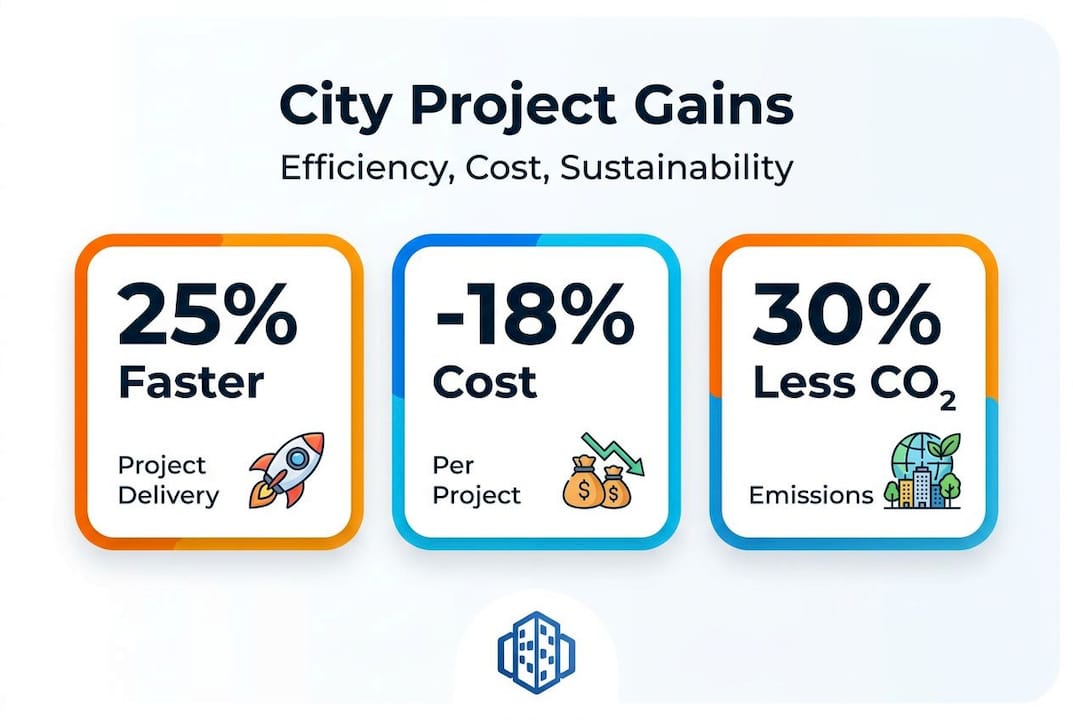
The table below illustrates how optimised approaches compare to conventional planning across three common municipal service areas:
| Service area | Conventional approach | Optimised approach | Typical improvement |
|---|---|---|---|
| Waste collection | Fixed routes, manual scheduling | Algorithm-driven route planning | 8 to 15% cost reduction |
| Urban energy systems | Incremental upgrades | Least-cost pathway modelling | 10 to 20% emissions reduction |
| Transport networks | Demand-reactive adjustments | Scenario-based capacity planning | 12 to 18% efficiency gain |
Pro Tip: Before investing in optimisation tools, establish your current baseline metrics. Without a clear “before” picture, you cannot credibly measure the “after” — and measurable outcomes are precisely what justify continued investment to elected members and senior officers.
Those who study urban optimisation with 3D technology consistently find that gains are not evenly distributed. The greatest returns tend to emerge in areas where planning decisions are currently made with incomplete information or where operational silos prevent cross-department coordination. Waste logistics, energy zoning, and transport interchange design are prime candidates.
There is also a sustainability dividend that goes beyond cost. When you optimise city layouts for pedestrian access, green space integration, and building orientation, the result is a city fabric that generates lower lifecycle emissions. The short-term cost of running the analysis is more than offset by the long-term reduction in operational carbon. That is a compelling argument in any net-zero discussion with treasury.
Embedding performance measurement for smarter decision-making
While cost and sustainability benefits are key, the real power of optimisation emerges when cities make these results visible and actionable through strong measurement and governance routines.
Producing an optimised design or plan is only half the work. The other half is ensuring that the outputs feed back into institutional decision-making. Without that connection, optimisation remains a technical exercise rather than a governance improvement.
The evidence on this point is clear. The ICMA notes that KPI frameworks embedded in management routines can significantly improve budget development, council reporting, and public engagement. Performance data becomes a shared language between technical officers and elected members, enabling more informed and defensible decisions.
The table below shows a practical example of how KPIs can be structured across project phases:
| Project phase | Key performance indicator | Target | Reporting frequency |
|---|---|---|---|
| Planning | Scenario options modelled | Minimum 3 | Pre-approval |
| Delivery | Spend versus budget | Within 5% | Monthly |
| Operations | Carbon emissions per service unit | Year-on-year reduction | Quarterly |
| Outcomes | Public satisfaction score | Above 75% | Annually |
A structured approach to embedding measurement works best when it follows a clear sequence. Use the following steps as a practical guide:
- Define strategic objectives before selecting KPIs. Measurement must serve goals, not generate data for its own sake.
- Select a small number of high-impact indicators. Departments cannot meaningfully track 40 KPIs. Focus on five to eight that directly connect operational activity to strategic outcomes.
- Automate data collection wherever possible. Manual reporting is slow, inconsistent, and resource-intensive.
- Connect KPI outputs to decision cycles. Quarterly performance reviews should directly inform budget adjustments and project continuation decisions.
- Report publicly. Transparent performance reporting builds civic trust and creates a positive accountability loop.
An essential resource for this work is a robust infrastructure planning guide, which can help teams identify which infrastructure variables are most sensitive to measurement and where data gaps are likely to undermine analysis.
Governance and technology: Why optimisation is not just about smart tools
However, smart measurement alone cannot safeguard success — governance and inclusivity are equally critical to real-world project outcomes.
There is a persistent and damaging myth in urban development circles that better technology automatically produces better cities. The evidence says otherwise. Research published in The Conversation warns that tech-centred smart city projects frequently fail when governance, legitimacy, inclusion, and long-term delivery capacity are weak. The technology itself is rarely the limiting factor. The limiting factors are institutional.
“A city is not a machine to be optimised. It is a community to be governed. The tools must serve the community, not define it.”
This distinction matters enormously for how you structure project teams and procurement. When digital optimisation tools are positioned as solutions in themselves, rather than decision-support instruments within a broader governance framework, two things tend to happen. First, the technology is adopted without adequate training or change management, so its outputs are ignored or misunderstood. Second, community voices are excluded from the process, which erodes legitimacy and leads to costly rework or outright rejection of plans.
Genuine optimisation, then, must be broad. It covers:
- Strategic management: Ensuring project objectives are aligned with long-term city plans
- Policy integration: Connecting infrastructure decisions to housing, transport, and climate policy
- Community engagement: Including residents in scenario testing, not just consultation after decisions are made
- Accountability mechanisms: Clear lines of responsibility for delivering on optimised outcomes
- Adaptive management: Building in review points where plans can be adjusted as reality diverges from projections
Reviewing the most effective development strategies for city optimisation reveals a consistent pattern: the cities that succeed treat governance and technology as equally important. Neither can substitute for the other.
Pro Tip: When launching an optimisation initiative, appoint a governance lead alongside a technical lead from the outset. The technical team will produce the analysis; the governance lead ensures it actually changes how decisions are made. Without both roles, the project is incomplete.
Understanding this balance is what separates cities that use urban project optimisation with advanced tools effectively from those that invest in technology but see little tangible improvement in outcomes.
Making optimisation work: Practical steps for city officials
Understanding the complex interplay of strategy, measurement, and governance, city leaders need practical steps to make optimisation work in their own projects.
Moving from principle to practice requires discipline and sequencing. The following framework is designed for city officials who are beginning or scaling an optimisation effort:
- Diagnose current project performance. Identify where costs consistently overrun, where sustainability targets are missed, and where community satisfaction is lowest. These are your optimisation priorities.
- Set precise, measurable goals. Vague objectives like “improve efficiency” are not actionable. Define specific targets: reduce waste collection costs by 10% within 18 months, or cut transport-related carbon by 15% by 2028.
- Build or procure scenario modelling capability. The ability to leverage 3D modelling for spatial and operational scenarios is foundational. Without it, trade-off analysis is guesswork.
- Run multi-scenario analysis before committing. Test at least three distinct configurations for every major decision. Identify the option that best balances cost, carbon, and community impact.
- Align outputs with your KPI framework. Ensure that scenario recommendations are expressed in the same metrics your performance reporting uses. This makes it far easier for senior officers and councillors to act on findings.
- Engage stakeholders in the process, not just the outcome. Presenting a finished optimised plan for approval is not engagement. Inviting communities and departments to stress-test scenarios builds ownership and surfaces practical constraints that models miss.
- Review and adapt continuously. Master urban space modelling best practice emphasises that no initial model is perfect. Build in structured review points every six to twelve months to update assumptions and recalibrate targets.
Even when optimisation reduces energy or operational costs, cities must guard against broader system constraints and unintended consequences. The COMET scenario modelling tools are explicitly designed to surface these cross-domain interactions, ensuring that solutions in one system do not create problems in another.
Pro Tip: Start with one high-visibility project rather than attempting city-wide optimisation from day one. A successful, well-documented pilot builds institutional confidence and creates a replicable model that other departments can adopt.
Why true optimisation demands more than smart tools
There is a version of the optimisation conversation that focuses almost entirely on platforms, algorithms, and data pipelines. It is seductive, because the technology is genuinely impressive. But in our experience working across urban development contexts, the projects that deliver lasting results share one trait that has nothing to do with software: they treat optimisation as an ongoing institutional discipline, not a project phase.
The mindset shift required is significant. Most city project teams are trained to work in phases: plan, design, build, hand over. Optimisation disrupts that linearity. It demands that you revisit assumptions when new data arrives, that you challenge a committed design when scenario analysis reveals a better option, and that you accept the discomfort of uncertainty as a feature rather than a flaw.
The optimise city development strategies that generate the most durable outcomes are those woven into how councils and project boards operate on a routine basis. Not as a special initiative, but as a standing expectation. When performance data informs every budget conversation, when scenario analysis is a required input for every major planning decision, and when community feedback shapes model assumptions rather than just validating outputs, optimisation becomes genuinely transformative.
The tools are the foundation. The discipline is the building.
How to unlock optimisation with advanced city planning tools
Taking a step from strategy to technical application, dedicated 3D simulation resources can accelerate and de-risk your city planning efforts considerably.
The principles outlined in this article are most powerfully realised when supported by purpose-built simulation environments. Advanced platforms allow your team to run multi-scenario spatial analyses, visualise trade-offs in real time, and integrate performance data directly into planning workflows. This is not about replacing professional judgement — it is about giving that judgement a richer, more reliable foundation.
At 3D City Planner, advanced urban planning simulations put scenario modelling, sightline analysis, noise simulation, and 4D project timelines into a single integrated environment. Whether you are stress-testing a new transport corridor, evaluating building heights against sustainability targets, or presenting phase-by-phase project development to stakeholders, the platform is designed to turn complex data into clear, actionable insight. Trial access is available without upfront payment, making it straightforward to validate the approach against your own project challenges before committing.
Frequently asked questions
How does city project optimisation differ from traditional planning?
City project optimisation uses scenario analysis and data-driven modelling to select optimal solutions under defined constraints, while traditional planning tends to rely more heavily on past precedent and professional intuition with less quantified trade-off analysis. The least-cost pathway approach central to modern optimisation makes the decision logic explicit and auditable.
Can optimisation tools improve public trust in city projects?
Yes, embedding optimisation outputs into public-facing KPI and performance frameworks can materially increase transparency and accountability. The ICMA argues that KPI frameworks embedded in management routines should be used directly for budget development, council reports, and public engagement, creating a visible link between technical analysis and democratic decision-making.
What is the main pitfall cities encounter when focusing only on technology?
Relying solely on technology risks neglecting governance, legitimacy, and inclusion — factors that are essential for long-term project success. Evidence confirms that tech-centred smart city projects frequently fail not because the tools are inadequate but because the institutional and community foundations are insufficiently developed.
Can you quantify the benefits of optimisation in urban operations?
Case studies demonstrate clear operational cost and emission reductions with measurable outcomes. A Bangkok study found that route optimisation reduced weekly vehicle travel distance by 8.51% and projected five-year economic benefits exceeding 4.7 million Baht, demonstrating that well-designed optimisation initiatives produce auditable, replicable results across municipal services.
Recommended
- Why optimise city planning: 3D tools for better design – 3D Urban Development
- Urban optimisation: How 3D technology transforms city planning – 3D Urban Development
- Why optimising urban spaces drives smarter cities – 3D Urban Development
- Urban project optimisation with advanced 3D tools in 2026 – 3D Urban Development


