Collaborative urban design: Methods for innovation
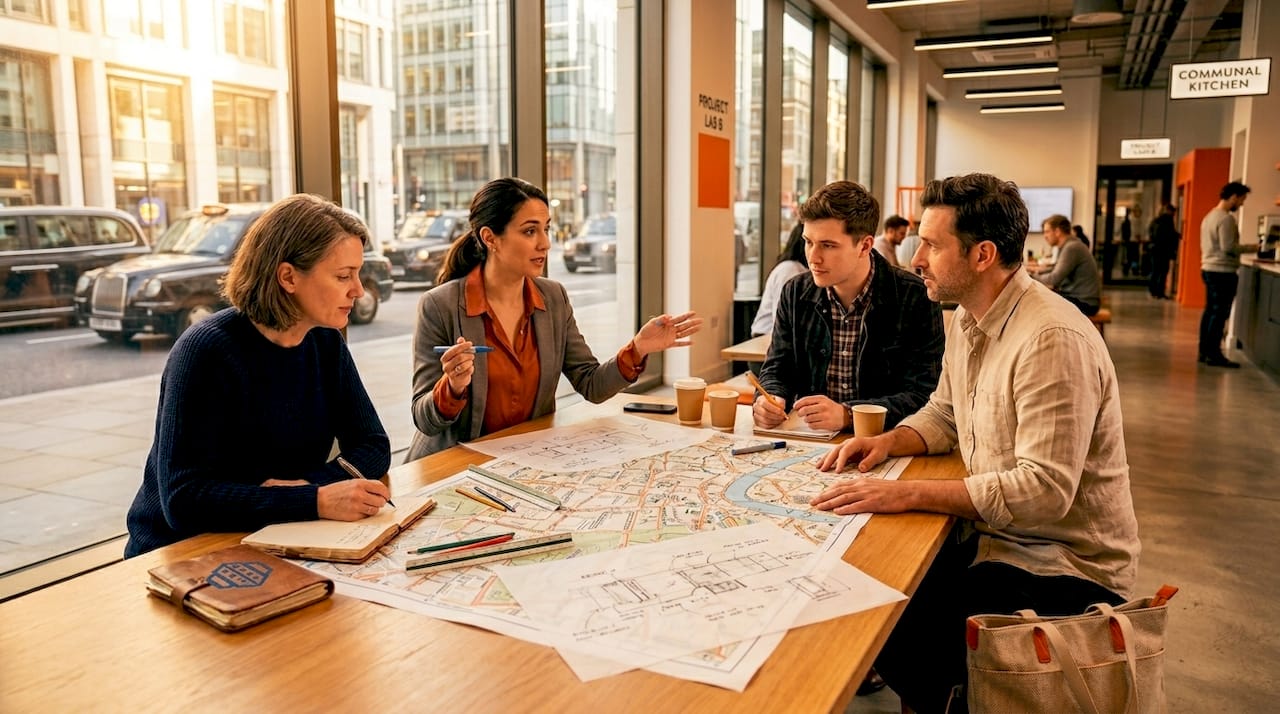
Urban design has long been treated as a specialist discipline, with outcomes handed down from architects and planners rather than shaped by the people who actually inhabit cities. That assumption is rapidly losing ground. Collaborative urban design brings together a diverse mix of stakeholders, including residents, developers, policymakers, and technical experts, to co-create environments that genuinely reflect collective needs. The result is not just more inclusive outcomes; it drives stronger innovation, greater sustainability, and far better long-term adoption of new urban spaces.
Key Takeaways
| Point | Details |
|---|---|
| Participatory process | Collaborative urban design actively involves diverse stakeholders for inclusive outcomes. |
| Digital and hybrid tools | Advanced platforms like AR and 3D modelling drive better community engagement. |
| Facilitation and spatial justice | Neutral facilitators and attention to spatial justice help prevent power imbalances and inequality. |
| Community-driven success metrics | Best results are measured by criteria defined by local participants, not just by professionals. |
| Iterative and empathetic innovation | Hybrid, role-based approaches and ongoing refinement encourage sustainable urban development. |
Defining collaborative urban design: Stakeholders and principles
Having outlined the paradigm shift away from siloed urban planning, let’s dig into what truly defines collaborative urban design and its key players.
Collaborative urban design is a participatory process involving stakeholders such as community members, architects, urban planners, and governments to co-create urban environments that reflect diverse needs, emphasising inclusivity, sustainability, and adaptability. This definition is important because it repositions the professional as a facilitator, not the sole author of the built environment.
The main stakeholders typically involved include:
- Community members and residents, who bring lived experience, cultural context, and local knowledge that no technical survey can fully replicate
- Architects and urban designers, who translate ideas into viable spatial proposals
- Urban planners and local authorities, who understand regulatory frameworks, infrastructure constraints, and long-term development strategies
- Private developers and investors, who determine financial feasibility and delivery timelines
- Civil society organisations, including advocacy groups, charities, and neighbourhood associations that represent marginalised voices
- Academic and research institutions, which provide evidence-based insight and evaluation capacity
The core principles that hold these groups together are inclusivity, sustainability, and adaptability. Inclusivity means actively designing processes to lower barriers for participation, including language, timing, location, and format. Sustainability keeps ecological and social resilience at the centre of decision-making. Adaptability means designing processes and proposals that can evolve as community needs and environmental conditions change.
“The most powerful collaborative processes are those where communities are not merely consulted but become genuine co-authors of their built environment. The planner’s role shifts from expert authority to skilled facilitator.”
A deeper understanding of AI and collaboration in urban design can help teams structure more effective engagement from the outset. For practical frameworks on managing diverse stakeholder groups, the stakeholder engagement guide offers structured approaches that work in real project contexts.
Methodologies and tools enabling collaborative urban design
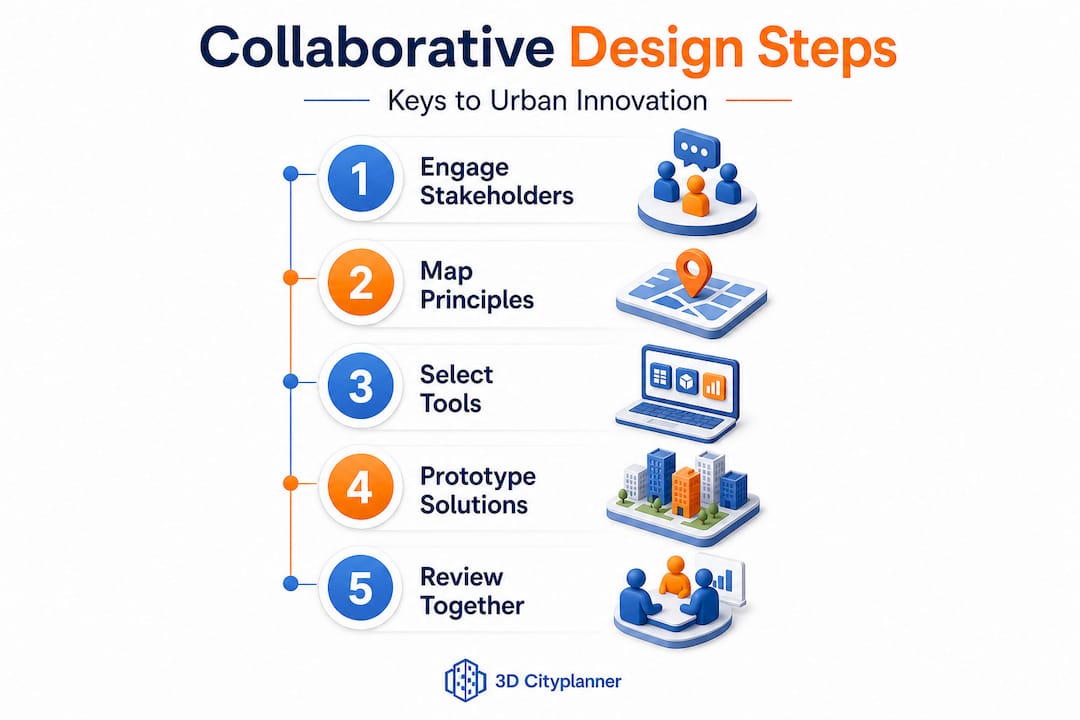
With the stakeholders and principles mapped out, it’s time to examine the proven methodologies and advanced tools that empower collaborative urban design in practice.
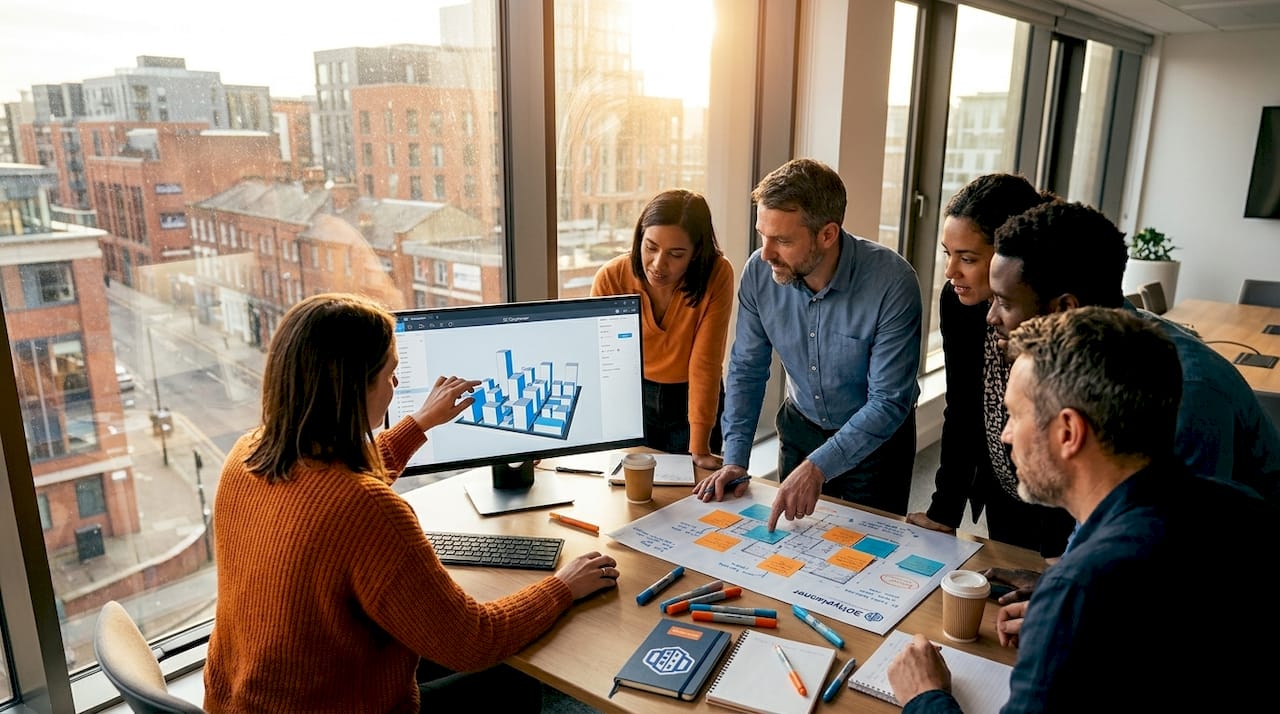
Core methodologies include three-step processes like Sustrans’ Co-Discover, Co-Design, and Co-Refine, as well as design charrettes, participatory workshops, stakeholder sessions, and digital tools like AR and 3D modelling. Each methodology is suited to different project scales, community contexts, and desired outcomes.
A structured approach to selecting your methodology might follow these sequential phases:
- Discovery phase: Use community surveys, neighbourhood walks, and focus groups to identify needs, aspirations, and barriers. This phase builds trust and sets the tone for genuine co-creation rather than tokenistic consultation.
- Co-design phase: Run intensive workshops or design charrettes where stakeholders actively sketch, model, and debate spatial proposals. AR visualisation and 3D platforms allow non-technical participants to respond meaningfully to design options.
- Refinement phase: Present emerging proposals back to the community, gather structured feedback, and iterate. This is where digital tools for asynchronous participation, such as online platforms and interactive maps, ensure broad reach beyond those who can attend in person.
- Evaluation phase: Test outcomes against community-defined success metrics and assess whether the design responds to the original brief.
The following table compares the most widely used collaborative methodologies across key dimensions:
| Methodology | Group size | Time required | Technology integration | Best suited for |
|---|---|---|---|---|
| Design charrette | 20 to 100 | 1 to 5 days | Moderate (visualisation tools) | Complex mixed-use sites |
| Co-design workshop | 10 to 30 | Half-day to 2 days | Low to high | Neighbourhood-scale projects |
| Sustrans Co-Discover/Co-Design/Co-Refine | 15 to 50 | Multiple sessions | High (phygital tools) | Active travel and public realm |
| Online participatory platform | Hundreds to thousands | Asynchronous | Very high | City-wide consultations |
| AR-assisted engagement | 10 to 40 | 2 to 4 hours | Very high | Site-specific design decisions |
Pro Tip: Integrate hybrid digital-physical tools, sometimes called phygital tools, at every phase. A physical model on a table sparks conversation, but pairing it with a real-time 3D digital counterpart means changes are captured instantly and shared beyond the room. This approach dramatically widens participation without sacrificing depth.
Platforms that support urban participation tools make this hybrid approach operationally feasible. For design teams already using BIM or GIS workflows, integrating dedicated 3D modelling in urban design adds a visual language that bridges technical and non-technical participants. The right collaboration software tools can serve as a single source of truth across the entire project team.
Navigating challenges: Power dynamics, spatial justice, and technology
Even with advanced tools and inclusive goals, collaboration faces difficulties, so next, we’ll unpack how leading practitioners manage these hurdles.
Power dynamics and mistrust require neutral facilitators, and there is also the risk of green gentrification without a spatial justice focus, as well as the need for hybrid phygital tools to support asynchronous and synchronous collaboration across different group sizes. These challenges are more common than most project briefs acknowledge.
The following data illustrates the most frequently cited barriers in collaborative urban design projects:
| Challenge | Frequency cited | Primary mitigation strategy |
|---|---|---|
| Power imbalances between stakeholders | Very high | Neutral facilitation, structured dialogue |
| Low participation from marginalised groups | High | Community outreach, flexible formats |
| Technology literacy gaps | High | Hybrid phygital tools, hands-on training |
| Risk of green gentrification | Moderate | Spatial justice framework, affordability safeguards |
| Mistrust of developers or authorities | Very high | Transparent process, independent facilitation |
| Asynchronous vs synchronous misalignment | Moderate | Layered engagement platforms |
Breaking these down further reveals important nuances:
- Power imbalances are perhaps the most persistent challenge. When developers hold financial power and residents have lived experience but no formal authority, the design process can easily become performative. Neutral facilitators, whether human or AI-assisted, serve as a credible third voice that keeps the process honest.
- Technology literacy is frequently underestimated. Deploying AR or real-time 3D platforms assumes participants can navigate them intuitively. Without hands-on onboarding, these tools can exclude rather than include.
- Synchronous versus asynchronous engagement matters greatly depending on group size. For small groups of under 20 people, live workshops generate the richest dialogue. For city-wide consultations involving hundreds of participants, asynchronous platforms allow more people to engage on their own terms.
- Spatial justice is a concept that deserves particular attention. When urban greening or regeneration projects raise property values, long-standing residents can face displacement. Collaborative design that ignores this risk can inadvertently cause the very harm it set out to prevent. Every project should include an explicit spatial justice assessment.
Pro Tip: When AI tools are used to facilitate discussion or summarise community input, frame them explicitly as a neutral voice rather than a decision-maker. Participants respond more openly when they understand that the technology is there to support the conversation, not to predetermine its outcomes.
An efficient 3D planning workflow can help teams manage the complexity of multi-stakeholder projects without losing momentum, particularly during the refinement and evaluation phases where iteration is most intense.
Achieving innovation: Empathy, hybrid engagement, and community-defined success
With challenges addressed, let’s focus on the strategies driving real innovation and concrete improvements in collaborative urban design.
To prioritise vulnerable groups through role-play for empathy, integrate hybrid tools, use iterative phases, and measure success via community-defined metrics are the key strategies that separate genuinely innovative collaborative design from processes that merely look participatory on paper.
Empathy-driven role-play is one of the most effective yet underutilised techniques in the profession. By asking planners, developers, and even elected officials to physically navigate a site from the perspective of a wheelchair user, a child, or an elderly resident with mobility challenges, teams gain visceral insight that data alone cannot provide. This is not a soft exercise. It has been shown to measurably shift design priorities, leading to better accessibility outcomes, more human-scale public spaces, and improved safety features.
Key strategies for achieving genuine innovation include:
- Hybrid engagement channels: Combining in-person workshops with online platforms ensures that shift workers, parents with young children, and people with limited mobility can all contribute meaningfully. This is not just about fairness; it produces a richer, more representative dataset of community needs.
- Iterative design loops: Rather than presenting a final scheme for approval, leading teams share rough concepts early, gather feedback, revise, and repeat. Each cycle builds community investment in the outcome and reduces the risk of late-stage rejection.
- Community-defined success metrics: Standard KPIs such as units delivered or cost per square metre tell only part of the story. Communities often define success through metrics like social cohesion, perceived safety, access to green space, and cultural continuity. Embedding these into the project brief from the start makes them measurable.
- Transparent documentation: Sharing meeting notes, design iterations, and decision rationales publicly builds trust and signals that community input is genuinely influencing outcomes.
Statistic to note: Research published in Land (2025) indicates that projects employing iterative, community-led design phases reported significantly higher resident satisfaction and stronger long-term stewardship of public spaces compared to traditionally planned developments.
For teams seeking visual inspiration and technical benchmarks, reviewing architecture model examples from completed urban design projects shows how 3D visualisation tools translate collaborative intent into communicable design outcomes.
What most urban teams miss: Lessons from truly participatory design
Most urban design teams believe they are doing collaborative design when, in reality, they are running consultation theatre. The distinction matters enormously, both for project quality and for the communities affected.
Genuine participation means that community input demonstrably changes the design. It means residents can point to a specific element and say, “We asked for that, and it was included.” Tokenistic engagement, by contrast, involves hosting workshops, collecting feedback, and then proceeding with the original proposal regardless. Communities recognise this pattern quickly, and once trust is broken, it is extraordinarily difficult to rebuild.
The most effective teams we observe share three habits. First, they start with listening rather than presenting. Before any design option is placed on a table, they invest time in understanding what the community values, fears, and hopes for. This shifts the entire framing of the conversation. Second, they use AI or neutral human facilitators to mediate discussions, which prevents dominant voices from drowning out quieter ones. The role of 3D technology in urbanism also plays a part here: when proposals are rendered in clear, accessible 3D visualisations rather than abstract technical drawings, more participants can engage meaningfully and on equal footing. Third, they commit to transparent feedback loops, explicitly reporting back to participants on how their input was used and, critically, why certain suggestions were not incorporated. This honesty is rare, and it is precisely what builds lasting trust.
Community authorship fosters ownership. When people genuinely co-create a space, they maintain it, defend it, and use it. That social investment is worth more than any conventional maintenance budget.
Next steps: Explore collaborative tools for urban design innovation
Translating these insights into practice requires the right platform. 3D City Planner offers urban developers, architects, and planners a powerful suite of tools designed specifically for collaborative, multi-stakeholder projects.
From real-time 3D modelling and visualisation to 4D planning with automatic timelines, the platform enables teams to present design options clearly, gather structured feedback, and iterate rapidly. Features such as line-of-sight analysis, sound simulation, and automatic building generation give every stakeholder a shared, evidence-based environment to work from. Whether you are managing a neighbourhood regeneration project or a city-scale masterplan, 3D City Planner provides the technical foundation to support genuinely collaborative urban design, with a free trial available and no upfront payment required.
Frequently asked questions
Who are the main participants in collaborative urban design?
Community members, architects, urban planners, and governments all play critical roles in the co-creation process, each contributing distinct knowledge and authority to produce outcomes that reflect diverse needs.
What technologies are used to enhance collaboration?
Digital tools like AR and 3D modelling are common for participatory planning, alongside hybrid phygital platforms that blend physical engagement with real-time digital visualisation to widen participation.
How do teams address power imbalances in urban design projects?
Neutral facilitators and AI mediation help manage power dynamics by creating structured, equitable dialogue where no single stakeholder group can dominate the outcome.
What is spatial justice in collaborative urban design?
Spatial justice avoids green gentrification by ensuring that urban improvements, such as parks or regeneration schemes, benefit existing residents rather than displacing them through rising costs.
How do you measure success in collaborative urban design?
Success through community-defined metrics reflects the true priorities of all stakeholders, moving beyond conventional KPIs to capture social cohesion, cultural continuity, and quality of life improvements.
Recommended
- Data-driven urban design: 34% better space efficiency – 3D Urban Development
- Examples of 3D urban design in Europe: 60% collaboration boost – 3D Urban Development
- Collaborative Urban Planning: Advancing Sustainable Cities – 3D Urban Development
- Which Urban Planning Software Provides Strong Collaboration Features?


