Annex IV Compliant Costing for Dutch Developments With Digital Twins
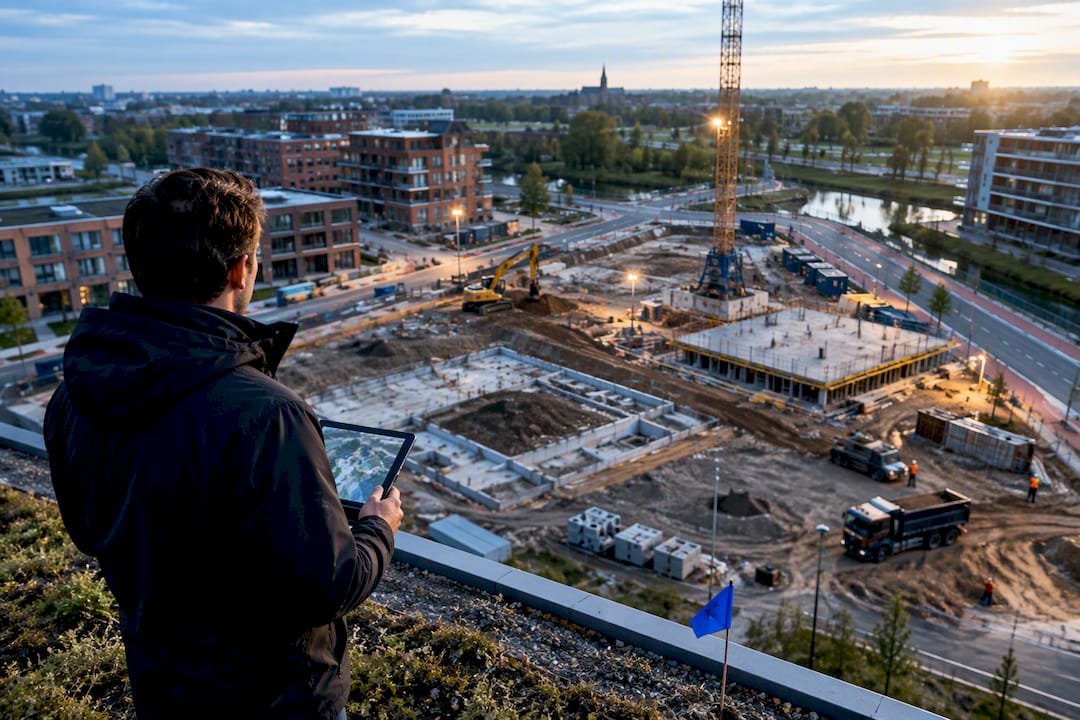
A credible kostenraming gebiedsontwikkeling is an itemised estimate that maps every recoverable cost line to Annex IV, the kostensoortenlijst, and applies the correct recovery method for the situation, whether integrale or organische development. It must build in contingency and phasing, and it must leave a documented trail that supports the eindafrekening once the development closes out. Skip any of these three obligations and the estimate, however precise the arithmetic, will not survive a legal challenge.
TL;DR:A credible kostenraming must include contingency, phasing, and a documented trail for legal enforceability, especially for end-of-project reconciliation.Costs mapped to Annex IV categories are essential; many errors occur when practitioners skip this step, risking unenforceable schemes.The correct recovery method depends on whether the development follows integral or organic modeling, with each having specific time, cost, and value testing requirements.Early estimates should be based on benchmarks and phased cash flows, with accuracy typically within ±25 to 30 percent at concept stage and improving with detailed data.Using 3D scenario modeling helps maintain volumetry and scenario consistency, reducing estimation drift and supporting defensible cost recovery claims.
3D Cityplanner3dcityplanner.comModel Development Costs With ConfidenceUse 3D Cityplanner to compare spatial scenarios, analyse development capacity, and support data-driven decisions for Dutch urban development.Explore 3D Cityplanner
Table of Contents
- What does the Omgevingswet require from a kostenraming gebiedsontwikkeling?
- Which cost categories belong in the kostensoortenlijst mapping?
- Should you use the integral or organic recovery method?
- How do you build the estimate: inputs, benchmarks and contingency?
- How do you keep the estimate defensible through eindafrekening?
- What does a compliant estimate look like in practice?
- How does 3D scenario modelling improve the underlying estimate?
- Why do planners underestimate their own contingency needs?
- Get a defensible estimate faster with 3D Cityplanner
- Sources
- FAQ
What does the Omgevingswet require from a kostenraming gebiedsontwikkeling?
The Omgevingswet makes public cost recovery, kostenverhaal, mandatory when a municipality has no anterior agreement with a developer. Recoverable costs are restricted to items named on the kostensoortenlijst, Annex IV of the Omgevingsbesluit. Anything outside that list, however reasonable it seems on a spreadsheet, cannot legally be charged back.
Two routes exist. The privaatrechtelijk route runs through a negotiated agreement, usually an anterieure overeenkomst, where cost recovery terms are contractual. The publiekrechtelijk route applies when no agreement exists, and its rules must then sit in the omgevingsplan or a projectbesluit, not in a side letter.
Kostenverhaal does not always apply. Three common exceptions matter for estimators:
- Total recoverable costs fall under the statutory threshold, currently set for the activity in question.
- The only costs involved are standard connection charges for utilities, which are covered separately.
- No new construction or use change triggers a cost obligation under Annex IV.
Get the route wrong and a municipality risks issuing a kostenverhaalsbeschikking that a court later strikes down.
Which cost categories belong in the kostensoortenlijst mapping?
Every line in a kostenraming should be traceable to a specific Annex IV category before it goes into a total. Practitioners who skip this step are the most common source of unenforceable schemes, according to guidance on the kostensoortenlijst.
- Plankosten (A1): feasibility studies, plan-making, permit processing and supervision. The Omgevingsregeling sets maximums here, and municipalities may use a forfaitaire calculation from prescribed tables rather than itemising every planning hour.
- Inbrengwaarde and land acquisition (B categories): valued using WOZ data or a formal taxatie, never an assumed market price plucked from a comparable transaction.
- Public works: roads, utilities, water management and public open space, including bovenwijkse kosten, the shared infrastructure costs allocated across multiple developments rather than one site.
- Soft costs and nadeelcompensatie: only where Annex IV explicitly names them. Developer profit, unrelated mitigation measures and general operating costs do not qualify, no matter how the business case presents them.
Municipal legislation guidance is explicit that mapping is required for enforceability, not optional good practice.
Should you use the integral or organic recovery method?
The legal route you choose changes what the kostenraming has to produce, and getting it wrong risks invalidating the entire recovery scheme, per IPLO’s guidance on publiekrechtelijk kostenverhaal.
- Integrale gebiedsontwikkeling requires a defined timevak, a fixed time period for the development. The estimate must cover full projected costs and opbrengsten (revenues) across that period, and a macro‑aftopping rule caps recovery at the point where costs exceed the value uplift the development creates.
- Organische gebiedsontwikkeling has no fixed timevak. Instead, the omgevingsplan sets a kostenplafond, a cost ceiling, and can add per‑activity maximums. This ceiling must be motivated from a realistic scenario, not an optimistic one, and adjusted if actual costs run ahead of it.
- Waardevermeerderingstoets applies at the moment of the vergunning (permit) in organic schemes, testing whether the value increases the permit creates still justifies the charge being levied.
- Practical consequence: integral schemes demand a full area revenue model, essentially a business case; organic schemes demand a defensible per‑activity ceiling built on assumed take‑up rates rather than a fixed total.
Municipalities frequently misjudge which route fits a phased, uncertain redevelopment site and default to integral modelling when an organic ceiling would be more resilient to delay. The choice should follow the development’s actual certainty of timing, not administrative habit.
How do you build the estimate: inputs, benchmarks and contingency?
Start with the inputs that drive volume: gross floor area, programme mix (housing, commercial, social), existing infrastructure capacity, WOZ valuations for land, and any confirmed grants or subsidies.
- Source unit rates from recent comparable projects in the same region, adjusting kengetallen (benchmarks) for site conditions rather than applying them unadjusted.
- Build a simple phased cashflow across construction stages, and fold in financing costs or a WACC assumption whenever the timevak stretches beyond two or three years.
- Apply contingency by stage, wider at concept level and narrower as design develops, and document the assumption behind each percentage rather than a flat 10% applied everywhere.
- Run a basic sensitivity test on the two or three inputs most likely to move, usually land value and infrastructure trigger points.
Statistic Callout: Early‑stage estimates built on benchmarks and rules of thumb typically sit within a wide accuracy band at concept stage, an accuracy class recognised in international estimating practice as roughly ±25 to 30% at masterplan level, tightening as unit pricing and design detail replace kengetallen.
How do you keep the estimate defensible through eindafrekening?
Documentation is what turns a plausible number into a legally sound kostenverhaalsbeschikking.
- Record the source, method, unit rate and date for every cost line, mapped explicitly to its Annex IV category.
- Apply indexation consistently and note the interest treatment used for phased costs; both the municipality and the developer retain a right to recalculation.
- Keep the claim window in mind: recovery rights and recalculation typically apply within a five‑year period after the relevant cost is incurred.
- Present the scenario logic behind any kostenplafond or per‑activity cap explicitly, showing the assumptions that produced it, not just the resulting figure.
- At eindafrekening, the municipality settles actual against estimated costs; where actual costs come in under estimate, retained meevallers (windfalls) are typically capped, with municipal practice commonly limiting retention to around 5%.
Pro Tip: Keep a single version-controlled register of every cost assumption from the first concept estimate onward. When a scheme faces objection years later, the estimator who can show the assumption trail wins the argument, not the one with the tidiest final number.
What does a compliant estimate look like in practice?
A mid-sized redevelopment site, mixed housing and retail, illustrates the sequence. Planners set the programme mix, translate it into gross floor area, apply regional unit rates per square metre for construction and infrastructure, then add contingency and phase the spend across the expected build period.
- Confirm which recovery route applies before pricing a single line.
- Map every cost to its Annex IV category and flag anything uncertain for legal review.
- Run the waardevermeerderingstoets at permit stage if the scheme is organic.
- Cross-check the scenario assumptions against both a conservative and an optimistic build-out rate.
| Step | Input used | Output |
|---|---|---|
| Programme definition | Housing and retail mix, site area | Gross floor area by use |
| Cost pricing | Regional unit rates, kengetallen | Base construction and infrastructure cost |
| Risk adjustment | Stage-appropriate contingency % | Adjusted cost range |
| Phasing | Construction schedule, WACC | Phased cashflow with financing cost |
The handreiking rekenvoorbeelden walks through comparable municipal tables using 100/100 and 75/90 scenario logic, worth reviewing before finalising any ceiling.
How does 3D scenario modelling improve the underlying estimate?
Cost estimates are only as reliable as the volumetry and programme data behind them. A digital twin built in a browser-based platform like 3D Cityplanner keeps that data consistent across every scenario a team tests.
- Automated area generation produces gross floor area and programme volumes directly from massing studies, rather than manual takeoffs.
- Scenario comparison lets planners test two or three build-out options side by side and export the resulting KPIs into a calculation sheet.
- Infrastructure trigger detection flags where added density pushes a road, utility connection or public space threshold that changes bovenwijkse cost allocation.
- Exportable project calculations keep volumetry synchronised with the cost model, reducing the drift between design and estimate that undermines eindafrekening.
Teams wanting assisted setup can start with a gebiedsscan or a structured projectstart engagement rather than building scenario models from scratch.
Why do planners underestimate their own contingency needs?
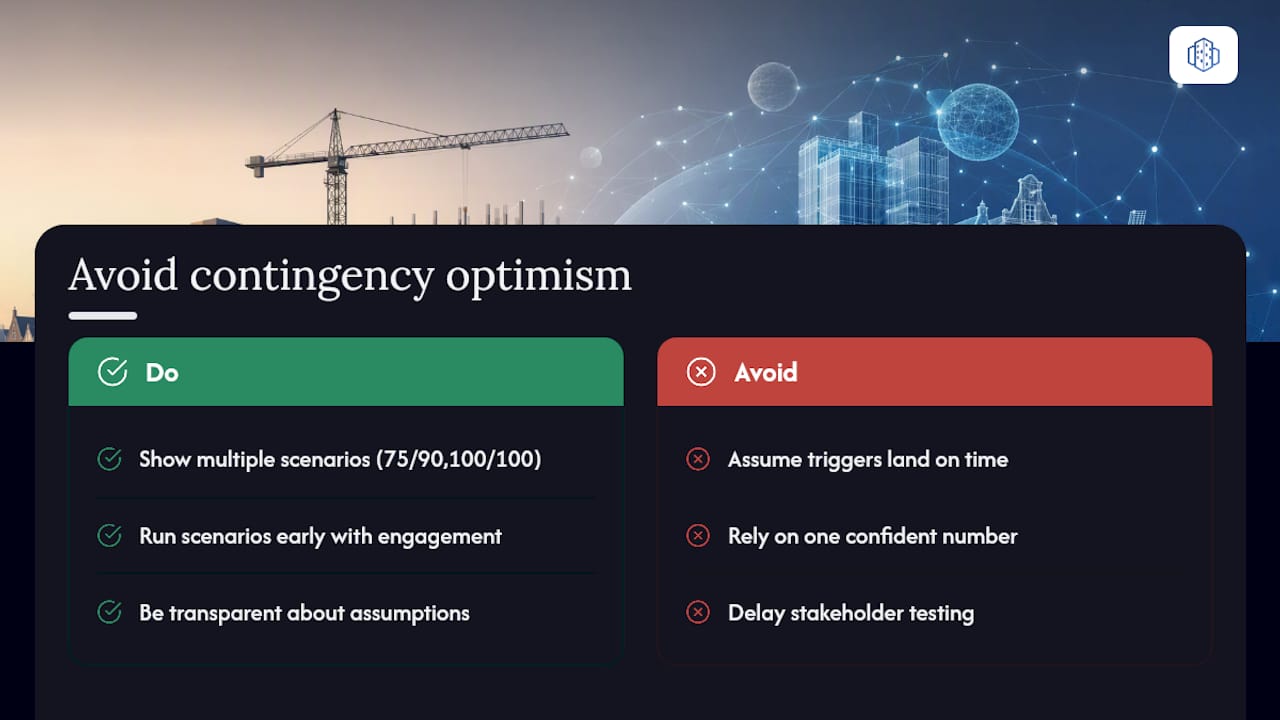
The biggest pitfall is not bad arithmetic, it is optimism about timing. Planners routinely assume infrastructure triggers land on schedule and take-up rates hold steady, then find the kostenplafond they set no longer matches reality three years in.
Transparency about scenario assumptions matters more than precision in the base figure. A council that shows its 75/90 case alongside its 100/100 case earns more public trust than one presenting a single confident number. Run the scenario work early, in parallel with stakeholder engagement, and the eventual kostenverhaalsbeschikking rests on ground that has already been tested.
— Anne Dullemond
Get a defensible estimate faster with 3D Cityplanner
A browser-based digital twin platform can keep every scenario’s gross floor area, programme mix and infrastructure triggers traceable back to the cost model feeding your kostenraming.
Rather than rebuilding massing studies each time a scenario changes, planners can run integral and organic comparisons side by side and export the resulting KPIs straight into a calculation sheet, cutting the drift that undermines eindafrekening later. It can combine GIS data with automated area generation, so estimators start from consistent inputs rather than reconciling numbers from separate tools. Municipal teams and consultants can order a gebiedsscan to get an early spatial baseline for a site, or check the Starter and Professional plans to see which subscription fits a planning department’s caseload. Demos may be available to show how a live scenario comparison looks against site data.
FAQ
What is a kostenraming gebiedsontwikkeling?
It is an itemised cost estimate for an area development that maps each cost line to a recoverable category under Annex IV, the kostensoortenlijst. It also states which recovery method, integral or organic, applies to the site.
What is the difference between integrale and organische kostenverhaal?
Integrale development sets a fixed timevak and requires a full cost and revenue model for that period. Organische development has no fixed timevak and instead relies on a motivated kostenplafond with per‑activity maximums, tested against value uplift at permit stage.
Which costs cannot be recovered under the Omgevingswet?
Anything outside Annex IV, including developer profit, unrelated mitigation measures and general operating costs, cannot legally be charged back through kostenverhaal. Including such items is a common reason cost recovery schemes get overturned.
How accurate does an early-stage kostenraming need to be?
Concept-level estimates built on kengetallen and benchmarks typically fall within a wide accuracy band, commonly cited around ±25 to 30% at masterplan stage. Accuracy improves as unit pricing replaces benchmarks during design development.
Can 3D Cityplanner help produce the volumetry behind a kostenraming?
Yes. 3D Cityplanner generates gross floor area and programme volumes automatically from 3D massing scenarios, and exports the resulting KPIs for use in a cost calculation. Current pricing for the Starter, Professional and Team plans is listed on the site.