Turn 3D Scenarios into MKBA Ready Grondexploitatie for Dutch Planners

A grondexploitatie (grex) is the municipal budget and cash-flow record for making land bouwrijp and selling or transferring plots. It converts spatial plans into a financial result that decides whether a development is feasible. Municipalities, or their delegated development partners, prepare it before council approval, and it remains the reference document throughout negotiations. This article, aimed at Dutch practice, also explains how grex outputs feed into MKBA assessment.
TL;DR:The feasibility of a grex heavily depends on accurate, conservative cost and revenue estimates, including land costs, infrastructure, and market price assumptions.Sensitivity analysis and regular updates throughout the project lifecycle are crucial to manage market risks, such as rising construction costs or delayed sales, that could turn a surplus into a deficit.Structuring risks early, using clear contractual allocations in public-private partnerships, and maintaining detailed documentation prevent common calculation errors and legal issues.Using digital GIS-linked planning tools at early stages improves scenario testing and helps derive more reliable grex inputs before design finalization.The grex should be treated as a living document, actively updated and used for negotiation throughout the project’s duration to improve accuracy and manage unexpected developments.
3D CityplannerBuild More Reliable Planning ScenariosTest spatial development scenarios in 3D and support data driven feasibility studies with GIS linked planning insights.Explore 3D Cityplanner
Table of Contents
- Grondexploitatie uitleg: definition and institutional role
- The three forms: actief, passief and publiek-private samenwerking
- What goes into a grex: costs, revenues and timing assumptions
- How to calculate a GREX: method and sensitivity testing
- From GREX to MKBA: preparing outputs for societal appraisal
- Drafting a grex without the usual mistakes
- Applied example: two 3D scenario options and their effect on the residual
- Legal framework governing grondexploitatie
- Stakeholders and their roles beyond preparation
- Market conditions and managing feasibility risk
- Tax implications in grondexploitatie transactions
- Monitoring and updating the grex over the project lifetime
- Why the grex works best as a living document
- Turning spatial scenarios into grex-ready figures
- Sources
- FAQ
Grondexploitatie uitleg: definition and institutional role
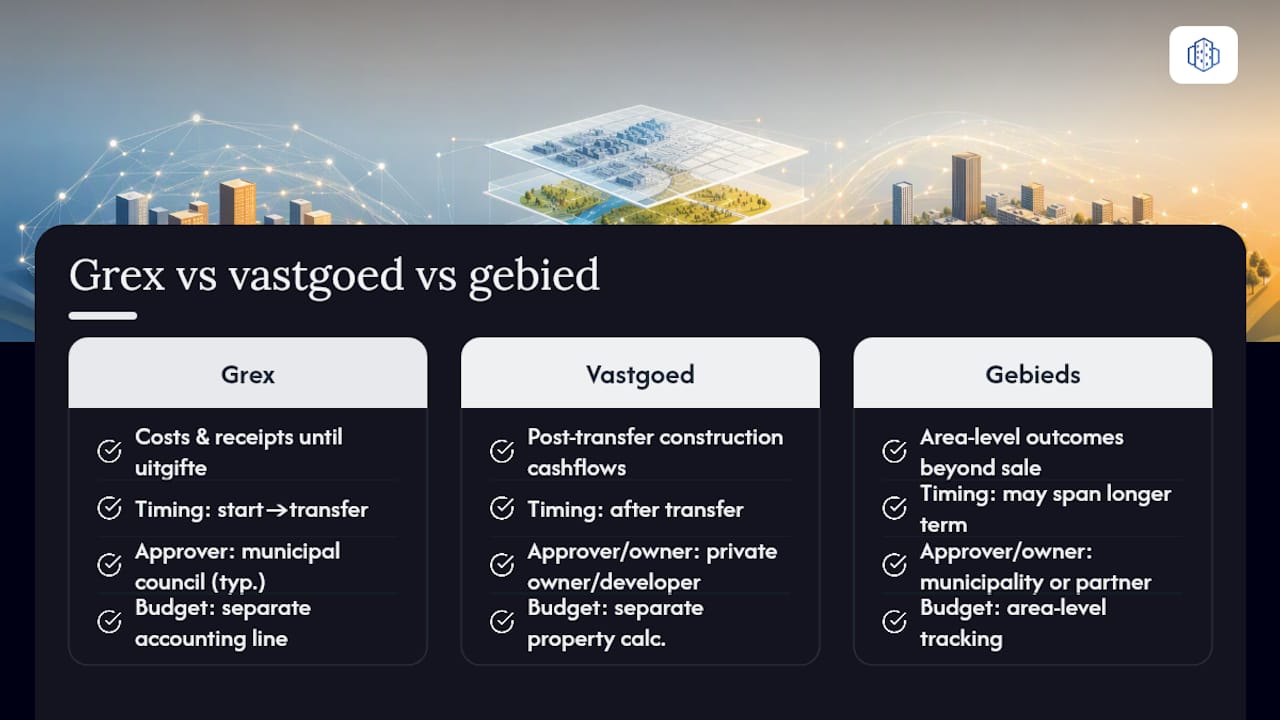
A grex records every cost and receipt tied to preparing land for building, from the moment a municipality starts acquiring or planning the area, right through to the point of uitgifte (transfer or sale of the serviced plots). It stops there. What happens after the land changes hands, the construction of homes, offices, or infrastructure on top of it, sits in a separate calculation called vastgoedexploitatie, or in a wider gebiedsexploitatie if the municipality is tracking area-level outcomes beyond the land transaction itself. Confusing these three terms is one of the more common errors in early project documentation, and it matters because each has a different owner, a different risk profile, and a different audience.
Formally, the grondexploitatie functions as a budget that shows expected ground costs and receipts for a spatial development plan up to that transfer moment. The municipal council typically sets and approves it, often as an annex to a bestemmingsplan or omgevingsplan procedure, though provinces or a joint venture partner can hold that role in structures with shared control. Once approved, the grex becomes an “exploitatiecomplex”: an administrative unit with its own budget line in the municipal accounts, tracked separately from general funds.
This institutional weight is why practitioners increasingly describe the grex as more than a spreadsheet. It works as the financial translation of spatial policy, and as an instrument for managing risk across a project’s lifetime, not just a one-off calculation produced for a council vote. Treating it that way, as something to update rather than file away, tends to separate the developments that stay on budget from the ones that don’t.
The three forms: actief, passief and publiek-private samenwerking
Dutch practice generally recognises three forms of grondexploitatie, and the choice between them shapes who carries the financial risk and who controls the pace of development.
Actieve grondexploitatie puts the municipality in the position of landowner and developer. It buys the ground, arranges site preparation and infrastructure, and sells the bouwrijpe kavels itself. This gives full control over quality, phasing, and design, but it also means the municipality absorbs every cost overrun and every dip in the sales market directly on its own balance sheet.
Passieve grondexploitatie keeps the municipality out of land ownership. Private parties acquire and develop the land themselves, while the municipality limits its role to public-law costs, infrastructure contributions, or facilitating permits. Balance-sheet exposure drops sharply, but procedural risk doesn’t disappear. Delays in permitting or disputes over cost contributions can still stall a project for years.
Publiek-private samenwerking splits the difference through a joint venture or contractual agreement. Costs, revenues, and risks are allocated by contract, often through an exploitatieovereenkomst that specifies who pays for what and under which conditions. Common risk clauses cover soil contamination discovered after acquisition, price indexation triggers, and exit provisions if a partner cannot meet its funding obligations. Many redevelopment projects on former industrial sites use this structure precisely because neither party wants to carry contamination risk alone.
What goes into a grex: costs, revenues and timing assumptions
Every grex rests on a defined set of cost and revenue lines. Missing one, or estimating it loosely, distorts the residual result that decision-makers rely on. The core cost and revenue structure is fairly standard across Dutch municipalities, even when the scale of a project varies enormously.
Cost items typically include:
- Land acquisition (verwerving), including any compensation for existing use rights
- Bouwrijp maken: grading, drainage, and preparing the subsoil for construction
- Infrastructure: roads, cabling, water and sewage connections
- Bodemsanering where soil contamination is found or suspected
- Inrichting of public space: streets, green areas, water features
- Professional fees for engineering, planning, and legal advice
- Financing costs on capital tied up before revenues arrive
- A contingency post (onvoorzien) for the risks that don’t yet have a name
Revenue items typically include:
- Sale of bouwrijpe kavels to developers, housing corporations, or private buyers
- Grants and subsidies from provincial or national programmes
- Financial contributions from developers or corporations tied to specific infrastructure benefits
Timing and pricing assumptions decide how these figures translate into a result. Phasing determines when each cost falls due and when each parcel can realistically be sold, which matters because financing costs accumulate on unsold land. Indexation adjusts future costs and revenues for expected price movement, and applying an inconsistent indexation basis across different cost lines is a well-documented source of miscalculation. VAT and transfer tax treatment also need early attention, since the fiscal position of land transactions can shift the net result meaningfully depending on the legal structure chosen.
How to calculate a GREX: method and sensitivity testing
The mechanics of a GREX calculation follow a residual logic: total expected revenues minus total expected costs, adjusted for the time value of money, produce the exploitatiesaldo, the financial result that tells a council whether a plan stands up.
- Start from the spatial plan. Building massing, street layout, and public space allocation determine the sellable area and the length of infrastructure needed, so this step comes before any figures are entered.
- Assign cost lines to each spatial element. Every square metre of road, every parking space, and every strip of green space carries a cost, and these should map directly back to the design choices made in step one.
- Estimate revenues per parcel type. Different land uses, housing, commercial, mixed, carry different price points per square metre, and these assumptions should reflect current local market evidence rather than a single citywide average.
- Phase the cash flows. Spread costs and revenues across the years the project will actually run, since a ten-year programme behaves very differently from a two-year one even with identical totals.
- Apply discounting and indexation. Discount future cash flows to a present value and apply an indexation rate consistent across all cost and revenue lines, avoiding the common trap of indexing costs and revenues on different assumptions.
- Calculate the residual. Subtract discounted costs from discounted revenues to arrive at the exploitatiesaldo gebiedsontwikkeling, the net result that either supports or undermines the case for proceeding.
- Run sensitivity scenarios. Vary price assumptions, delay timelines, remediation costs, and interest rates one at a time, then present the range of outcomes rather than a single point estimate.
Sensitivity testing deserves particular attention because a grex built on a single “expected” scenario hides exactly the risks that matter most to elected officials. A ten percent drop in sale prices, a two-year permit delay, or an unexpected remediation cost can each shift a positive residual into a deficit. Presenting a range, best case, expected case, and stressed case, gives a council a realistic basis for approval rather than false precision. Practical case observations suggest that integration between design and finance teams, paired with explicit sensitivity reporting, prevents a large share of the failures seen in underperforming projects.
From GREX to MKBA: preparing outputs for societal appraisal
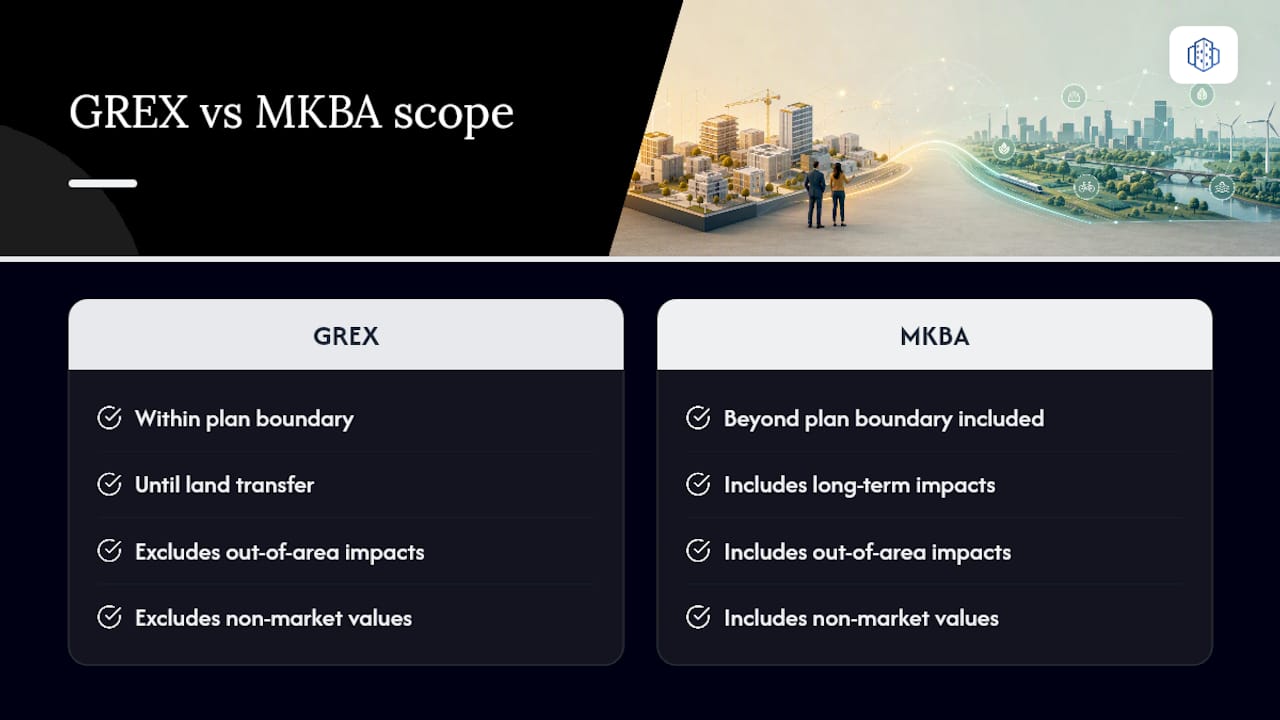
A grex answers a narrow question: does the land transaction balance financially for the municipality? A maatschappelijke kosten-batenanalyse (MKBA) asks a broader one: does the project create net value for society, including effects the grex never counted. That gap is deliberate, not a flaw in the grex, but it does mean the two documents cannot simply be swapped for one another.
GREX figures cover costs and receipts up to the point land is transferred. They exclude effects outside the plan boundary, long-term impacts after completion, and non-market values such as improved public health from added green space or reduced travel time from a new connection. An MKBA needs all of these.
The werkinstructie ‘van GREX naar MKBA’ sets out how to bridge that gap. In practice, this means adding estimated values for out-of-area impacts and post-completion cash flows, while stripping out entries that are purely internal transfers between parties rather than genuine changes in societal value, developer contributions being a frequent example.
For planners handing data to an MKBA author, a short checklist helps: confirm which cost and revenue lines are pure transfers versus real resource use, flag any effects known to occur beyond the plan boundary, and note any long-term operational costs or benefits the grex period doesn’t capture. Doing this early avoids a rebuild of the entire dataset later. Readers preparing this handover may find it useful to see how project evaluation broadens from land accounting to full societal appraisal in comparable Dutch cases.
Drafting a grex without the usual mistakes
Most grex problems trace back to a handful of recurring habits rather than exotic modelling errors.
- Allocate major risks, soil contamination, archaeological finds, and permit delays, to a named party as early as possible, rather than leaving them implicit.
- Use conservative timing and price assumptions rather than the most optimistic plausible case, and always build in a contingency line and consistent indexation.
- Map every spatial choice, density, parking ratio, amount of green space, water storage measures, directly to a cost line so a design change shows its financial consequence immediately.
- Document every assumption in writing and present sensitivity outputs, not single-point forecasts, when the plan goes to elected officials.
Timing assumptions, soil remediation, and permit risk are the items practitioners underestimate most often, and they are precisely the items that turn a projected surplus into an actual deficit. A related trap worth naming separately: double-counting developer contributions, where the same contribution appears on both the cost and revenue side under different labels, inflating the apparent robustness of the calculation.
Pro Tip: Version your grex every time a major design decision changes, density, road layout, parking count, and keep the previous version on file. When a council member asks why the residual shifted between two meetings, you want a paper trail, not a reconstruction.
Applied example: two 3D scenario options and their effect on the residual
Consider an illustrative Dutch redevelopment site of roughly four hectares, a former industrial plot being converted to mixed residential use. Two spatial options are tested in 3D before either reaches the grex.
Option A uses lower-density massing: three to four storeys, generous setbacks, and surface parking. Option B raises density with five to six storeys, partial underground parking, and a larger shared green courtyard. Viewed in 3D massing, the difference is immediately visible, not just in building height but in how much land each option leaves for streets, parking, and open space.
Translated into grex inputs, the contrast sharpens. Option B increases sellable floor area substantially within the same plot boundary, which lifts revenue per hectare. But underground parking carries a materially higher construction cost per space than surface parking, and that cost line partially offsets the revenue gain. Option A’s lower density needs less structural cost per unit but yields fewer saleable units overall, and its larger footprint of surface parking eats into space that could otherwise generate revenue or reduce infrastructure length.
Running both options through a grex typically shows Option B producing a stronger residual on paper, but with tighter sensitivity to construction price inflation, since underground parking costs are more exposed to material and labour price swings than surface layouts. Option A shows a smaller but more stable residual. Presenting both, rather than a single “recommended” option, gives a council or developer a genuine choice grounded in figures. Testing spatial choices against grex inputs before committing to a design direction is exactly the kind of feedback loop that early scenario tools are built for, and it’s far cheaper to run at the massing stage than after a plan is fixed.
Legal framework governing grondexploitatie
The Omgevingswet, which replaced the older Wro cost-recovery rules, forms the current legal backbone for grondexploitatie in the Netherlands. It sets out how municipalities may recover the costs of public infrastructure and facilities from private developers benefiting from a plan, either through an exploitatieplan (a binding municipal instrument) or an exploitatieovereenkomst (a negotiated contract between the municipality and a developer).
An exploitatieplan becomes necessary when a municipality cannot reach agreement with all landowners in a plan area through contract alone. It legally obliges private parties to contribute to public costs proportional to the benefit they receive, and it must be substantiated by the underlying grex calculation, which is why the accuracy of that calculation carries legal as well as financial weight.
Provincial and national subsidy rules also intersect with the legal framework, particularly for housing programmes or infrastructure grants tied to specific policy targets. Municipalities drafting a grex need to check current eligibility conditions for any subsidy line included as a revenue item, since qualifying criteria and funding rounds change between years. Where a joint venture structure is used, company law and contract law govern the publiek-private samenwerking agreement itself, separate from the planning law that governs the exploitatieplan.
Stakeholders and their roles beyond preparation
Preparing a grex is only the start. Several parties stay involved as the project moves from approval towards completion.
Municipalities hold formal responsibility for the grex and typically chair negotiations on cost recovery, but their council also has an ongoing oversight role, approving amendments as the exploitatiesaldo changes over time.
Developers negotiate the terms under which they acquire land or contribute to public costs, and in active or PPS structures they often co-manage phasing decisions that directly affect the grex timeline.
Housing corporations frequently appear as both buyers of land and contributors to public space or infrastructure costs, particularly where a scheme includes social housing quotas.
Investors and financing parties care primarily about the phasing and risk profile behind the residual figure, since financing costs on unsold or partially developed land accumulate against the project’s return.
Provinces occasionally act as co-financiers or regulators, particularly for infrastructure that crosses municipal boundaries or projects drawing on provincial subsidy programmes.
Each of these parties reads the same grex document for a different purpose, which is why clarity in presentation, separating assumptions from results, and results from sensitivity ranges, matters as much for stakeholder communication as for internal accuracy.
Market conditions and managing feasibility risk
Grondexploitatie feasibility is exposed to market movement on both sides of the ledger. A downturn in housing or commercial property prices reduces expected revenue from bouwrijpe kavels, while rising construction and financing costs push up the expenditure side simultaneously, a combination that has turned several previously sound plans into deficits within a single budget cycle.
Interest rate movement carries particular weight because grex projects often run for years, and financing costs on land held before sale compound over that period. A phased sales strategy that looked comfortable at one interest rate can become considerably tighter if rates rise before the later phases complete.
Municipalities manage this risk in a few consistent ways. Phasing sales across market cycles rather than committing an entire plan to a single sales window spreads exposure. Building explicit price and interest rate sensitivity into the grex, rather than relying on a single forecast, gives decision-makers early warning when conditions shift. Some municipalities also negotiate flexible land pricing with developers, tying final prices to market indices rather than fixing them years in advance. None of these measures eliminate market risk, but they keep a grex honest about how much of its projected surplus depends on conditions the municipality cannot control.
Tax implications in grondexploitatie transactions
Land transactions within a grex touch several areas of Dutch tax law, and the fiscal treatment can shift the net result of a project meaningfully depending on the structure chosen.
Value added tax (VAT) generally applies to the supply of building land, meaning the sale of bouwrijpe kavels is typically a VAT-taxed transaction rather than one exempt as “old” or unimproved land. Getting this classification right at the drafting stage matters, because miscategorising a parcel affects both the price a buyer is willing to pay and the municipality’s own recoverable input VAT on preparation costs.
Overdrachtsbelasting (transfer tax) applies on the buyer’s side in many land transactions, though its interaction with VAT depends on the specific legal qualification of the transfer. Municipalities structuring a publiek-private samenwerking should also consider corporate tax exposure if the joint venture entity is structured as a taxable body, since profit-sharing arrangements can trigger tax liabilities that a purely municipal actief grex would not face in the same way.
Because tax rules and rates are subject to change and depend on the specific structure and category of the transaction, municipalities and developers should confirm current fiscal treatment with a tax adviser before finalising a grex that assumes a particular VAT or transfer tax position, rather than relying on the treatment used in a previous project.
Monitoring and updating the grex over the project lifetime
A grex approved at the start of a project is a forecast, not a fixed outcome, and treating it as final the moment the council signs off is one of the more costly habits in Dutch practice. Prices move, permits take longer than planned, and remediation sometimes reveals problems no one budgeted for.
Municipalities that manage this well tend to review the grex on a fixed cycle, often annually, comparing actual costs and revenues realised so far against the original assumptions. Where deviations appear, whether a delayed phase, a price shift, or an unexpected cost, the grex should be updated and the revised residual reported back to the council rather than absorbed silently into a contingency line. Treating the grex as an active negotiation instrument, with a documented risk register that evolves as the project proceeds, keeps later decisions grounded in current reality rather than assumptions made years earlier. A staged approach, where phases are approved and financed incrementally rather than all at once, also gives councils the option to pause or adjust before committing to the full remaining programme.
Why the grex works best as a living document
Too many Dutch municipalities still treat the grex as a one-time exercise: build it, get council approval, file it. Edwin Buitelaar’s framing of the grex as an institution rather than a static spreadsheet points to something practitioners underestimate. When it’s revisited and used actively in negotiation, not just at the start but throughout, the outcomes tend to hold up better against the surprises every project eventually faces. Case studies bear this out more often than theory alone would suggest.
— Anne Dullemond
Turning spatial scenarios into grex-ready figures
Some planning teams use browser-based GIS-linked urban planning tools to speed the process from spatial idea to grex input compared to redrawing massing studies manually in separate design and spreadsheet tools. Browser-based urban planning platforms that link directly to GIS data enable teams to compare development options side by side and extract relevant numbers for a grex without manual translation of sketches into figures.
Some digital urban planning tools can generate GIS-linked building areas, massing volumes, and parking counts automatically as scenarios are developed, alongside sunlight and visibility checks to identify potential issues early in the process. For early feasibility work, density options can be tested and their area and cost implications extracted in the same session without needing to wait for separate CAD or GIS processing. It’s worth being clear that this covers the feasibility and scenario stage of GREX preparation; the final accounting still needs sign-off from your finance and legal teams before it goes to council. If you want to see how a real site translates into workable KPIs, request a demo walk-through and bring one of your own development sites to the session.
Sources
- De grondexploitatie: een kleine geschiedenis van een belangrijk begrip — Rooilijn
- Grondexploitatie — Wikipedia
- Grondexploitatie (GREX) — MKBA‑informatie
- Tips voor het opstellen van een gestructureerde grondexploitatie — Baker Tilly
FAQ
What is a grondexploitatie?
A grondexploitatie is the municipal budget covering all costs and revenues tied to preparing land for building, from acquisition through to the sale or transfer of bouwrijpe kavels.
What are the four phases of gebiedsontwikkeling?
Dutch area development is generally split into initiative, definition, design, and realisation phases, with the grex typically first drafted during the definition phase and refined through design before it underpins the realisation budget.
How is the GREX calculation carried out?
It follows a residual method: expected revenues minus expected costs, phased over time and discounted for present value, produce the exploitatiesaldo that shows whether a plan is financially viable.
What is the difference between actief and passief grondexploitatie?
In an actieve grex the municipality owns and develops the land itself, carrying full financial risk, while in a passieve grex private parties develop the land and the municipality limits its role to public-law costs and facilitation.
Why can’t a grex be used directly for a MKBA?
A grex only covers costs and receipts up to the point of land transfer and excludes effects outside the plan area or after completion, so the werkinstructie ‘van GREX naar MKBA’ prescribes specific adjustments before the figures are valid for societal appraisal.
Can early 3D scenario planning improve grex accuracy?
Yes. Testing massing, parking, and public space options in a tool such as 3D Cityplanner before finalising a design helps surface the area and cost implications of each choice earlier, which reduces the gap between what was designed and what the grex ultimately shows.