Why urban planners use 4D simulation in 2026
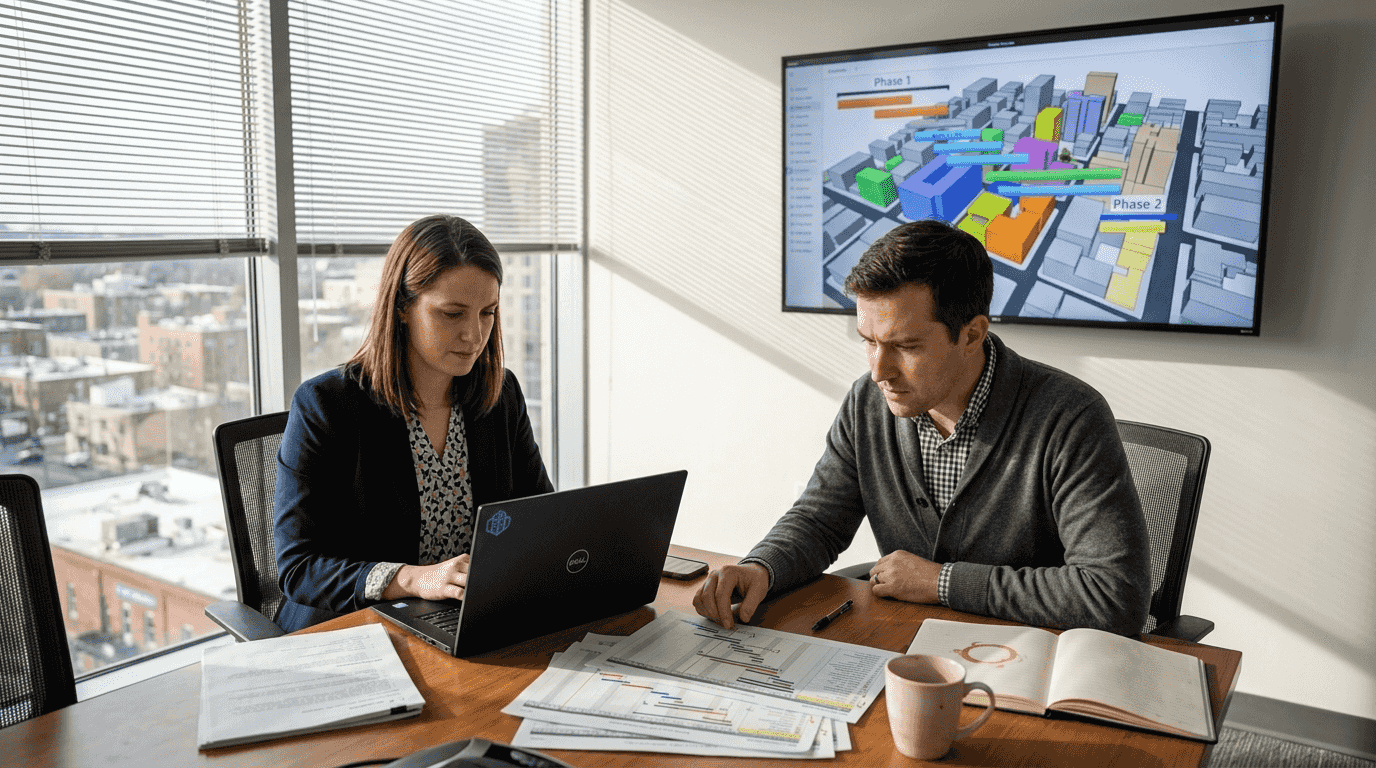
Many urban planners still view 4D simulation as little more than a sophisticated visualisation tool. This misconception overlooks its true power: dynamic project control that transforms how we plan, collaborate, and deliver urban development. By integrating time schedules with 3D models, 4D simulation provides actionable insights that reduce costly errors and enhance stakeholder alignment throughout the project lifecycle.
Table of Contents
- Understanding The Role Of 4D Simulation In Urban Planning
- How 4D Simulation Improves Stakeholder Collaboration And Project Control
- Cost Savings, Safety Benefits, And Practical Applications Of 4D Simulation
- Implementing 4D Simulation In Your Urban Planning Workflow
- Explore 3D Cityplanner For Cutting-Edge Urban Development
Key takeaways
| Point | Details |
|---|---|
| Enhanced visualisation and collaboration | 4D simulation creates shared understanding among stakeholders, enabling transparent communication and iterative engagement through visual scenarios. |
| Dynamic planning reduces delays | Real-time schedule integration identifies conflicts early, minimising rework and optimising resource allocation across project phases. |
| Scenario analysis drives cost savings | Virtual ‘what if’ testing prevents expensive on-site errors, with documented savings exceeding £80m on major infrastructure programmes. |
| Improved safety management | Virtual rehearsals and AI-powered simulations prepare teams for high-risk operations before physical work begins. |
| Evidence-based urban design | Data-driven workflows replace intuition, supporting verifiable decisions that enhance sustainability and public acceptance. |
Understanding the role of 4D simulation in urban planning
At its core, 4D simulation combines 3D spatial models with time and schedule data to create dynamic representations of urban development projects. Unlike traditional static plans that show only final states, 4D BIM enhances project visualisation by revealing how construction sequences unfold over weeks, months, or years. This temporal dimension transforms abstract concepts into tangible narratives that all stakeholders can grasp.
The benefits extend far beyond pretty animations. You gain the ability to visualise construction sequences in context, spot clashes before they occur on site, and communicate complex schedules to non-technical audiences. Resource management improves dramatically when you can see exactly when materials arrive, where teams operate, and how different activities interact across time.
Contrast this with conventional planning methods that rely on separate 2D drawings, Gantt charts, and mental gymnastics to piece together the full picture. Traditional approaches fragment information across multiple formats, creating gaps where errors hide. When digital urban planning integrates spatial and temporal data, those gaps disappear.
Key advantages of 4D simulation include:
- Early identification of scheduling conflicts and logistical bottlenecks
- Reduced miscommunication among architects, engineers, and contractors
- Enhanced resource allocation through visibility of peak demand periods
- Proactive risk management via scenario testing
- Improved coordination across multiple disciplines and workfaces
Systematic research confirms these benefits. Studies documenting construction outcomes consistently show that 4D approaches reduce errors, accelerate delivery, and improve team coordination compared to traditional methods.
How 4D simulation improves stakeholder collaboration and project control
Transparency is the foundation of successful urban development. 4D simulation creates a shared visual language that bridges technical and non-technical audiences, ensuring everyone from city councillors to construction crews understands project intentions. This shared understanding is not merely nice to have; it is essential for avoiding the misalignments that plague complex projects.
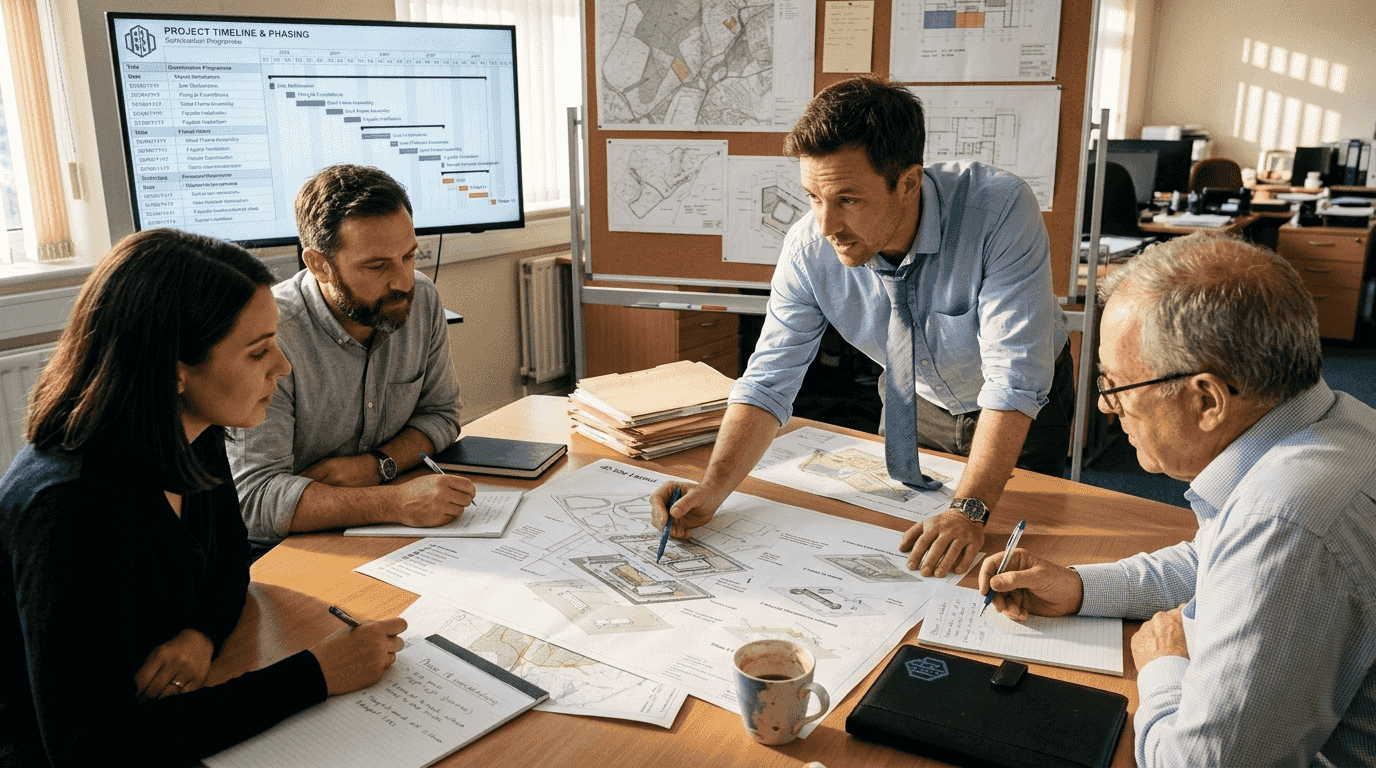
The real power emerges during iterative engagement. Rather than presenting static designs for approval, you can run ‘what if’ scenarios in real time with stakeholders present. What happens if we delay this phase by two weeks? How does relocating this utility affect the critical path? Evidence-based urban design using verifiable scenarios builds public acceptance and supports sustainability goals far better than intuition-based approaches.
This methodology transforms traditional consultation from rubber-stamping exercises into genuine participatory planning. When stakeholders see how their input affects project timelines and outcomes, engagement quality improves. They take shared responsibility for decisions because the consequences are visible and measurable.
Pro Tip: Involve all stakeholders early in the 4D planning process, not just at formal review gates. Early inclusion maximises learning opportunities and builds the shared mental models that prevent downstream conflicts.
The benefits extend to internal coordination as well. Multiple disciplines often work in parallel with limited visibility into each other’s schedules. 4D simulation aligns these workfaces by making dependencies explicit. Construction planning systems provide mechanisms to validate plans, simulate scenarios, align teams, and respond proactively to change rather than reactively to problems.
Consider how this contrasts with email threads and meeting minutes that capture intent but fail to show consequences. When urban environment simulation tools visualise trade-offs, decisions improve because stakeholders see impacts before committing resources. This is particularly valuable when implementing best practices for complex multi-phase developments.
Key collaboration improvements include:
- Transparent visualisation of project evolution eliminates ambiguity
- Interactive scenario testing validates assumptions before execution
- Evidence-based decision making replaces intuition and guesswork
- Cross-disciplinary alignment reduces finger-pointing when issues arise
- Proactive change management prevents reactive crisis responses
Cost savings, safety benefits, and practical applications of 4D simulation
The financial case for 4D simulation is compelling. On one £1bn+ infrastructure programme, 4D planning identified over £80m in potential rework savings by catching clashes and sequencing errors during virtual construction rather than on site. That is not an outlier; it represents the scale of waste hidden in traditional planning processes.
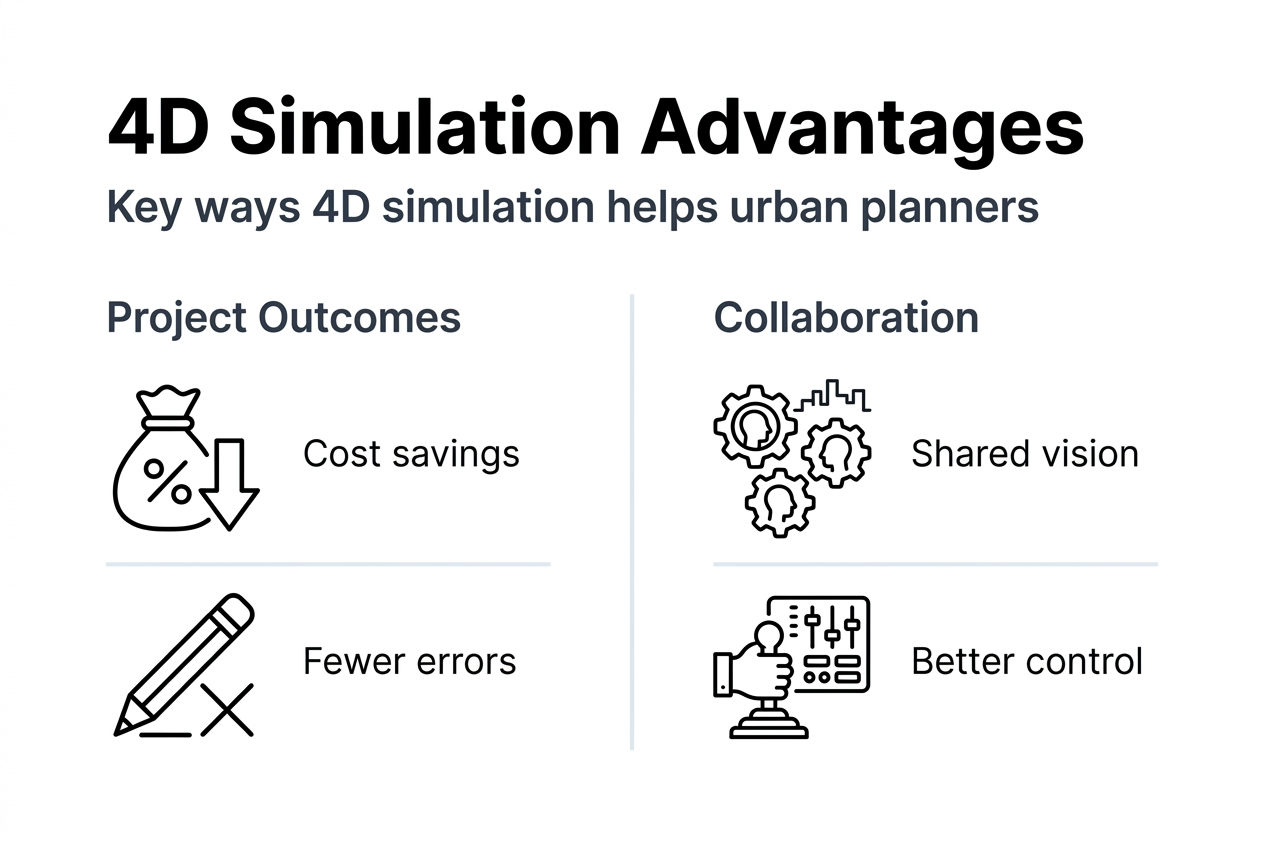
Dynamic site layout planning leverages 4D simulation to optimise how temporary facilities, material storage, and equipment placements evolve as projects progress. Research on 4D BIM based dynamic construction site layout demonstrates measurable efficiency gains and cost reductions by adapting spatial arrangements to schedule changes. Static layouts optimised for one phase often become bottlenecks in the next; dynamic planning prevents this.
Safety benefits deserve equal attention. Virtual rehearsals allow teams to practise high-risk operations in zero-risk environments. AI-powered simulation of egress routes and equipment movements identifies hazards before workers arrive on site. You can test emergency procedures, evaluate sight lines for crane operations, and optimise traffic flows to minimise pedestrian-vehicle conflicts.
Pro Tip: Use 4D simulation to run virtual safety drills for activities involving confined spaces, heavy lifts, or complex sequencing. The investment in preparation pays dividends in incident prevention.
Material quantity management becomes dynamic rather than static when integrated with BIM systems. As schedules shift, 4D tools automatically recalculate delivery timing and storage requirements. This prevents the twin problems of premature deliveries that congest sites and late deliveries that halt work.
| Benefit category | Typical improvement | Evidence source |
|---|---|---|
| Rework reduction | £80m+ savings on £1bn programme | Major infrastructure case study |
| Site layout efficiency | 15-25% productivity gain | Dynamic 4D BIM research |
| Safety incident reduction | 30-40% fewer reportable events | Construction management analysis |
| Material waste | 10-20% reduction | BIM integration studies |
When you consider how 4D planning urban design integrates these benefits, the cumulative impact on project outcomes becomes clear. Cost, schedule, safety, and quality improvements compound rather than trade off against each other.
Implementing 4D simulation in your urban planning workflow
Successful adoption requires more than purchasing software. Governance structures either enable or obstruct transformative practices. Research on governance impact shows that progressive frameworks emphasising collaboration and transparency support 4D simulation, whilst rigid hierarchies resist change. You must address organisational culture alongside technical capabilities.
Integrating 4D simulation into existing workflows begins with pilot projects that demonstrate value without disrupting ongoing operations. Select developments where schedule complexity justifies the investment, then expand as teams gain competence. The transition from intuition-based to evidence-based processes requires patience and iterative learning.
| Planning approach | Decision basis | Stakeholder role | Validation method |
|---|---|---|---|
| Intuition-based | Expert judgement | Passive recipients | Post-hoc review |
| Evidence-based | Verifiable scenarios | Active participants | Iterative simulation |
This comparison highlights fundamental differences. Traditional planning asks stakeholders to trust expert judgement without seeing consequences. Evidence-based approaches invite stakeholders to test assumptions and validate decisions through simulation. The latter builds confidence and reduces the adversarial dynamics that often characterise planning disputes.
Best practices for 4D adoption include:
- Start with high-value pilot projects where complexity justifies investment
- Ensure cross-disciplinary collaboration from project inception
- Invest in training that covers both technical skills and collaborative workflows
- Establish data sharing protocols that maintain transparency without overwhelming teams
- Schedule iterative stakeholder reviews that leverage visual scenario testing
- Document lessons learned to refine processes for subsequent projects
- Integrate 4D tools with existing BIM and project management systems
- Allocate time for virtual rehearsals and safety planning activities
The urban development workflow must accommodate these new practices whilst maintaining productivity. Incremental integration prevents the disruption that accompanies wholesale process overhauls.
Challenges will emerge. Resistance often stems from fear of transparency; when schedules and dependencies become visible, accountability increases. Address this by emphasising shared learning over blame assignment. When teams understand that 4D simulation exists to prevent problems rather than assign fault, resistance diminishes.
Technical challenges include data interoperability between different software platforms and the effort required to maintain model accuracy as designs evolve. Standardised data formats and clear ownership protocols mitigate these issues. The key is treating 4D models as living documents that evolve with projects, not static artefacts produced once and forgotten.
Many planners find that digital urban planning platforms streamline adoption by providing integrated environments where spatial design, scheduling, and simulation coexist. This eliminates the friction of moving data between disconnected tools.
Explore 3D Cityplanner for cutting-edge urban development
If you are ready to harness 4D simulation for your urban planning projects, 3D Cityplanner offers a comprehensive platform designed specifically for professionals like you. The system combines advanced 4D simulation capabilities with digital twin technology, enabling dynamic visualisation of project timelines and real-time collaboration across stakeholder groups.
Whether you are managing complex infrastructure developments or designing sustainable neighbourhoods, 3D Cityplanner supports data-driven decisions through integrated digital twin technology for site planning. The platform’s city planning tools facilitate scenario testing, resource optimisation, and evidence-based urban design that enhances project outcomes whilst reducing costs. Explore the full feature list to see how 3D Cityplanner transforms urban development workflows.
What is 4D simulation in urban planning?
What exactly does 4D simulation mean for urban planners?
4D simulation adds time and schedule data to 3D spatial models, creating dynamic representations that show how urban development projects evolve over days, weeks, or years. This temporal dimension transforms static designs into animated sequences that reveal construction phases, resource deployment, and potential conflicts before physical work begins.
How does 4D simulation support project visualisation?
By linking spatial geometry to project schedules, 4D tools generate animations showing exactly what gets built when and where. You can visualise crane movements, material deliveries, and phased occupancy in context, enabling stakeholders to understand complex sequences without technical training. This shared visual language bridges communication gaps that plague traditional planning.
Can 4D simulation really reduce errors and rework costs?
Yes, substantially. Virtual construction identifies clashes, sequencing conflicts, and logistical bottlenecks during planning rather than execution. Projects using 4D planning have documented savings exceeding £80m by catching issues early. The investment in simulation pays for itself many times over through avoided rework.
What role does 4D simulation play in stakeholder communication?
It transforms consultation from abstract discussions into concrete scenario testing. Stakeholders see how design changes affect timelines, costs, and urban impacts through interactive visualisation. This builds consensus because consequences become visible and measurable, supporting evidence-based urban design that enhances public acceptance.
What technology and software do urban planners need for 4D simulation?
Modern 4D workflows typically integrate BIM platforms with scheduling tools and visualisation engines. Cloud-based systems enable real-time collaboration, whilst AI-enhanced tools automate clash detection and optimisation. The specific stack depends on project complexity, but integrated platforms reduce the technical overhead of connecting disparate systems.
How does 4D simulation save costs on urban development projects?
Early detection of clashes and sequencing errors prevents expensive on-site rework. Dynamic scheduling reduces downtime by optimising resource allocation and identifying bottlenecks before they cause delays. Simulation of alternative scenarios helps you select the most cost-effective approach before committing resources, whilst integrated material management minimises waste through precise delivery timing.
Can 4D simulation improve safety during construction?
Absolutely. Virtual rehearsals prepare teams for high-risk operations in zero-risk environments, allowing you to identify hazards and refine procedures before workers arrive on site. AI tools simulate safe egress routes and equipment movements, whilst visualisation of sight lines and traffic flows prevents pedestrian-vehicle conflicts. This proactive approach reduces incidents significantly.
What challenges might urban planners face when adopting 4D simulation?
Resistance often stems from existing governance structures that favour traditional hierarchies over collaborative transparency. Successful adoption requires cross-disciplinary data sharing and willingness to embrace iterative stakeholder engagement. Training investments are necessary, and teams must learn to maintain model accuracy as designs evolve. However, these challenges diminish as the value becomes evident through pilot projects and shared learning.
Recommended
- Master 4D planning in urban design for 25% faster projects – 3D Urban Development
- 6 Best City Planning Best Practices for Urban Modelling – 3D Urban Development
- Why use digital urban planning for smarter design in 2026 – 3D Urban Development
- Master urban space modelling with advanced 3D tools in 2026 – 3D Urban Development