What is parametric urban design: a guide for planners
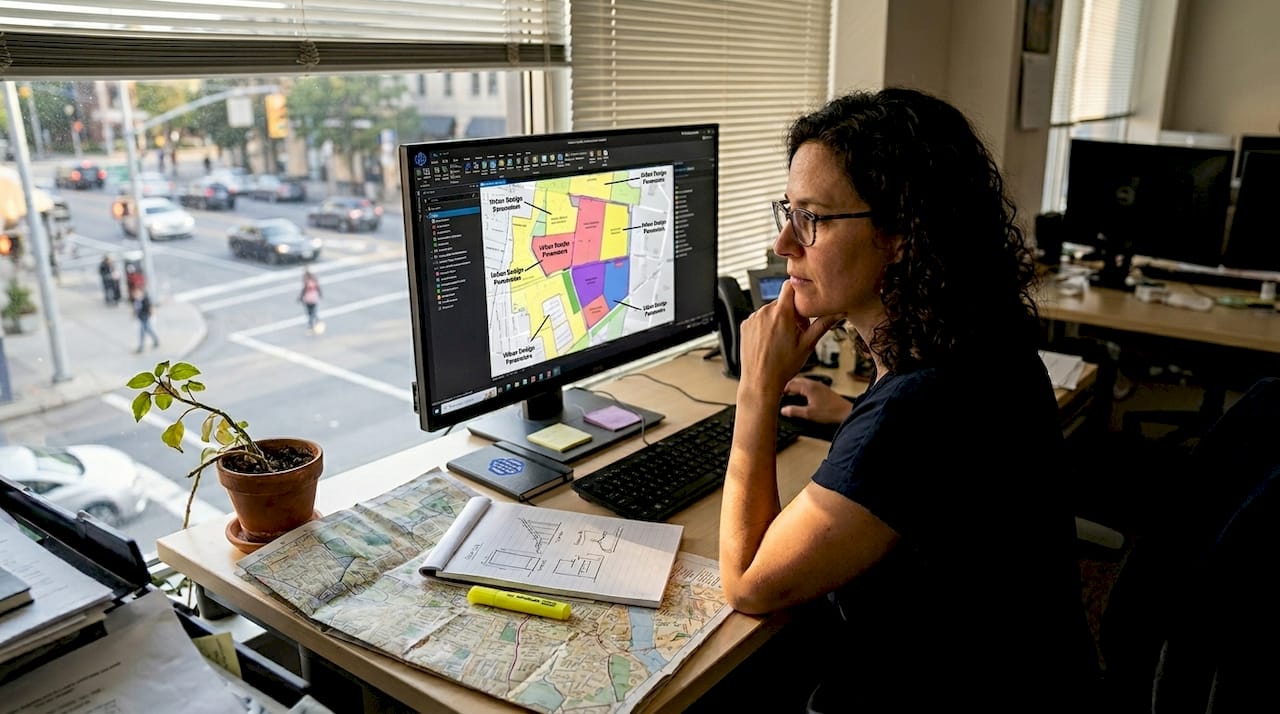
Parametric urban design is often misunderstood as purely a complex technological exercise reserved for elite architectural firms. In reality, it represents a practical, data-driven approach that enables innovative urban forms through computational algorithms and dynamic parameters. This misconception prevents many urban planners, architects, and developers from leveraging its substantial benefits in optimising sustainability, cost efficiency, and social impact. This guide clarifies the core principles, methodologies, and empirical applications of parametric urban design, demonstrating how professionals can integrate these techniques into modern urban development projects to achieve measurable improvements in project outcomes.
Table of Contents
- Key takeaways
- Understanding parametric urban design principles
- Methodologies and workflows in parametric urban design
- Empirical applications and nuanced challenges
- Practical steps and future directions for urban planners and developers
- Explore advanced parametric tools with 3D Cityplanner
- Frequently asked questions
Key Takeaways
| Point | Details |
|---|---|
| Practical data driven design | Parametric urban design is a practical data driven approach using algorithms and dynamic parameters to optimise urban form and outcomes. |
| Core design tools | Tools such as Grasshopper for Rhino, Dynamo for Revit and CityEngine enable parameter management and rapid iteration across urban layouts. |
| Multi objective optimisation | It balances resilience, energy use, cost and social impact through multi objective optimisation. |
| Rapid iteration benefits | Algorithms automatically propagate changes allowing rapid exploration cycles that reduce design testing from weeks to hours. |
| Start with simple geometry | Begin with simple geometric parameters in early design to test scenarios and build team confidence. |
Understanding parametric urban design principles
Parametric urban design is a computational approach using algorithms, parameters, and data-driven modelling to generate, optimise, and adapt urban forms, layouts, and infrastructures. Unlike traditional static planning methods, parametric design establishes relationships between design variables, allowing automatic updates when parameters change. This dynamic capability enables planners to test hundreds of scenarios rapidly, identifying optimal solutions that balance competing objectives.
The core mechanics involve defining parameters like density, height, orientation, and climate data linked via algorithms with tools like Grasshopper, Dynamo, and CityEngine. Changes propagate automatically through the model, enabling iterations and optimisation without manual recalculation. For instance, adjusting building height parameters instantly recalculates shadow patterns, density metrics, and infrastructure requirements across the entire urban layout.
Key parameters typically include:
- Building height and footprint dimensions
- Street width and orientation angles
- Green space ratios and vegetation density
- Solar exposure and wind flow patterns
- Pedestrian and vehicular circulation routes
Common tools facilitate this parametric urban design workflow through visual scripting interfaces. Grasshopper for Rhino excels at geometric manipulation and environmental analysis. Dynamo for Revit integrates building information modelling with parametric logic. CityEngine specialises in large-scale urban procedural generation with rule-based systems.
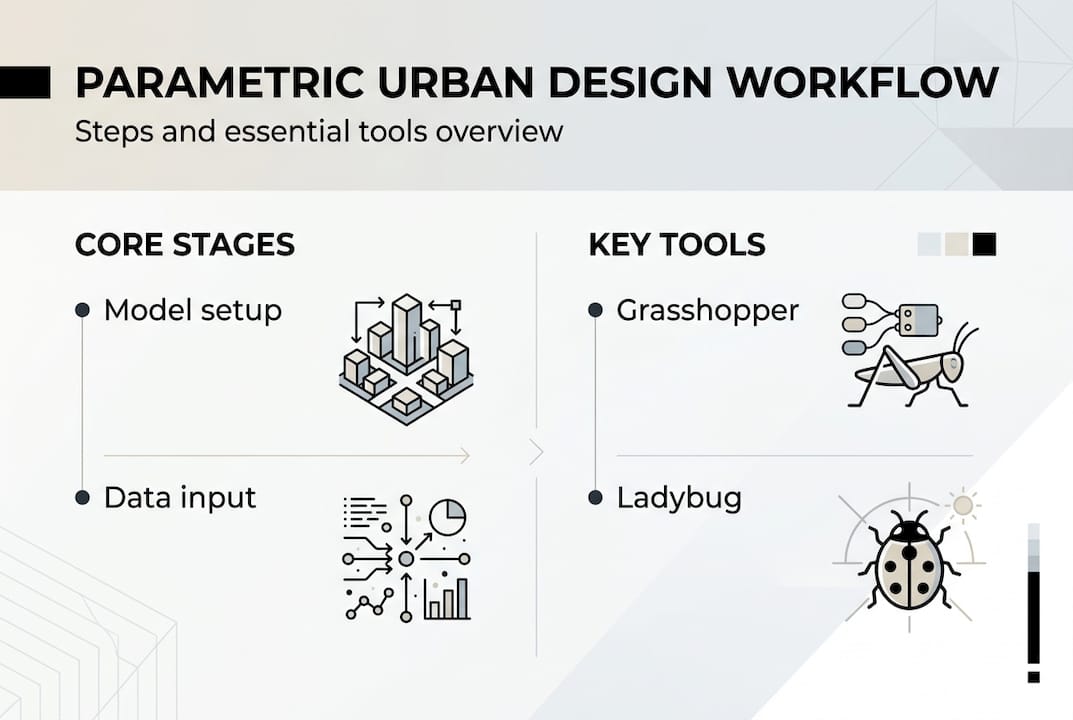
Algorithms enable automatic propagation of changes, supporting rapid iteration cycles that compress design exploration from weeks to hours. This efficiency proves particularly valuable during early design phases when testing fundamental massing and layout alternatives.
Pro Tip: Start with simple geometric parameters in the early design phase for efficient scenario testing before progressing to complex environmental modelling. This approach builds team confidence whilst establishing robust foundational relationships that support advanced analysis later.
Methodologies and workflows in parametric urban design
Parametric urban design methodologies include site analysis using slope, sunlight, and vegetation data, generative massing, and multi-objective optimisation balancing resilience, energy, cost, and social impact. These methodologies integrate urban building energy models and digital twins to create comprehensive analytical frameworks that inform decision-making throughout project lifecycles.
The workflow stages progress from descriptive baseline modelling through predictive generative design and multi-objective optimisation to prescriptive digital twins enabling real-time optimisation. Each stage builds upon previous outputs, creating increasingly sophisticated analytical capabilities.
- Data-driven site analysis: Collect environmental data including topography, solar radiation, wind patterns, existing vegetation, and infrastructure networks. These inputs establish baseline conditions and constraints that inform parameter ranges.
- Generative algorithm application: Deploy algorithms that produce multiple urban massing and infrastructure layout alternatives based on defined parameters and rules. This stage generates design diversity for evaluation.
- Multi-objective optimisation: Apply optimisation algorithms that simultaneously evaluate competing objectives like energy performance, construction cost, social connectivity, and environmental impact. Pareto frontier analysis identifies optimal trade-offs.
- Digital twin integration: Connect parametric models with real-time data streams from sensors and databases, enabling continuous performance monitoring and adaptive adjustments as conditions change.
| Workflow Stage | Primary Tools | Key Outputs | Typical Duration |
|---|---|---|---|
| Site Analysis | GIS, Ladybug | Environmental baselines | 1-2 weeks |
| Generative Design | Grasshopper, Dynamo | Design alternatives | 2-4 weeks |
| Optimisation | Galapagos, Octopus | Optimal solutions | 1-3 weeks |
| Digital Twin | IoT platforms | Real-time insights | Ongoing |
Specific software plugins enhance capabilities at each stage. Ladybug provides environmental performance analysis including solar radiation, daylight autonomy, and thermal comfort metrics. Honeybee connects energy simulation engines for detailed building performance evaluation. Galapagos and Octopus implement evolutionary algorithms for multi-objective optimisation.
Integration with digital twin urban planning platforms enables predictive and prescriptive insights that extend beyond initial design into operational phases. This continuity supports adaptive management strategies that respond to changing urban conditions and user needs.

Urban project optimisation techniques leverage these workflows to identify solutions that traditional methods would miss. The computational power to evaluate thousands of scenarios reveals non-obvious design opportunities that deliver superior performance across multiple criteria simultaneously.
Pro Tip: Follow a structured workflow moving from baseline modelling to advanced optimisation for best results. Attempting complex multi-objective optimisation without solid baseline data produces unreliable outputs that undermine stakeholder confidence.
Empirical applications and nuanced challenges
Case studies demonstrate that Tokyo’s Nihonbashi retrofitting optimised energy and carbon performance, Macarthur Park improved fabrication efficiency, and Cairo increased daylighting in informal areas. These implementations showcase parametric design enhancing urban sustainability and construction efficiency across diverse contexts and scales.
Empirical findings from completed projects reveal measurable benefits:
- Energy consumption reductions of 25-40% through optimised building orientation and massing
- Construction cost savings of 15-30% via efficient material use and fabrication optimisation
- Improved pedestrian connectivity with 20-35% increases in walkability scores
- Enhanced daylight access delivering 30-50% improvements in natural illumination
| Project | Location | Primary Objectives | Key Outcomes | Lessons Learned |
|---|---|---|---|---|
| Nihonbashi District | Tokyo | Energy/carbon reduction | 35% energy savings | Early stakeholder engagement critical |
| Macarthur Park | Multiple | Fabrication efficiency | 28% cost reduction | Parametric fabrication requires skilled contractors |
| Informal Settlement | Cairo | Daylight optimisation | 45% daylight improvement | Cultural context shapes parameter priorities |
| Residential Quarter | Amsterdam | Walkability enhancement | 32% connectivity increase | Iterative community feedback improves outcomes |
These successes demonstrate practical value, yet challenges include risks of equity issues, data privacy concerns, aesthetic homogeneity, and over-reliance on complex software. Critical evaluation reveals several nuanced concerns that practitioners must address.
Potential socio-economic divides emerge when parametric optimisation prioritises efficiency metrics over equitable access. Algorithms optimising for economic return may inadvertently concentrate resources in affluent areas whilst underserving marginalised communities. Intentional parameter weighting that values social equity alongside financial performance mitigates this risk.
Aesthetic homogeneity threatens when similar algorithms and parameters produce visually similar outcomes across different contexts. This loss of design diversity diminishes cultural identity and place-making qualities that traditional design processes naturally incorporate. Introducing contextual parameters reflecting local architectural vernacular and cultural preferences addresses this limitation.
Data privacy concerns arise when detailed urban models incorporate sensitive information about resident behaviours, movement patterns, and socio-economic characteristics. Robust data governance frameworks and anonymisation protocols protect individual privacy whilst enabling beneficial analytical insights.
Empirical findings emphasise balancing technological benefits with ethical and cultural considerations. Successful implementations actively involve diverse stakeholders throughout the parametric design process, ensuring that computational optimisation serves human needs rather than imposing purely technical solutions. The benefits of optimising city design must be evaluated against potential unintended consequences that undermine project goals.
Practical steps and future directions for urban planners and developers
Practitioners should start with Grasshopper for site analysis and massing, then scale up to multi-objective optimisation and digital twins for district-scale projects. This progressive approach builds technical capability whilst delivering incremental value at each stage.
Stepwise implementation pathway:
- Phase 1: Learn visual scripting fundamentals through online tutorials and simple geometric exercises. Establish basic parameter relationships for building massing studies.
- Phase 2: Integrate environmental analysis plugins like Ladybug to evaluate solar exposure, wind patterns, and thermal performance of design alternatives.
- Phase 3: Apply generative algorithms that produce multiple design options based on defined constraints and objectives. Compare alternatives using quantitative performance metrics.
- Phase 4: Implement multi-objective optimisation algorithms that simultaneously balance competing goals like sustainability, cost, and social impact.
- Phase 5: Connect parametric models with digital twin platforms for real-time data integration and adaptive management during operational phases.
Accessible tools like Grasshopper provide entry points with extensive online learning resources and active user communities. The visual scripting interface reduces coding barriers whilst maintaining powerful analytical capabilities. 3D building modelling tutorials offer structured learning paths for professionals new to parametric methods.
Progress to advanced capabilities requires understanding optimisation algorithms and their appropriate applications. Evolutionary algorithms excel at exploring large solution spaces with multiple objectives. Gradient-based methods provide faster convergence for problems with smooth objective functions. Selecting appropriate algorithms for specific project requirements improves computational efficiency and solution quality.
Expert advice highlights ethical data use and avoiding socio-economic divides as critical challenges moving forward. Practitioners must prioritise equity in urban outcomes through intentional parameter selection and constraint definition. Algorithms optimise what we tell them to optimise, making human judgment essential in defining objectives that serve diverse community needs.
Data privacy protection requires robust governance frameworks that limit data collection to necessary information, implement strong security protocols, and provide transparency about data use. Anonymisation techniques protect individual privacy whilst enabling aggregate analysis that informs planning decisions.
Avoiding aesthetic monotony demands incorporating contextual parameters reflecting local architectural character, cultural preferences, and place-making priorities. Parametric design should enhance rather than replace human creativity and cultural sensitivity.
Emerging technologies continue expanding parametric capabilities. Machine learning integration enables pattern recognition in complex urban datasets, informing parameter selection and constraint definition. Cloud computing provides computational power for large-scale optimisation problems previously impractical. Augmented reality interfaces facilitate stakeholder engagement by visualising parametric alternatives in physical contexts.
Urban design strategies increasingly incorporate parametric methods as standard practice rather than specialised techniques. This normalisation improves project outcomes whilst reducing implementation barriers through shared knowledge and standardised workflows.
Pro Tip: Pilot small urban projects to build expertise before scaling to district-wide applications. Starting with manageable scope allows teams to develop technical skills, establish effective workflows, and build stakeholder confidence through demonstrated success.
Explore advanced parametric tools with 3D Cityplanner
Applying parametric urban design principles requires integrated platforms that support the complete workflow from initial analysis through optimisation and operational management. 3D Cityplanner offers a comprehensive parametric urban design platform tailored for planners and architects seeking to enhance project outcomes through data-driven methods.
The toolset supports rapid iteration, environmental analysis, and multi-objective optimisation workflows within a unified interface. Automatic building generation capabilities accelerate initial massing studies. Line-of-sight visualisations evaluate view corridors and visual impact. Noise simulation assesses acoustic environments. These integrated features eliminate workflow friction between separate software tools.
Digital twin capabilities enable real-time data integration for smarter urban development decisions that adapt to changing conditions. The platform imports diverse 3D model formats and connects with extensive building and infrastructure databases worldwide. 4D planning with automatic timelines visualises project phases and construction sequences.
Explore the parametric urban design tools to discover how computational methods enhance your urban development projects. The user-friendly interface reduces learning curves whilst maintaining powerful analytical capabilities that deliver measurable improvements in sustainability, efficiency, and livability.
Frequently asked questions
What is parametric urban design?
Parametric urban design is a computational approach using algorithms and parameters to generate, optimise, and adapt urban forms dynamically. It enables rapid testing of design alternatives by establishing relationships between variables that update automatically when parameters change.
How does parametric design differ from traditional urban planning?
Traditional planning relies on static drawings and manual calculations, whilst parametric design uses computational models that automatically update when parameters change. This enables testing hundreds of scenarios rapidly and optimising multiple objectives simultaneously, which manual methods cannot achieve efficiently.
What software tools are commonly used for parametric urban design?
Grasshopper for Rhino, Dynamo for Revit, and CityEngine are primary tools. Grasshopper excels at geometric manipulation and environmental analysis. Dynamo integrates building information modelling with parametric logic. CityEngine specialises in large-scale procedural urban generation.
What are the main benefits of parametric urban design?
Benefits include 25-40% energy consumption reductions through optimised orientation, 15-30% construction cost savings via efficient material use, and 20-35% improvements in pedestrian connectivity. Parametric methods enable multi-objective optimisation that balances competing goals simultaneously.
What challenges should practitioners be aware of?
Key challenges include potential socio-economic divides when algorithms prioritise efficiency over equity, aesthetic homogeneity from similar parametric approaches, data privacy concerns with detailed urban models, and over-reliance on complex software. Addressing these requires intentional parameter selection, cultural sensitivity, robust data governance, and maintaining human judgment in design decisions.
What future trends are shaping parametric urban design?
Machine learning integration enables pattern recognition in complex datasets, informing parameter selection. Cloud computing provides computational power for large-scale optimisation. Augmented reality interfaces facilitate stakeholder engagement. Digital twin platforms enable real-time adaptive management throughout project lifecycles.


