What is a digital twin city? A guide for urban planners

Many urban professionals mistakenly view digital twin cities as static 3D visualisations, but they are actually dynamic, real-time virtual counterparts that continuously update to mirror physical urban environments. This comprehensive guide explores the definitions, architectures, benefits, and real-world applications of digital twin cities, demonstrating how they transform urban planning through enhanced traffic management, environmental monitoring, and infrastructure optimisation. You will discover how AI-driven adaptability and edge-core deployment enable scalable, data-informed decision-making for sustainable urban development.
Table of Contents
- What Is A Digital Twin City? Defining The Concept
- Architecture And Technology Behind Digital Twin Cities
- Key Benefits And Applications Of Digital Twin Cities For Urban Planning
- Implementing Digital Twin Cities: Challenges And Best Practices
- Explore 3D Cityplanner – Empowering Your Digital Twin Projects
- Frequently Asked Questions
Key takeaways
| Point | Details |
|---|---|
| Real-time monitoring | Digital twin cities continuously update to reflect actual urban conditions, enabling immediate response to traffic, pollution, and infrastructure issues. |
| AI-driven forecasting | Advanced algorithms enhance predictive accuracy for traffic patterns, air quality, and infrastructure performance, supporting proactive planning decisions. |
| Edge-core architecture | Distributed processing balances local real-time analysis with centralised analytics, optimising data handling and application scalability. |
| Sustainable development | Integrated simulations reduce emissions, improve public transport efficiency, and support environmental goals through evidence-based interventions. |
| Cross-disciplinary collaboration | Successful implementation requires aligned data standards and coordinated efforts across planning, technology, and governance teams. |
What is a digital twin city? Defining the concept
A digital twin city represents a dynamic, data-driven virtual replica of a physical urban environment. Unlike static 3D models or conventional maps, this technology creates a continuously updated virtual counterpart that reflects real-time behaviour, status, and characteristics of the actual city. The system integrates sensor data, satellite imagery, traffic flows, environmental readings, and infrastructure performance metrics to maintain accuracy and relevance.
This virtual representation enables urban planners and architects to monitor current conditions, forecast future scenarios, and simulate interventions before implementing them physically. You can test traffic management strategies, evaluate air quality impacts of proposed developments, or assess infrastructure resilience under various stress conditions. The digital twin city overview demonstrates how these capabilities extend far beyond visualisation into actionable intelligence.
Core features distinguish digital twins from basic modelling tools:
- Real-time data integration from IoT sensors, traffic systems, and environmental monitors
- Bidirectional synchronisation between physical and virtual environments
- Predictive analytics enabling scenario testing and impact assessment
- Interactive interfaces allowing stakeholders to explore urban dynamics
- Scalable architecture supporting city-wide or district-specific applications
The 2025 smart city digital twin case study illustrates how these features translate into practical urban management improvements. Rather than relying on historical data alone, planners gain current insights that inform immediate decisions and long-term strategies. This shift from reactive to proactive planning fundamentally changes how cities address challenges like congestion, pollution, and resource allocation.
Architecture and technology behind digital twin cities
The technical foundation of digital twin cities relies on sophisticated edge-core deployment architectures that balance local processing with centralised analytics. Edge computing handles time-sensitive operations near data sources, processing sensor inputs and generating immediate responses for traffic signals or environmental alerts. Core systems manage complex simulations, historical analysis, and city-wide optimisation that require substantial computational resources.
This distributed approach addresses the challenge of managing massive data volumes whilst maintaining responsiveness. A comprehensive software architecture integrates correlation-aware model reduction and dynamic adaptive forecasting to support diverse urban applications, improving both generalisability and scalability. Model reduction techniques compress data without losing critical patterns, enabling efficient storage and faster processing.
AI-driven adaptability represents a crucial technological advancement. Machine learning algorithms continuously refine predictive models based on actual outcomes, improving forecast accuracy for traffic flows, pollution dispersion, and infrastructure stress. These systems learn from seasonal patterns, special events, and gradual urban changes, adjusting their parameters to maintain relevance as cities evolve.
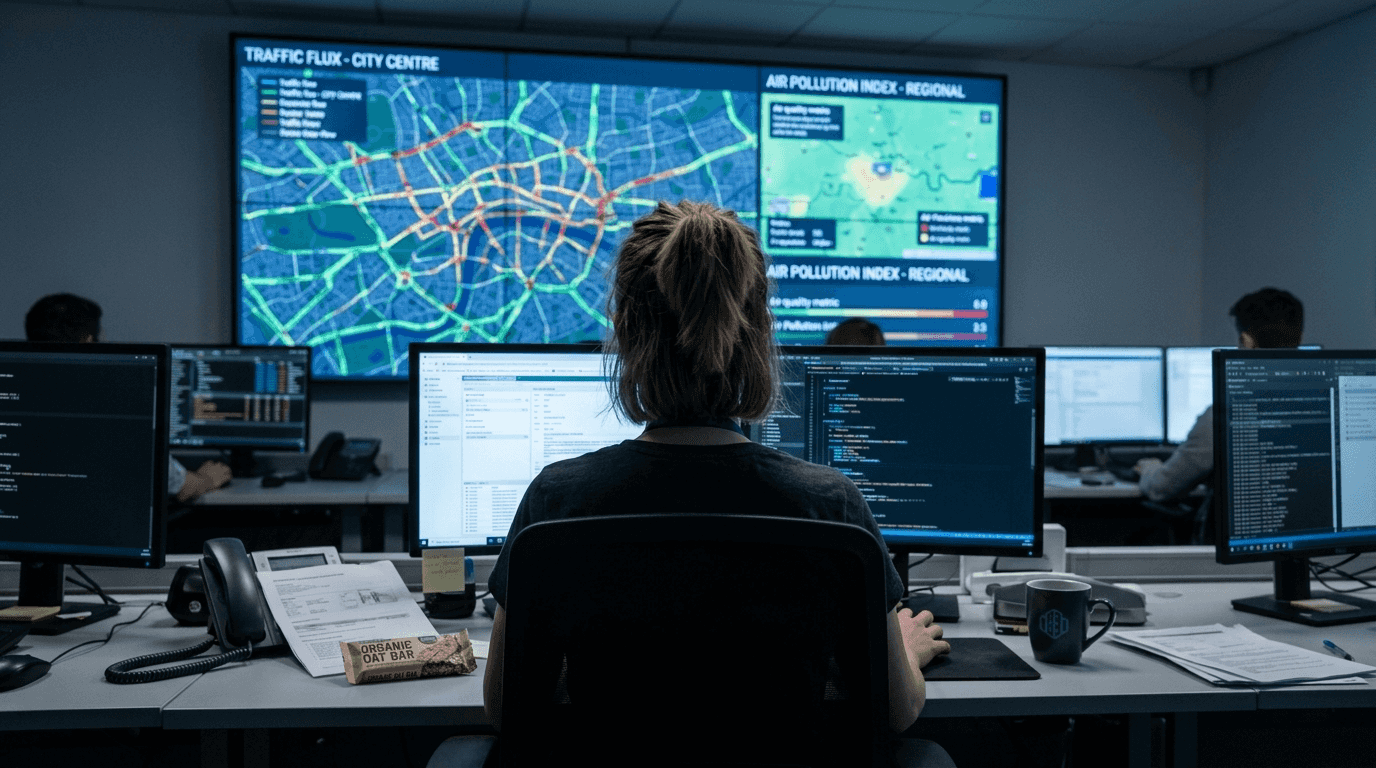
The digital twin architecture in urban development demonstrates how modular design principles enable future expansion. You can start with traffic management modules and progressively add environmental monitoring, energy optimisation, or emergency response capabilities. This flexibility proves essential for cities with limited initial budgets or those testing digital twin concepts before full-scale deployment.
| Component | Edge Processing | Core Processing |
|---|---|---|
| Response time | Milliseconds to seconds | Minutes to hours |
| Data volume | High frequency, limited scope | Comprehensive, city-wide |
| Primary functions | Real-time alerts, local optimisation | Complex simulations, strategic planning |
| Resource requirements | Distributed, moderate capacity | Centralised, high capacity |
| Typical applications | Traffic signal control, sensor monitoring | Scenario analysis, long-term forecasting |
Pro Tip: Prioritise modular architecture from the outset, allowing your digital twin to grow with organisational capabilities and budget availability whilst maintaining compatibility with existing AI tools for urban planning.
The digital twin architecture research validates how edge-core deployment enhances both performance and cost-effectiveness. By processing routine operations locally and reserving central resources for complex analytics, cities achieve optimal resource utilisation without compromising responsiveness or analytical depth.
Key benefits and applications of digital twin cities for urban planning
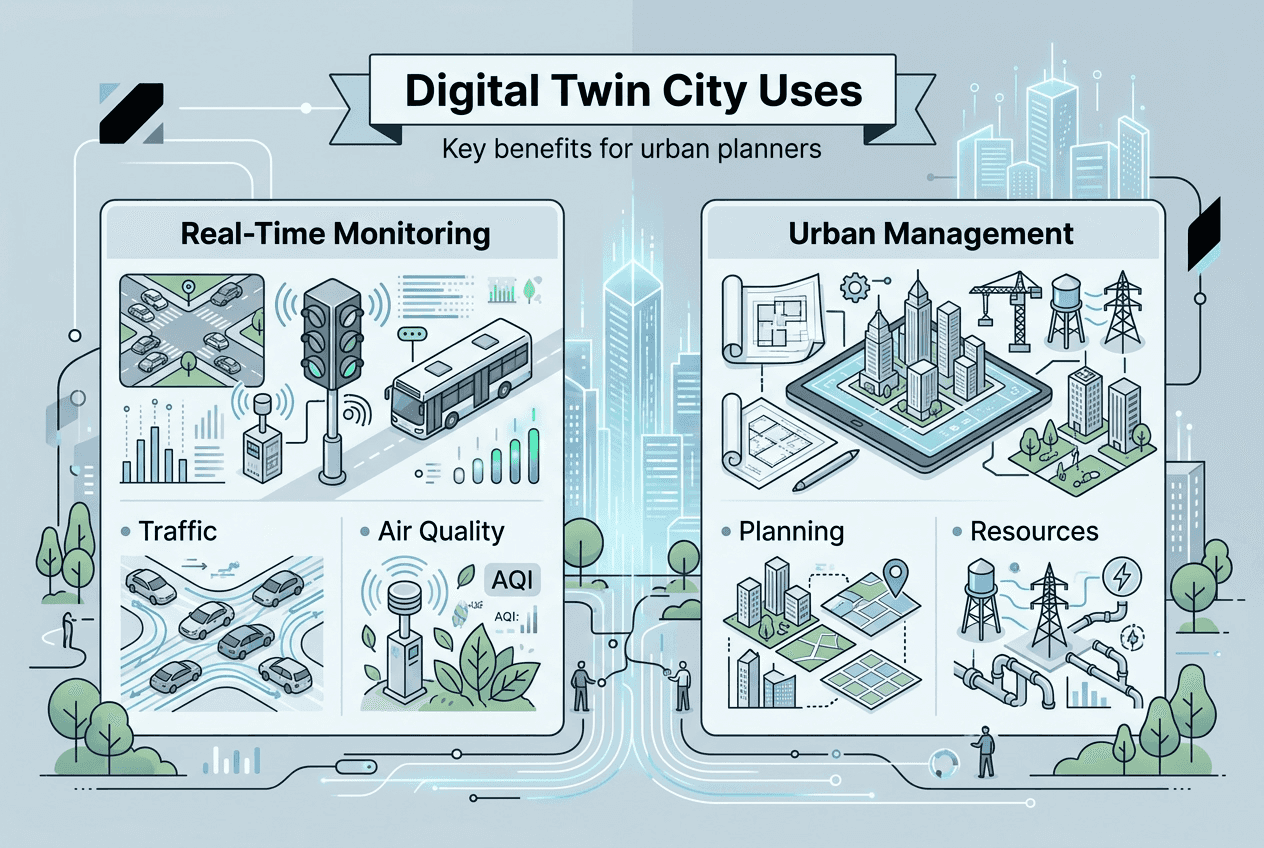
Digital twin cities deliver measurable improvements across multiple urban management domains. The smart city digital twin edge-core deployment demonstrates significant enhancements in traffic flow, emissions reduction, and public transportation efficiency, alongside improved air quality monitoring, forecasting, and pollutant management. These outcomes directly support sustainable development goals whilst addressing immediate operational challenges.
Traffic optimisation represents one of the most visible benefits. Real-time monitoring enables dynamic signal timing adjustments that reduce congestion during peak periods or special events. You can simulate proposed road changes, new public transport routes, or parking policies before implementation, identifying potential bottlenecks and unintended consequences. This evidence-based approach minimises costly mistakes and accelerates approval processes by providing stakeholders with clear impact visualisations.
Environmental management gains substantial advantages from continuous air quality monitoring and pollutant source tracking. Digital twins correlate traffic patterns, industrial activity, and weather conditions with pollution levels, enabling targeted interventions. Cities can test low-emission zones, evaluate green infrastructure placements, or assess the cumulative impact of multiple development projects on local air quality.
Infrastructure monitoring extends asset lifespans and prevents failures through predictive maintenance. Sensors track structural stress, material degradation, and usage patterns, alerting managers to emerging issues before they become critical. This proactive approach reduces emergency repairs, minimises service disruptions, and optimises maintenance budgets by focusing resources where they deliver maximum value.
Top applications for urban planners include:
- Traffic management and congestion reduction through adaptive signal control
- Environmental monitoring for air quality, noise pollution, and thermal comfort
- Infrastructure optimisation covering roads, bridges, utilities, and public facilities
- Emergency response planning with evacuation route testing and resource allocation
- Energy system management integrating renewable sources and demand forecasting
The digital twin urban planning uses demonstrate how these applications interconnect, creating synergies that amplify individual benefits. Improved traffic flow reduces emissions, which enhances air quality, supporting public health goals whilst demonstrating progress towards climate commitments.
Data flow to decision-making follows a structured process:
- Sensors and data sources continuously feed information into the digital twin platform
- Edge processing filters and analyses time-sensitive data, triggering immediate responses
- Core systems aggregate data, identify patterns, and generate predictive models
- Planners access interactive dashboards showing current conditions and forecast scenarios
- Stakeholders evaluate proposed interventions through simulations and impact assessments
- Decisions are implemented with ongoing monitoring to validate outcomes and refine models
The digital twin city planning impact illustrates how this systematic approach transforms planning from intuition-based to evidence-informed. You gain confidence in proposals through quantified benefits and risk assessments, strengthening communications with elected officials, community groups, and funding agencies. The case study on digital twin benefits provides specific examples of improved outcomes across diverse urban contexts.
Implementing digital twin cities: challenges and best practices
Successful digital twin implementation requires addressing several technical and organisational challenges. Data integration complexity tops the list, as cities must consolidate information from disparate sources using incompatible formats, update frequencies, and quality standards. Legacy systems often lack APIs or standardised outputs, requiring custom interfaces that increase costs and maintenance burdens.
Financial considerations extend beyond initial technology investments to ongoing operational expenses. Sensor networks need maintenance, software requires updates, and staff need training to utilise new capabilities effectively. Smaller cities or those with constrained budgets must prioritise applications delivering immediate value whilst building towards comprehensive coverage.
Maintaining real-time data accuracy presents persistent challenges. Sensor failures, communication interruptions, and calibration drift can compromise data quality, leading to flawed analyses and misguided decisions. Robust monitoring systems must detect anomalies quickly, triggering alerts and fallback procedures that maintain service continuity.
Privacy concerns arise when detailed monitoring capabilities intersect with individual movements and behaviours. Citizens rightfully question how their data is collected, stored, and used. Transparent policies, strong security measures, and clear boundaries between legitimate urban management and intrusive surveillance prove essential for maintaining public trust and legal compliance.
Best practices for overcoming these challenges include:
- Establishing clear data governance frameworks defining ownership, access rights, and quality standards
- Adopting open standards and interoperable platforms that reduce vendor lock-in
- Implementing phased rollouts that demonstrate value before requesting major investments
- Engaging stakeholders early to align expectations and build cross-functional support
- Investing in staff development to build internal expertise and reduce dependence on consultants
The importance of scalable and adaptable architecture using AI cannot be overstated. Key contributions include AI-driven adaptability, edge-core deployment, and extensive validation through predictive analytics, ensuring systems grow with urban needs whilst maintaining performance. This architectural approach accommodates new data sources, additional applications, and evolving analytical requirements without requiring complete redesigns.
Edge-core deployment manages data efficiently by distributing processing loads and minimising bandwidth requirements. Local edge nodes handle routine operations, reducing latency for time-critical applications whilst filtering data before transmission to central systems. This approach proves particularly valuable for cities with limited network infrastructure or those seeking to minimise cloud service dependencies.
Pro Tip: Collaborate with cross-disciplinary teams early, bringing together urban planners, data scientists, IT specialists, and community representatives to align goals, establish data standards, and ensure solutions address real operational needs rather than theoretical possibilities.
The building a city digital twin guide provides practical frameworks for navigating implementation complexities. Starting with focused pilot projects allows you to test technologies, refine processes, and demonstrate value before committing to city-wide deployment. These pilots also generate case studies that support funding applications and stakeholder engagement.
The validation of scalable digital twin architecture confirms that well-designed systems deliver consistent performance as they expand. Modular architectures enable incremental investments aligned with budget cycles and organisational readiness, reducing financial risk whilst building momentum through visible successes.
Explore 3D Cityplanner – empowering your digital twin projects
Transforming theoretical knowledge into operational digital twin capabilities requires robust platforms designed specifically for urban planning and architectural applications. 3D Cityplanner provides comprehensive tools supporting every stage of digital twin development, from initial 3D modelling through real-time data integration and scenario analysis.
The platform excels at consolidating diverse data sources into unified digital environments where you can visualise current conditions, test proposed interventions, and communicate findings to stakeholders. Advanced features include automatic building generation, sight line visualisations, noise pollution simulations, and 4D planning with automated timelines enabling real-time project phase reviews.
Compatibility with AI tools for urban planning and scalable architectures ensures your digital twin evolves alongside technological advances and organisational capabilities. Whether you are initiating pilot projects or expanding existing implementations, the digital twin urban development tools provide the functionality and flexibility required for success. Explore how 3D Cityplanner city planning tools can accelerate your journey towards data-informed urban management.
Frequently asked questions
What is the difference between a digital twin city and a smart city?
A digital twin city is a virtual real-time digital replica of the physical urban environment, continuously updated with sensor data and operational information. A smart city refers to an urban area deploying technology to improve services and quality of life, which may or may not include a digital twin component. Digital twins serve as analytical tools within smart city ecosystems.
How does AI improve digital twin city forecasting and management?
AI enables dynamic updates and adaptive forecasting by learning from actual outcomes and refining predictive models continuously. These algorithms support decision-making by predicting traffic patterns, pollution dispersion, and infrastructure performance with increasing accuracy. Machine learning identifies subtle correlations that traditional statistical methods miss, uncovering opportunities for optimisation. Explore AI tools in urban planning to understand specific applications.
What are the key challenges in implementing digital twin cities?
Data integration complexity and high initial costs represent primary obstacles, requiring substantial technical expertise and financial resources. Maintaining real-time data accuracy demands robust sensor networks and quality monitoring systems. Privacy concerns necessitate transparent policies and strong security measures to protect individual information whilst enabling legitimate urban management functions.
Can digital twin cities help reduce urban carbon emissions?
Digital twins enable precise measurement of emission sources and testing of reduction strategies before physical implementation. You can simulate low-emission zones, evaluate public transport improvements, or assess green infrastructure impacts on local climate. Real-time monitoring validates intervention effectiveness, supporting iterative refinement towards climate goals.
How long does it take to implement a functional digital twin city?
Implementation timelines vary dramatically based on scope, existing infrastructure, and organisational readiness. Focused pilot projects addressing specific challenges like traffic management can deliver value within six to twelve months. Comprehensive city-wide systems typically require two to five years, with phased rollouts enabling progressive capability expansion whilst demonstrating ongoing value.