Urban planning workflow explained: optimise projects in 2026
Did you know that implementing 3D visualisation in urban planning can reduce design time by 30%? For urban planners and architects in the Netherlands, this statistic represents more than efficiency. It signals a fundamental shift in how complex urban environments are conceived, analysed, and realised. This article unpacks the components of modern urban planning workflows, demonstrating how integrating advanced 3D tools transforms traditional processes into dynamic, collaborative systems that deliver superior project outcomes.
Table of Contents
- Understanding Urban Planning Workflows
- Role Of 3D Tools In Enhancing Urban Planning Workflows
- Challenges And Adaptations In Dutch Urban Planning Workflows
- Stakeholder Collaboration Through Digital And 3D Platforms
- Common Misconceptions About Urban Planning Workflows
- Comparing Traditional And Modern Digital Workflows
- Common Pitfalls And Failure Points In Urban Planning Workflow
- Practical Applications And Case Studies
- Discover 3D Cityplanner For Smarter Urban Development
- Frequently Asked Questions
Key takeaways
| Point | Details |
|---|---|
| Workflow efficiency | 3D tools accelerate design phases by 30% and reduce modelling time by 25%, enabling faster iterations. |
| Dutch specialisation | Noise and line-of-sight simulations address unique challenges in high-density Dutch urban environments. |
| Collaboration boost | Digital platforms improve stakeholder communication by 40%, reducing conflicts and delays. |
| Iteration advantage | Integrated 3D/4D workflows decrease iteration cycles by 40% compared to traditional 2D approaches. |
| Iterative nature | Urban planning workflows thrive on continuous adjustments, not rigid linear sequences. |
Understanding urban planning workflows
Urban planning workflows comprise seven globally recognised stages: initial assessment, concept development, detailed design, impact analysis, stakeholder consultation, regulatory approval, and implementation monitoring. Each stage requires careful coordination between technical analysis and human engagement. The process isn’t linear but cyclical, with findings from later stages often informing revisions to earlier work.
Integrating analysis and stakeholder engagement throughout these stages proves critical for quality outcomes. When planners separate technical work from community input, projects face higher rejection rates and costly revisions. Dutch urban environments impose special requirements due to exceptional density, complex water management needs, and stringent environmental regulations. These factors demand workflows that can rapidly test multiple scenarios whilst maintaining regulatory compliance.
Key workflow components include:
- Site analysis incorporating environmental, social, and infrastructural data
- Iterative design cycles that refine concepts based on feedback and simulation results
- Impact assessments covering noise, traffic, environmental quality, and visual integration
- Stakeholder engagement protocols ensuring input from residents, officials, and developers
- Regulatory compliance checks aligned with Dutch national and municipal standards
- Implementation phasing that coordinates construction with existing urban functions
- Post-implementation monitoring to validate predictions and inform future projects
Traditional workflows relied heavily on 2D drawings and physical models, creating bottlenecks when changes emerged. Modern digital workflows address these limitations by enabling real-time adjustments and comprehensive visualisation.
Role of 3D tools in enhancing urban planning workflows
Advanced 3D modelling transforms urban planning from abstract representation to immersive spatial understanding. When planners work in three dimensions, they detect design conflicts earlier, saving time and resources. 3D visualisation accelerates the design phase by 30% and automatic building generation reduces modelling time by 25%, allowing teams to explore more design alternatives within the same timeframe.
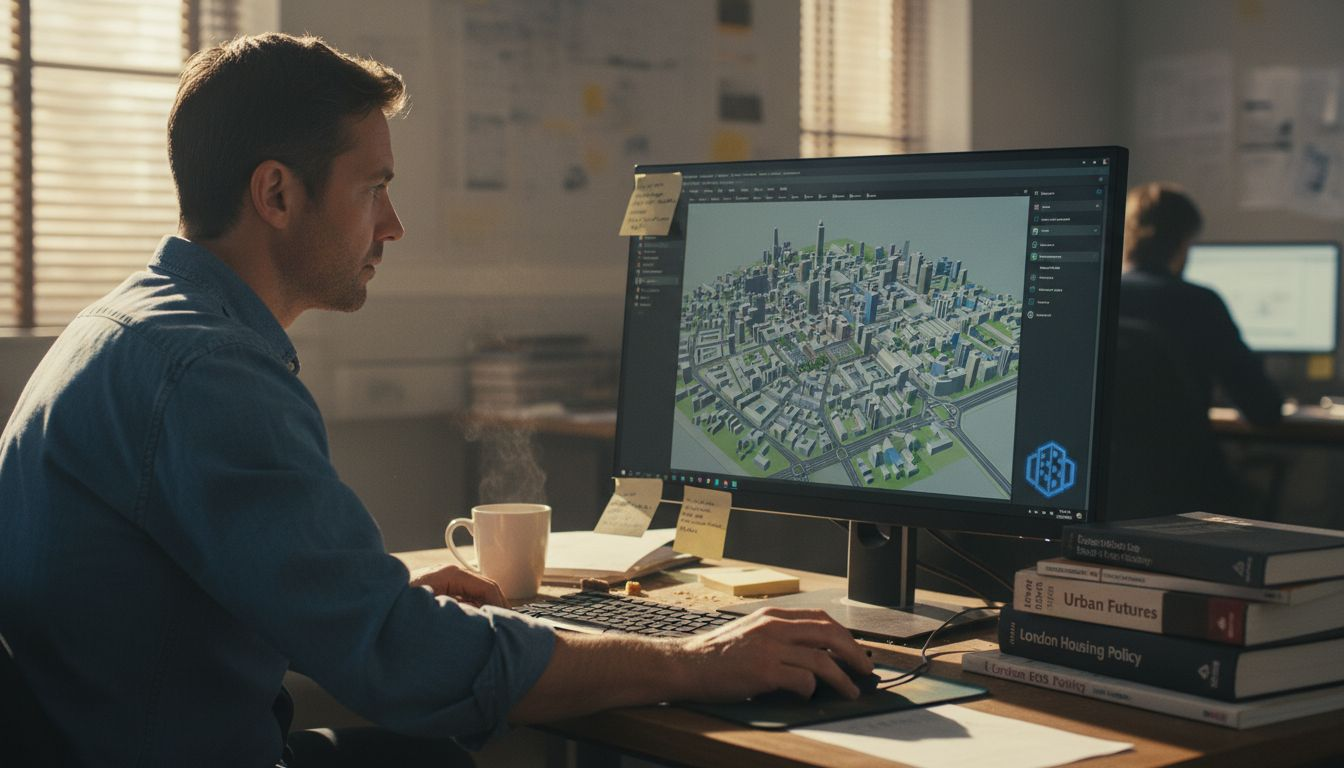
Spatial accuracy improves dramatically with 3D tools. Planners identify sight line obstructions, shadow patterns, and accessibility issues that remain invisible in plan view. This precision prevents costly errors during construction. Automatic building generation saves substantial time when modelling complex urban forms, enabling rapid prototyping of neighbourhood-scale developments.
Simulations boost adaptability by enabling fast iterative changes during design. When a stakeholder suggests modifications, planners regenerate visualisations within minutes rather than days. This responsiveness keeps projects moving forward and maintains engagement momentum. Environmental simulations, including shadow studies and wind flow analysis, provide quantifiable data for design decisions rather than educated guesses.
Pro Tip: Start with low-detail 3D models during concept phases to maintain agility, then progressively add detail as designs solidify. This approach balances speed with precision.
The workflow acceleration extends beyond design. Documentation generation, typically consuming weeks, becomes semi-automated. Understanding why 3D modelling matters helps teams appreciate how these tools contribute directly to quality improvement. Integrated platforms eliminate file conversion issues and version control problems that plague fragmented workflows.
Key 3D tool benefits include:
- Early error detection reducing rework by identifying conflicts before construction
- Rapid scenario testing enabling comparison of multiple design alternatives
- Stakeholder comprehension through intuitive visualisation accessible to non-technical audiences
- Database integration pulling real-world building and infrastructure data into models
- Automated documentation generation from 3D models to 2D technical drawings
Challenges and adaptations in Dutch urban planning workflows
Dutch urban areas present unique challenges that demand specialised workflow adaptations. High population density means projects must carefully balance competing space demands whilst minimising disruption to existing functions. Limited available land intensifies pressure to optimise every square metre, requiring precise analysis tools.
Noise pollution assessment becomes essential in dense environments where residential, commercial, and industrial zones exist in close proximity. Specialised simulations model sound propagation from traffic, construction, and activities, ensuring developments comply with Dutch noise standards. Line-of-sight simulations assess privacy concerns and visual impact, particularly important in compact neighbourhoods where buildings stand close together.
4D time-lapse project phasing addresses construction coordination challenges in active urban areas. By visualising construction sequences over time, planners identify conflicts between project phases and existing city operations. This foresight helps avoid traffic disruptions, utility conflicts, and public space closures that erode community support. The temporal dimension streamlines approval processes by demonstrating mitigation strategies to regulatory bodies.
Water management integration distinguishes Dutch planning workflows from those in other countries. Below-sea-level developments require sophisticated flood risk modelling and drainage system design. Leveraging 3D modelling for smarter city planning becomes particularly valuable when coordinating with water authorities and testing climate adaptation scenarios.
Adaptations for Dutch contexts include:
- Integrated noise simulation tools assessing multiple sound sources simultaneously
- Line-of-sight analysis protecting privacy and preserving valued views
- 4D phasing visualisations coordinating construction with urban operations
- Flood risk modelling incorporating climate change projections
- Heritage impact assessments for developments near protected structures
- Bicycle infrastructure integration ensuring seamless active transport networks
Adopting digital tools tailored to these needs improves project success rates. Projects that incorporate specialised simulations early in workflows experience fewer regulatory delays and stronger community acceptance.
Stakeholder collaboration through digital and 3D platforms
Effective urban planning depends on synthesising input from diverse stakeholders with competing interests and varying technical expertise. Digital collaboration platforms improve communication efficiency by 40%, transforming how planners, architects, residents, and officials interact throughout project lifecycles.
Real-time communication tools enhance interaction speed and clarity. When stakeholders access shared 3D models, discussions focus on specific design elements rather than abstract concepts. This precision reduces misunderstandings that typically derail consensus-building. Cloud-based platforms enable asynchronous collaboration, allowing participants across different schedules and locations to contribute meaningfully.
Collaborative platforms help manage input from multiple parties efficiently. Version control systems track changes and maintain clear audit trails, essential for regulatory compliance. Annotation tools let stakeholders mark concerns directly on 3D models, creating visual records of feedback. These features prevent the communication fragmentation that occurs when feedback arrives through emails, meetings, and documents.
Improved communication reduces planning conflicts and accelerates decision-making. When all parties view identical information simultaneously, debates shift from arguing about facts to discussing values and priorities. This shared understanding foundation speeds consensus formation. Projects using integrated collaboration tools report 30% faster approval processes compared to those relying on traditional communication methods.
User-friendly interfaces encourage broader participation and acceptance. City planning best practices emphasise accessibility for non-technical stakeholders. When residents explore 3D models through intuitive interfaces, they engage more substantively than when reviewing technical drawings. This deeper engagement builds trust and reduces opposition rooted in misunderstanding.
Pro Tip: Schedule regular virtual walk-throughs with stakeholders rather than waiting for formal review meetings. Frequent informal engagement prevents surprises and builds collaborative relationships.
Collaboration platform benefits include:
- Centralised information access eliminating version confusion and outdated references
- Visual annotation tools enabling precise feedback communication
- Automated notification systems keeping stakeholders informed of changes
- Access control features protecting sensitive information whilst enabling transparency
- Mobile compatibility allowing stakeholders to review materials anywhere
Common misconceptions about urban planning workflows
Several persistent myths about urban planning workflows prevent organisations from adopting more effective practices. The most damaging misconception treats workflows as rigid linear sequences. In reality, urban planning workflows are iterative, not fixed progressions. Successful projects cycle repeatedly through design, analysis, and consultation stages, refining solutions based on accumulated insights.
Another widespread belief holds that 3D urban planning tools are prohibitively complex. Whilst sophisticated capabilities exist, modern platforms prioritise user-friendliness. User acceptance rates increase by 22% with guided training for 3D tools, demonstrating that perceived complexity stems from unfamiliarity rather than inherent difficulty. Most planners achieve productive competence within weeks of structured training.
Many practitioners mistakenly believe traditional 2D workflows suffice for contemporary projects. This assumption ignores the complexity of modern urban challenges requiring integrated analysis of spatial, environmental, and social factors. Iterative workflows enabled by 3D tools deliver 35% better adaptability and project outcomes compared to linear 2D approaches. The spatial understanding gap between 2D and 3D becomes particularly evident when communicating with non-technical stakeholders.
Some organisations worry that adopting new workflows disrupts established practices excessively. Gradual integration strategies address this concern by introducing tools incrementally. Starting with visualisation-only applications before expanding to full workflow integration reduces disruption whilst building organisational capacity. Successful adopters report that workflow enhancements complement rather than replace existing processes.
“The transition to 3D workflows seemed daunting initially, but we discovered that iterative approaches actually reduced pressure on our team. Being able to test ideas quickly before committing resources transformed how we approach complex projects.”
Key misconceptions include:
- Workflows must follow predetermined sequences without deviation
- 3D tools require extensive technical training beyond most planners’ capabilities
- Traditional 2D workflows provide adequate analysis for contemporary challenges
- Adopting new workflows necessitates abandoning all existing practices
- Digital collaboration platforms compromise data security and intellectual property
Comparing traditional and modern digital workflows
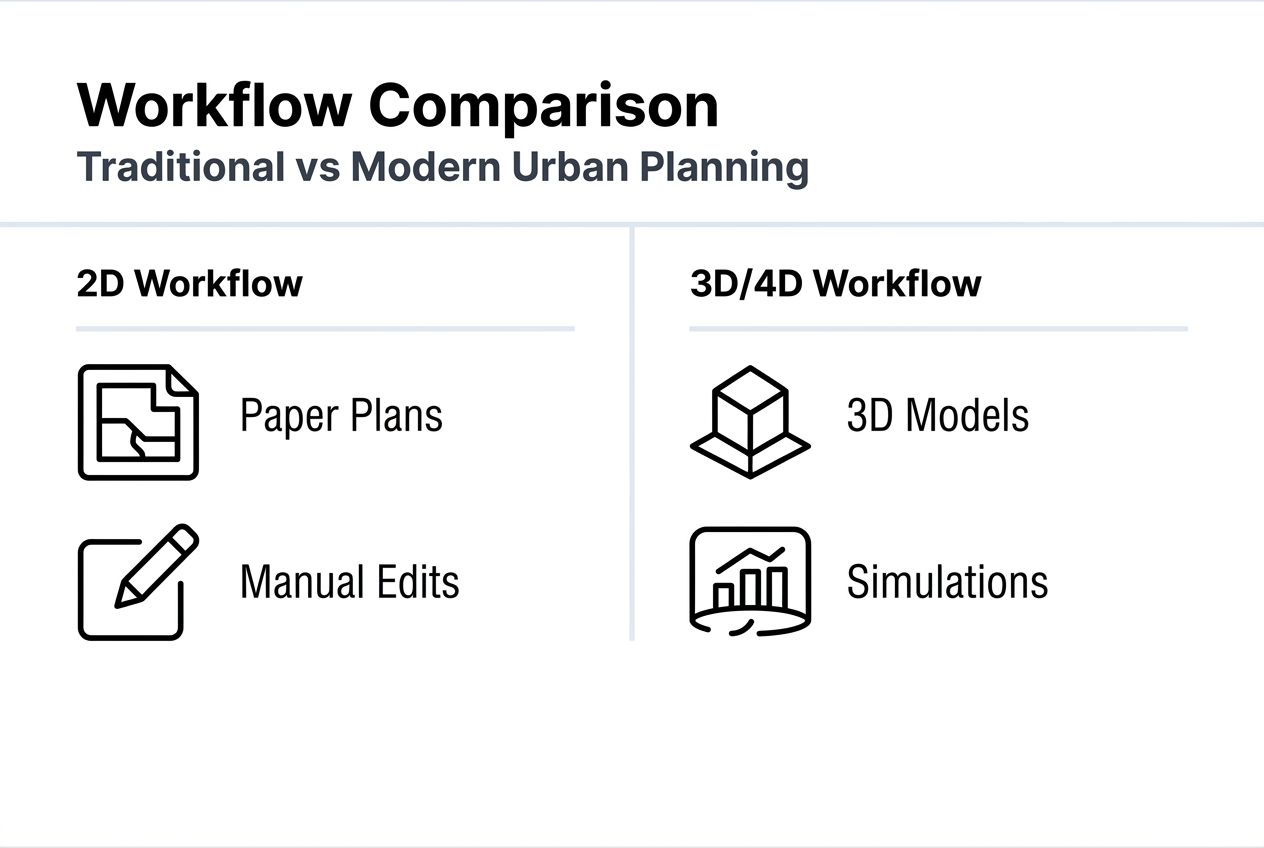
Understanding the concrete differences between traditional 2D and modern 3D/4D workflows helps planners appreciate the transformation potential. The comparison reveals not just incremental improvements but fundamental capability expansions that change what’s possible in urban planning.
| Aspect | Traditional 2D workflow | Modern 3D/4D workflow |
|---|---|---|
| Design iteration time | 2-3 weeks per major revision cycle | 3-5 days per cycle, 40% faster |
| Spatial analysis | Plan and elevation views requiring mental 3D reconstruction | Direct 3D visualisation showing actual spatial relationships |
| Stakeholder communication | Technical drawings requiring interpretation skills | Intuitive visualisations accessible to non-technical audiences |
| Scenario testing | 2-3 alternatives due to time constraints | 10+ alternatives within same timeframe |
| Impact simulation | Separate tools requiring manual data transfer | Integrated simulations using shared model data |
| Construction phasing | Static sequence diagrams | Dynamic 4D visualisations showing temporal conflicts |
| Collaboration method | Sequential review cycles with document versions | Concurrent access to shared models with real-time updates |
| Error detection timing | During construction or late design phases | Early design stages preventing costly corrections |
Modern workflows enable dynamic scenario testing impossible with traditional approaches. Planners explore variations in density, building placement, and infrastructure configuration rapidly. This exploration capacity supports evidence-based decision-making rather than relying on limited alternatives constrained by production time.
Environmental and social impact simulation accuracy improves dramatically with integrated 3D tools. Rather than approximating shadow patterns or traffic flow, planners model these factors precisely. Real-time impact visualisation supports faster, better decisions by immediately showing consequences of design changes.
The efficiency gains compound throughout project lifecycles. Time saved during design creates capacity for additional stakeholder engagement or more thorough analysis. Enhanced workflows reduce the pressure that forces compromises in traditional processes, enabling higher-quality outcomes within equivalent timelines.
Common pitfalls and failure points in urban planning workflow
Identifying where workflows typically break down enables proactive mitigation. The most frequent failure point involves fragmented modelling and communication tools causing coordination problems. When teams use separate platforms for design, analysis, and collaboration, data transfer errors and version conflicts emerge. Fragmented tools cause 25% project delays due to coordination overhead and miscommunication.
Linear workflows that resist iteration miss crucial feedback opportunities. When organisations treat initial designs as near-final, they lock in assumptions before testing reveals problems. This rigidity leads to expensive late-stage revisions or completed projects that underperform expectations. Successful workflows build in multiple feedback loops, treating each cycle as a learning opportunity.
Excluding stakeholders until late stages creates opposition rooted in feeling ignored. When communities first see developed plans rather than participating in concept formation, they perceive decisions as predetermined. This perception generates resistance even to objectively beneficial projects. Early stakeholder exclusion extends approval timelines by 6-12 months on average as planners address belated objections.
Inadequate documentation and knowledge transfer cause problems during implementation and future modifications. When design rationale exists only in team members’ memories, personnel changes create knowledge gaps. Future modifications become difficult because decision context disappears. Integrated platforms that automatically document design evolution address this vulnerability.
Key workflow vulnerabilities include:
- Tool fragmentation creating data silos and version control problems
- Insufficient iteration cycles preventing design refinement
- Late stakeholder engagement generating opposition and delays
- Inadequate impact analysis leaving environmental or social concerns unaddressed
- Poor documentation practices losing design rationale over time
- Rigid adherence to initial concepts despite contradictory evidence
Integration of modelling, analysis, and collaboration tools proves essential for smooth workflow operation. Comprehensive workflow platforms eliminate transfer points where errors typically occur. Maintaining iterative flexibility whilst documenting decision rationale balances agility with institutional knowledge preservation.
Practical applications and case studies
Real-world implementations demonstrate how modern workflows deliver measurable improvements. An Amsterdam urban regeneration project exemplifies these benefits. The development involved redeveloping a 12-hectare former industrial site into mixed-use neighbourhoods. The project team adopted integrated 3D workflows incorporating automatic building generation, noise simulation, and 4D phasing visualisation.
The project achieved a 15% reduction in approval time compared to similar developments using traditional workflows. Early engagement with residents through 3D visualisations built support by demonstrating how designs addressed community concerns about privacy, noise, and public space access. Regulatory bodies appreciated 4D phasing presentations that showed construction would minimise disruption to surrounding areas.
Visualisation tools boosted stakeholder consensus by enabling residents to explore proposed spaces virtually. This experience created emotional connections to the project before construction began, transforming abstract plans into tangible futures. The development received planning approval with minimal opposition, avoiding the contentious processes that delay comparable projects.
Workflow improvements decreased project risks by identifying potential conflicts early. Automated clash detection found infrastructure conflicts between proposed buildings and existing utilities, preventing costly construction delays. Shadow analysis ensured proposed buildings wouldn’t darken neighbouring properties beyond acceptable limits. These proactive solutions enhanced design quality whilst maintaining project schedules.
The case demonstrates practical return on investment for modern workflow adoption. Despite initial platform costs and training time, the project came in 8% under budget due to reduced rework and faster approvals. Team members reported lower stress levels from having reliable tools that prevented surprises.
Successful implementation elements included:
- Comprehensive training ensuring all team members achieved platform competency
- Early stakeholder engagement building community support from project inception
- Integrated tools eliminating coordination overhead between design and analysis
- Iterative design cycles refining solutions based on simulation results
- Clear documentation maintaining decision rationale throughout development
These workflow principles apply across project scales and contexts, from individual building developments to district-wide masterplans.
Discover 3D Cityplanner for smarter urban development
Transforming your urban planning workflow begins with the right platform. 3D Cityplanner provides comprehensive tools that integrate the capabilities discussed throughout this article. As a leading solution for Dutch urban planners and architects, the platform combines intuitive 3D modelling with specialised simulations addressing Netherlands-specific challenges.
The platform supports the future of urban development through automatic building generation, noise and line-of-sight simulations, and 4D project phasing visualisations. These capabilities accelerate your workflow whilst improving design quality and stakeholder engagement. Comprehensive database integration pulls real-world building information into your models, eliminating manual data entry.
Explore how 3D Cityplanner enhances your city planning processes through collaborative features that connect your entire project team. The platform’s user-friendly interface reduces training time whilst providing professional-grade analytical capabilities. Experience the benefits of digital twins for urban development that evolve throughout project lifecycles, maintaining consistency from concept through implementation.
Frequently asked questions
How do 3D urban planning tools integrate with existing systems?
Most modern 3D platforms support standard file formats like IFC, DWG, and GeoJSON, enabling seamless data exchange with CAD software, GIS systems, and BIM tools. Cloud-based platforms typically offer API connections for custom integrations with municipal databases and project management systems.
Do 3D tools support Dutch regulatory compliance requirements?
Yes, leading platforms include built-in compliance checking for Dutch building codes, noise standards, and environmental regulations. Automated report generation produces documentation formatted for submission to municipal authorities, streamlining approval processes and ensuring nothing gets overlooked.
What training investment is required for teams adopting 3D workflows?
Most planners achieve productive competence within 2-4 weeks of guided training. Platforms with intuitive interfaces reduce this timeframe. Organisations typically designate power users who receive advanced training, then support colleagues, spreading expertise efficiently whilst maintaining productivity.
Can we measure concrete outcomes from workflow improvements?
Absolutely. Track metrics like design iteration time, approval duration, stakeholder meeting efficiency, and error correction costs. Most organisations adopting integrated 3D workflows report 25-40% improvements across these measures within six months, with gains continuing as teams develop expertise.
Are cloud-based collaboration platforms secure for sensitive projects?
Reputable platforms employ bank-level encryption, role-based access controls, and data residency options complying with GDPR requirements. Many offer on-premises deployment for projects requiring maximum security. Regular security audits and certifications provide assurance for handling confidential municipal and commercial data.
Recommended
- Urban design workflow guide 2026: cut project time 20% – 3D Urban Development
- Urban Development Workflow for Efficient 3D Planning – 3D Urban Development
- 6 Best City Planning Best Practices for Urban Modelling – 3D Urban Development
- 6 Top Urban Design Strategies for Modern Planners – 3D Urban Development