Top urban development strategies for city optimisation 2026
Urban planners face mounting pressure to implement effective 3D technology strategies that genuinely optimise city environments. With diverse approaches and heterogeneous data complicating decision-making, selecting the right path forward requires more than intuition. This article presents a criteria-based framework grounded in recent global benchmarking data, offering you a curated list of top urban development strategies for 2026. You’ll learn how to evaluate options systematically, understand what separates effective initiatives from superficial implementations, and make informed selections that deliver measurable improvements to your urban projects.
Table of Contents
- Establishing Selection Criteria For 3D Urban Development Strategies
- Top Urban Development Strategies Leveraging Advanced 3D Technology
- Comparing Large-Scale Harmonised Initiatives And Local 3D Model Projects
- Selecting And Implementing The Optimal Urban Development Strategy For Your City
- Explore 3D Cityplanner Solutions To Enhance Your Urban Development Projects
Key takeaways
| Point | Details |
|---|---|
| Selection criteria matter | Effective strategies prioritise 3D data quality, model interoperability, semantic richness, and accessible portals for long-term scalability. |
| European cities lead progress | Cities like Helsinki and Espoo demonstrate measurable advancement in open 3D city models between 2022 and 2025. |
| Harmonised initiatives scale faster | State and national programmes like PLATEAU and Digital Twin Victoria offer consistency advantages over fragmented local projects. |
| Digital twins drive decisions | Real-time urban environment simulation enables evidence-based planning and continuous monitoring of interventions. |
| Early stakeholder engagement succeeds | Multi-disciplinary teams involved from data collection through implementation produce higher-quality, more usable 3D models. |
Establishing selection criteria for 3D urban development strategies
Before committing resources to any 3D urban development approach, you need a robust evaluation framework. The 3D City Index framework assesses 3D city models across four categories: data portals, model descriptions, thematic content, and semantic information. These categories form the foundation for comparing strategies objectively rather than relying on vendor claims or anecdotal success stories.
Data portals determine how easily your team and external stakeholders access urban models. A strategy promising sophisticated 3D capabilities means little if the portal lacks intuitive navigation, download options, or API integration. Model descriptions reveal whether initiatives provide sufficient metadata for you to understand coverage, accuracy, update frequency, and coordinate systems without extensive detective work.
Thematic content breadth directly impacts planning versatility. Does the strategy deliver only building footprints, or does it include vegetation, terrain, transportation networks, and underground infrastructure? Semantic information depth determines whether models support advanced analysis. A visually impressive 3D city that lacks attribute data about building use, construction year, or energy performance severely limits analytical potential.
Model quality strongly impacts digital twin effectiveness in urban planning. Heterogeneous practices and incompatible data formats create integration nightmares, forcing your team to spend resources on data wrangling rather than strategic analysis. When evaluating strategies, prioritise those addressing interoperability through standardised formats like CityGML or OGC standards.
Pro Tip: Prioritise strategies promoting open data and standardised formats for long-term scalability. Proprietary systems may offer flashy features today but often become expensive maintenance burdens as your urban development needs evolve and require integration with emerging technologies.
Your selection criteria should include:
- Portal accessibility and user experience quality
- Completeness and clarity of model documentation
- Breadth of thematic layers beyond basic building geometry
- Semantic richness enabling attribute-based queries and analysis
- Adherence to international standards for future-proofing
- Update frequency matching your planning cycle requirements
These criteria help you move beyond superficial comparisons and identify strategies delivering genuine planning value. Creating 3D city models for planning requires understanding these fundamentals before selecting implementation approaches.
Top urban development strategies leveraging advanced 3D technology
Armed with evaluation criteria, you can now examine strategies proving effective across diverse urban contexts. The trend analysis between 2022 and 2025 highlights measurable progress in the development of open 3D city models, with certain approaches consistently outperforming others.
Adopting open 3D city data models transforms how your organisation collaborates internally and with external stakeholders. Cities publishing comprehensive, freely accessible models report faster approval processes, reduced redundant data collection, and increased private sector innovation leveraging public spatial data. Helsinki’s open approach enabled dozens of startups to build services addressing urban challenges without duplicating expensive data acquisition.
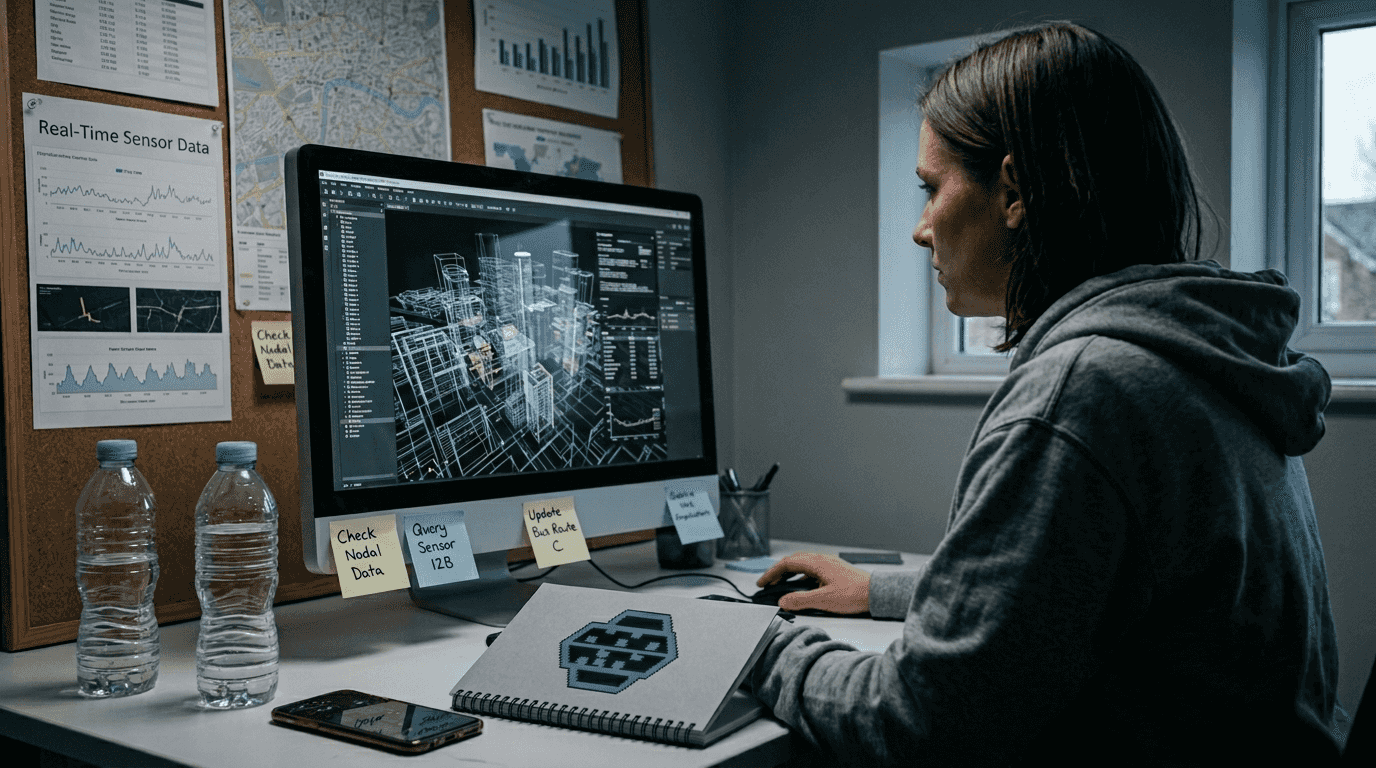
Integrating digital twins for real-time urban environment simulation represents a strategic leap beyond static models. Rather than viewing your city as a frozen snapshot, digital twins incorporate sensor feeds, traffic patterns, energy consumption, and environmental conditions. This enables you to test interventions virtually before physical implementation, dramatically reducing costly mistakes and accelerating evidence-based decision-making.
Utilising CityGML standard ensures interoperability and semantic richness across your urban data ecosystem. This international standard defines how to represent urban objects with rich attributes, relationships, and multiple levels of detail. When procurement specifications mandate CityGML compliance, you avoid vendor lock-in and ensure models remain usable as software platforms evolve.
Leveraging enhanced data portals increases thematic content breadth and user engagement. Modern portals go beyond simple file downloads, offering web-based visualisation, query builders, and API access. Zurich’s portal allows planners to overlay noise pollution simulations, solar potential analysis, and demographic data directly within the 3D environment, eliminating tedious data export and import cycles.
European cities demonstrate particularly strong leadership in these areas. Examples of 3D city models in Europe show how Helsinki, Espoo, Rotterdam, and Vienna have built comprehensive ecosystems around open, standardised 3D data. Their approaches share common elements:
- Commitment to open data policies reducing access barriers
- Investment in regular model updates maintaining currency
- Multi-agency coordination ensuring consistent data standards
- Public engagement through accessible visualisation tools
- Integration with planning approval workflows for efficiency
These strategies aren’t theoretical aspirations but proven approaches delivering measurable planning improvements. The key is adapting their principles to your specific governance context and resource constraints rather than attempting direct replication.
Comparing large-scale harmonised initiatives and local 3D model projects
You face a fundamental choice between joining harmonised programmes or developing bespoke local solutions. There is an emerging trend toward large-scale harmonised initiatives at the state or national level, such as Japan’s PLATEAU project and Australia’s Digital Twin Victoria. Understanding their trade-offs helps you make strategic decisions aligned with your city’s circumstances.
Large-scale harmonised initiatives offer compelling advantages. Data consistency across jurisdictions enables regional planning and infrastructure coordination impossible with fragmented approaches. When Victoria standardised its digital twin specifications, neighbouring municipalities could finally model cross-boundary transport corridors and watershed management with confidence. Scalability improves as centralised technical teams develop reusable workflows and tools benefiting all participating cities.
Policy alignment accelerates adoption when national frameworks provide funding, technical support, and governance structures. PLATEAU’s success stems partly from coordinated national investment eliminating the need for each Japanese city to independently justify 3D model budgets and navigate procurement complexity. Shared training programmes and communities of practice reduce your team’s learning curve.
However, harmonised initiatives face challenges. Heterogeneity in existing local data creates integration friction. Your city may have invested heavily in proprietary systems incompatible with national standards, forcing difficult migration decisions. Adoption barriers emerge when local governments perceive harmonised approaches as inflexible or misaligned with specific planning priorities.
Localised projects offer agility and customisation advantages. You control timelines, select tools matching your team’s capabilities, and prioritise thematic content addressing your most pressing planning challenges. Rotterdam’s approach focused initially on flood risk modelling because coastal vulnerability demanded immediate attention, whilst deferring less critical thematic layers.
| Aspect | Harmonised initiatives | Local projects | | — | — | | Data consistency | High across jurisdictions | Variable, potential gaps | | Implementation speed | Slower initial setup, faster scaling | Quick starts, slower scaling | | Customisation flexibility | Limited to framework parameters | Full control over specifications | | Resource requirements | Shared costs, economies of scale | Full local funding burden | | Technical support | Centralised expertise available | Dependent on local capacity |
Pro Tip: Combine harmonised initiatives’ broad scope with local projects’ agility for balanced urban planning. Participate in national frameworks for foundational data layers whilst maintaining flexibility to add specialised local content addressing unique challenges your city faces.
The optimal path often involves hybrid approaches. Adopt harmonised standards and participate in shared infrastructure whilst preserving autonomy for priority-driven enhancements. Urban development workflows with 3D technology succeed when they balance standardisation with contextual adaptation.
Selecting and implementing the optimal urban development strategy for your city
Translating evaluation criteria and strategic options into concrete action requires systematic assessment of your city’s current state and realistic capacity. Begin by auditing existing 3D data infrastructure and openness. What models already exist, who controls them, and how accessible are they to planning teams and external stakeholders? Many cities discover valuable 3D data trapped in departmental silos or proprietary formats limiting reuse.
The quality of 3D city models plays a role in the effectiveness of designing and implementing urban digital twins. Match strategy choices to local government capacity and stakeholder needs rather than pursuing technically sophisticated approaches your organisation cannot sustain. A modest but well-maintained open model delivers more planning value than an ambitious digital twin abandoned after initial funding expires.
Adopt digital twins for dynamic urban scenario testing and monitoring when your city faces complex, interconnected challenges requiring evidence-based intervention design. Digital twins excel at revealing unintended consequences and optimising multi-objective decisions. Singapore’s digital twin enabled testing thousands of micromobility deployment scenarios, identifying optimal station locations balancing accessibility, safety, and network efficiency.
Engage multi-disciplinary teams early for effective data collection and model building. Urban 3D initiatives fail when treated as purely technical IT projects. Successful implementations involve planners defining required attributes, domain experts validating semantic accuracy, and end users shaping portal functionality from project inception. This collaborative approach produces models people actually use rather than impressive but irrelevant technical achievements.
Monitor and iterate chosen strategies based on continuous performance metrics and feedback. Establish clear success indicators beyond model completeness: planning process efficiency gains, stakeholder engagement increases, decision quality improvements. Rotterdam tracks how often 3D models inform permit decisions and public consultations, using these metrics to prioritise model enhancements delivering maximum planning impact.
Your implementation roadmap should include:
- Stakeholder workshops identifying priority use cases and requirements
- Pilot projects testing approaches before full-scale commitment
- Procurement specifications emphasising openness and interoperability
- Training programmes building internal capacity for model use and maintenance
- Governance frameworks clarifying data ownership, update responsibilities, and access policies
- Performance monitoring systems tracking planning outcomes, not just technical metrics
Top urban design strategies in 2026 share a common thread: they prioritise planning outcomes over technical sophistication for its own sake. Your strategy succeeds when it demonstrably improves how your city plans, engages stakeholders, and delivers better urban environments.
Explore 3D Cityplanner solutions to enhance your urban development projects
Implementing the strategies outlined requires robust technical platforms supporting advanced 3D modelling, scenario testing, and collaborative planning. 3D Cityplanner provides a comprehensive digital twin and urban development platform designed specifically for professionals navigating the complexities discussed throughout this article.
Our tools support the criteria-based approach you need: open data integration, CityGML compatibility, rich semantic modelling, and intuitive visualisation enabling stakeholder engagement. Whether you’re developing harmonised regional initiatives or focused local projects, 3D Cityplanner’s flexible architecture adapts to your specific planning context and scales with your ambitions. Explore how 3D Cityplanner shapes the future of urban development through advanced spatial analysis and real-time scenario modelling. Discover our digital twin capabilities for urban development projects ranging from neighbourhood regeneration to metropolitan infrastructure planning. Review our comprehensive city planning tools supporting every phase from initial concept through implementation monitoring.
Frequently asked questions
What are the main benefits of using 3D city models in urban development?
3D city models improve spatial understanding by providing intuitive visualisation of complex urban relationships invisible in traditional 2D plans. They enable scenario testing, allowing you to evaluate design alternatives and policy interventions virtually before committing resources to physical implementation. Enhanced collaboration among stakeholders results from shared spatial references reducing miscommunication and accelerating consensus-building around planning decisions.
How can urban planners ensure data quality when implementing 3D strategies?
Consistently update data portals and model descriptions to maintain currency and user trust in the information foundation. Use standardised formats like CityGML to maintain semantic coherence across data sources and software platforms. Implement validation and cross-verification protocols during data acquisition, comparing automated extraction results against ground truth samples to identify systematic errors before they propagate through your planning workflows. The quality of 3D city models directly determines analytical reliability and stakeholder confidence.
What challenges do local governments face adopting 3D urban development initiatives?
Diverse software and incompatible data standards cause integration difficulties when attempting to combine datasets from multiple sources or time periods. Resource constraints limit ability to update or harmonise 3D models, particularly for smaller municipalities competing for technical staff with private sector employers. The heterogeneity of 3D city models and different practices presents a challenge for usability and for local governments who are yet to establish their 3D initiatives, creating barriers to entry that harmonised national programmes help address.
Which cities provide the best examples of successful 3D urban development strategies?
Helsinki and Espoo in Finland lead European cities with comprehensive open 3D models supporting diverse planning applications from building permits to climate adaptation. Singapore’s digital twin integrates real-time sensor data enabling dynamic traffic management and environmental monitoring. Rotterdam’s flood risk-focused approach demonstrates how targeted thematic content addresses critical local vulnerabilities. These cities share commitment to open data, regular updates, and integration with actual planning workflows rather than treating 3D models as standalone visualisation tools.
Recommended
- Urban project optimisation with advanced 3D tools in 2026 – 3D Urban Development
- 6 Top Urban Design Strategies for Modern Planners – 3D Urban Development
- Why Optimise City Design for Sustainable Cities – 3D Urban Development
- Future of City Planning 2026: Shaping Sustainable Urban Spaces – 3D Urban Development